
Catocala amestris
Strecker, 1874
Three-staff Underwing
Catocala amestris, the three-staff underwing, is a North American in the Erebidae. It is listed as endangered and receives legal protection in Michigan. The has a wingspan of 4-4.5 cm and exhibits the characteristic underwing pattern of cryptic forewings concealing brightly colored hindwings. It has been documented as a new record for southern Colorado when attracted to stations, indicating potential range expansion or underreporting.
Pronunciation
How to pronounce Catocala amestris: /ˈkætəkələ əˈmɛstrɪs/
These audio files are automatically generated. While they are not always 100% accurate, they are a good starting point.
Identification
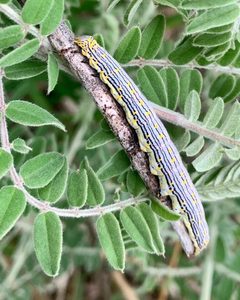
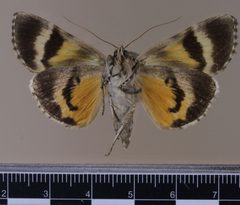
Distinguished from other Catocala by the specific pattern of two wavy black lines on the yellow-orange hindwing, combined with the kidney-shaped forewing blotch. The caterpillar's bluish-white ground color with yellowish dorsum, orange band, and seven thin black lateral lines provides additional identification characters. Similar underwing species may share general color patterns but differ in specific line arrangements and forewing markings.
Images
Appearance
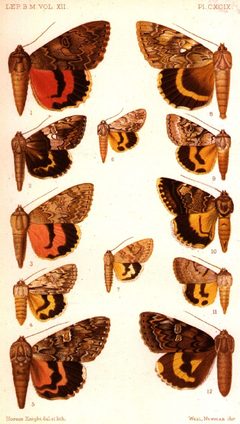
Forewings brownish-gray with a distinct kidney-shaped blotch and mixed wavy lines beyond. Hindwings yellow-orange with two wavy black lines separating the coloration. Wingspan 1.6-1.8 inches (4-4.5 cm). Caterpillar bluish-white with yellowish coloring, an orange band, and seven thin black lateral lines.
Habitat
Dry-mesic prairies and oak forests. Dependent on presence of plants in Amorpha, which restricts its distribution even within suitable types.
Distribution
North America. Documented in Michigan (where legally protected), with records from southern Colorado indicating broader distribution than previously recognized. GBIF records confirm presence in North America.
Seasonality
active June through August. One per year.
Diet
Larval plants restricted to Amorpha ( Fabaceae). feeding habits not documented.
Host Associations
- Amorpha - larval Only documented ; specificity likely contributes to rarity
Life Cycle
Complete with , larval, pupal, and stages. Caterpillar described as bluish-white with distinctive color pattern. Single with adult June-August.
Behavior
attracted to fermented (sugaring) in addition to light sources. Typically remains on periphery of lighted areas when at lights. Has been observed flying erratically before settling at light stations. Hindwing flash display used as startle defense when disturbed.
Ecological Role
Herbivore in larval stage, potentially serving as prey for . Specific ecological interactions poorly documented due to rarity.
Human Relevance
Subject of conservation concern; legally protected in Michigan. Attracted to stations during observation events, contributing to citizen science records. New state records (e.g., Colorado) demonstrate value of targeted survey efforts for rare .
Similar Taxa
- Catocala aholibahSimilar large underwing with bright hindwings, but differs in specific hindwing banding pattern and forewing markings
- Catocala verillianaCo-occurring underwing , smaller than C. amestris, with different hindwing coloration and pattern
- Catocala epioneAnother yellow-orange hindwinged underwing, but with distinctively different forewing pattern and hindwing line arrangement
More Details
Conservation Status
Listed as endangered in Michigan with legal protection. Rarity attributed to specialized plant association with single (Amorpha), limiting suitability.
Survey Methods
Documented at stations using fermented fruit-beer-sugar mixture ('sugaring') during National Week events, suggesting this method may be more effective than light trapping for this .
Sources and further reading
- BugGuide
- Wikipedia
- GBIF taxonomy match
- iNaturalist taxon
- NCBI Taxonomy
- Catalogue of Life
- A Gathering of Lepidopterists: Who's Who of the Butterfly, Moth Experts | Bug Squad
- Bug Eric: National Moth Week Recap, 2015
- Got Moths? Celebrate National Moth Week and Global Citizen Science
- Bug Eric: National Moth Week Recap for Colorado Springs
- Bug Eric: National Moth Week 2024 Recap from Kansas City
- Bug Eric: New Mexico Night Bugs