
Ethmia
Hübner, 1819
Species Guides
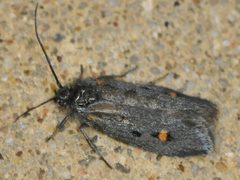
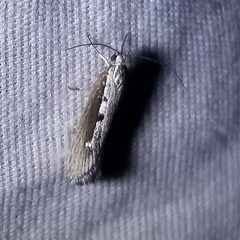
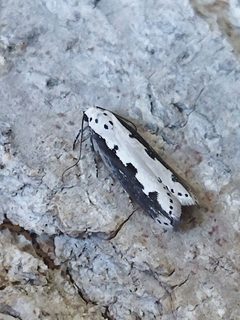
35Ethmia is a large of small gelechioid moths comprising over 250 described globally. The genus serves as the type genus for Ethmiidae (sometimes treated as within Elachistidae or Oecophoridae). Species are characterized by distinctive black, white, and gray patterned forewings, and most larvae feed on plants in the Boraginaceae family, with Gesneriaceae recorded as an additional family in the Neotropics. The genus exhibits greatest diversity in arid and semi-arid regions, with substantial radiations in southwestern North America and the Neotropics.
Pronunciation
How to pronounce Ethmia: //ˈɛθ.mi.ə//
These audio files are automatically generated. While they are not always 100% accurate, they are a good starting point.
Identification
Identification to level requires examination of genitalia in most cases, as external wing patterns are often similar among . Forewing pattern elements including spot arrangement, banding, and reticulation provide preliminary guidance. using COI sequences has been employed to delimit species boundaries, particularly for morphologically similar . Reference to regional monographs (e.g., Powell 1973 for North America; Phillips-Rodríguez et al. 2014 for Rica) is essential.
Images
Habitat
Diverse including oak woodlands, coniferous forests, dry mixed forests, scrublands, and tropical rainforests. Many associated with specific plant . In southwestern North America, often found in foothill and mountain habitats with abundant Boraginaceae. Neotropical species occur across elevational gradients from lowland to montane forests.
Distribution
Global distribution with centers of diversity in southwestern North America (especially Arizona, New Mexico, Texas, and adjacent Mexico), the Neotropics ( Rica, Mexico), the Palearctic (Europe, Asia Minor, Central Asia), and the Afrotropical region. Individual ranges vary from widespread to highly restricted microendemic distributions.
Seasonality
activity patterns vary by region and ; many North American species fly in spring and summer (March-August), with some extending into autumn. Tropical species may show less pronounced seasonality or multiple correlated with wet/dry seasons.
Diet
Larvae are herbivorous, feeding primarily on Boraginaceae (borage ) including such as Ehretia, Cordia, and Tournefortia. Gesneriaceae recorded as family for some Neotropical . do not feed or feed sparingly on nectar.
Host Associations
- Boraginaceae - larval food plantPrimary for most ; includes woody shrubs and herbs
- Gesneriaceae - larval food plantRecorded for some Rican ; new record for
- Drymonia - larval food plantGesneriaceae hosting Ethmia lesliesaulae and E. normgershenzi in Rica
Life Cycle
Complete . laid on plant foliage or stems. Larvae feed externally on leaves or bore into stems, sometimes spinning silk shelters. occurs in silk cocoon on host plant or in leaf litter. Some have extended larval development or . Multiple per year in favorable climates; single generation in temperate or arid regions.
Behavior
are and attracted to light, though some rarely come to artificial lights. Larvae are concealed feeders, often remaining hidden in silk webbing or within plant tissues. activity peaks after dusk.
Ecological Role
Larvae function as primary consumers in , converting plant to animal tissue. Serve as prey for , predatory insects, and insectivorous vertebrates. Some may contribute to nutrient cycling in arid through herbivory on shrubs.
Human Relevance
No significant economic importance; not considered agricultural pests. Subject of taxonomic and biodiversity research, with numerous new described in recent decades. Some species named in honor of conservationists (e.g., E. lesliesaulae, E. normgershenzi).
Similar Taxa
- ColeophoridaeEthmia formerly placed in this ; distinguished by wing venation, genitalia structure, and larval (Coleophoridae larvae are case-bearers)
- ElachistidaeSometimes treated as within this ; Elachistidae typically smaller with reduced wing patterning and different genitalia
- OecophoridaeAlternative placement in some classifications; Oecophoridae generally more diverse in form and larval habits, with broader plant range
- DepressariidaeCurrent placement for Ethmia in many modern classifications; distinguished by combination of morphological and molecular characters
More Details
Taxonomic instability
-level classification of Ethmia has changed repeatedly, reflecting ongoing revision of gelechioid relationships. Ethmiidae, Elachistidae, Oecophoridae, and Depressariidae have all been proposed as appropriate placements.
Molecular systematics
studies have clarified boundaries and revealed cryptic diversity, including synonymization of some proposed species (e.g., E. hakkarica synonymized with E. amasina based on COI divergence).
Conservation significance
Several have extremely restricted distributions (microendemics), making them vulnerable to loss. The Rican fauna has been intensively studied through Área de Conservación Guanacaste inventory work.
Sources and further reading
- BugGuide
- Wikipedia
- GBIF taxonomy match
- iNaturalist taxon
- NCBI Taxonomy
- Catalogue of Life
- What's in a Name? Leslie Saul-Gershenz and Norm Gershenz | Bug Squad
- Bug Eric: My Personal National Moth Week, 2017
- Bug Eric: September 2017
- Bug Eric: New Mexico Night Bugs
- Nota Lepidopterologica goes advanced open access with Pensoft Publishers | Blog
- Uncategorized | Blog - Part 22
- TO THE DISTRIBUTION OF ETHMIA DISCREPITELLA (REBEL, 1901) (LEPIDOPTERA, ETHMIIDAE)
- Molecular phylogeny and taxonomy of five Ethmia (Hübner, 1819) morfo-species from Türkiye
- Figures 153–158 from: Phillips-Rodríguez E, Powell J, Hallwachs W, Janzen D (2014) A synopsis of the genus Ethmia Hübner in Costa Rica: biology, distribution, and description of 22 new species (Lepidoptera, Gelechioidea, Depressariidae, Ethmiinae), with emphasis on the 42 species known from Área de Conservación Guanacaste. ZooKeys 461: 1-86. https://doi.org/10.3897/zookeys.461.8377
- Figures 28–40 from: Phillips-Rodríguez E, Powell J, Hallwachs W, Janzen D (2014) A synopsis of the genus Ethmia Hübner in Costa Rica: biology, distribution, and description of 22 new species (Lepidoptera, Gelechioidea, Depressariidae, Ethmiinae), with emphasis on the 42 species known from Área de Conservación Guanacaste. ZooKeys 461: 1-86. https://doi.org/10.3897/zookeys.461.8377
- Figures 1–11 from: Phillips-Rodríguez E, Powell J, Hallwachs W, Janzen D (2014) A synopsis of the genus Ethmia Hübner in Costa Rica: biology, distribution, and description of 22 new species (Lepidoptera, Gelechioidea, Depressariidae, Ethmiinae), with emphasis on the 42 species known from Área de Conservación Guanacaste. ZooKeys 461: 1-86. https://doi.org/10.3897/zookeys.461.8377
- Figures 159–164 from: Phillips-Rodríguez E, Powell J, Hallwachs W, Janzen D (2014) A synopsis of the genus Ethmia Hübner in Costa Rica: biology, distribution, and description of 22 new species (Lepidoptera, Gelechioidea, Depressariidae, Ethmiinae), with emphasis on the 42 species known from Área de Conservación Guanacaste. ZooKeys 461: 1-86. https://doi.org/10.3897/zookeys.461.8377
- Figures 147–152 from: Phillips-Rodríguez E, Powell J, Hallwachs W, Janzen D (2014) A synopsis of the genus Ethmia Hübner in Costa Rica: biology, distribution, and description of 22 new species (Lepidoptera, Gelechioidea, Depressariidae, Ethmiinae), with emphasis on the 42 species known from Área de Conservación Guanacaste. ZooKeys 461: 1-86. https://doi.org/10.3897/zookeys.461.8377
- Figures 165–168 from: Phillips-Rodríguez E, Powell J, Hallwachs W, Janzen D (2014) A synopsis of the genus Ethmia Hübner in Costa Rica: biology, distribution, and description of 22 new species (Lepidoptera, Gelechioidea, Depressariidae, Ethmiinae), with emphasis on the 42 species known from Área de Conservación Guanacaste. ZooKeys 461: 1-86. https://doi.org/10.3897/zookeys.461.8377
- Figures 19–27 from: Phillips-Rodríguez E, Powell J, Hallwachs W, Janzen D (2014) A synopsis of the genus Ethmia Hübner in Costa Rica: biology, distribution, and description of 22 new species (Lepidoptera, Gelechioidea, Depressariidae, Ethmiinae), with emphasis on the 42 species known from Área de Conservación Guanacaste. ZooKeys 461: 1-86. https://doi.org/10.3897/zookeys.461.8377
- Figures 70–74 from: Phillips-Rodríguez E, Powell J, Hallwachs W, Janzen D (2014) A synopsis of the genus Ethmia Hübner in Costa Rica: biology, distribution, and description of 22 new species (Lepidoptera, Gelechioidea, Depressariidae, Ethmiinae), with emphasis on the 42 species known from Área de Conservación Guanacaste. ZooKeys 461: 1-86. https://doi.org/10.3897/zookeys.461.8377
- Figures 81–85 from: Phillips-Rodríguez E, Powell J, Hallwachs W, Janzen D (2014) A synopsis of the genus Ethmia Hübner in Costa Rica: biology, distribution, and description of 22 new species (Lepidoptera, Gelechioidea, Depressariidae, Ethmiinae), with emphasis on the 42 species known from Área de Conservación Guanacaste. ZooKeys 461: 1-86. https://doi.org/10.3897/zookeys.461.8377
- Figures 64–69 from: Phillips-Rodríguez E, Powell J, Hallwachs W, Janzen D (2014) A synopsis of the genus Ethmia Hübner in Costa Rica: biology, distribution, and description of 22 new species (Lepidoptera, Gelechioidea, Depressariidae, Ethmiinae), with emphasis on the 42 species known from Área de Conservación Guanacaste. ZooKeys 461: 1-86. https://doi.org/10.3897/zookeys.461.8377
- Figures 12–18 from: Phillips-Rodríguez E, Powell J, Hallwachs W, Janzen D (2014) A synopsis of the genus Ethmia Hübner in Costa Rica: biology, distribution, and description of 22 new species (Lepidoptera, Gelechioidea, Depressariidae, Ethmiinae), with emphasis on the 42 species known from Área de Conservación Guanacaste. ZooKeys 461: 1-86. https://doi.org/10.3897/zookeys.461.8377
- Figures 41–45 from: Phillips-Rodríguez E, Powell J, Hallwachs W, Janzen D (2014) A synopsis of the genus Ethmia Hübner in Costa Rica: biology, distribution, and description of 22 new species (Lepidoptera, Gelechioidea, Depressariidae, Ethmiinae), with emphasis on the 42 species known from Área de Conservación Guanacaste. ZooKeys 461: 1-86. https://doi.org/10.3897/zookeys.461.8377
- Figures 57–63 from: Phillips-Rodríguez E, Powell J, Hallwachs W, Janzen D (2014) A synopsis of the genus Ethmia Hübner in Costa Rica: biology, distribution, and description of 22 new species (Lepidoptera, Gelechioidea, Depressariidae, Ethmiinae), with emphasis on the 42 species known from Área de Conservación Guanacaste. ZooKeys 461: 1-86. https://doi.org/10.3897/zookeys.461.8377
- The genome sequence of the Dotted Ermel moth, Ethmia dodecea (Haworth, 1828).