
Ethmia bipunctella
(Fabricius, 1775)
Ethmia bipunctella is a in the Depressariidae, originally described by Fabricius in 1775. The has a broad geographic distribution spanning Central and Southern Europe, North Africa, Asia, and northeastern North America. It is , producing two per year with activity from May through September. The species was formerly considered to include E. iranella as a , but this is now recognized as distinct.
Pronunciation
How to pronounce Ethmia bipunctella: /ˈɛθ.mi.ə baɪ.pʌŋkˈtɛl.lə/
These audio files are automatically generated. While they are not always 100% accurate, they are a good starting point.
Identification
Members of the Ethmia are distinguished from superficially similar by their upturned labial palps, which project forward like small horns between the . This feature separates them from tortricid leafrolling moths, with which they may otherwise be confused. Specific identification within the genus often requires examination of genitalic characters due to the uniform coloration across .
Images
Appearance
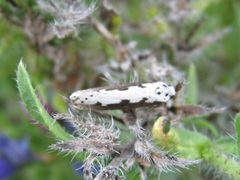
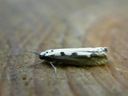
Wingspan ranges from 19–28 mm. The exhibits the characteristic black, white, and gray coloration typical of the Ethmia. are relatively large for microlepidoptera, with a slender body form.
Habitat
Inhabits diverse environments across its broad range, including oak woodlands in foothill regions. The is associated with supporting its larval plants in the Boraginaceae.
Distribution
Central and Southern Europe, North Africa, Asia, and northeastern North America. The shows a transcontinental distribution pattern with presence across multiple biogeographic regions.
Seasonality
period extends from May to September. The is , with two distinct occurring annually.
Diet
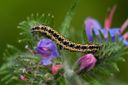
Larvae feed primarily on viper's bugloss (Echium vulgare), with additional records from common bugloss (Anchusa officinalis) and plants in the Symphytum. All plants belong to the Boraginaceae.
Host Associations
- Echium vulgare - primary larval plantviper's bugloss
- Anchusa officinalis - larval plantcommon bugloss
- Symphytum - larval plant level association
Life Cycle
with two per year. Pupae are attached to dead wood, representing the stage.
Behavior
are diurnally active, in contrast to the predominantly of most . The species is attracted to light, though less frequently observed at blacklights in high plains compared to foothill oak woodlands.
Ecological Role
Herbivore in larval stage, feeding on Boraginaceae plants. The contributes to local dynamics as prey for various .
Human Relevance
Minor significance; not known as an agricultural pest. The may serve as an indicator of quality in regions where its Boraginaceae plants occur.
Similar Taxa
- Ethmia iranellaFormerly treated as a of E. bipunctella but now recognized as a distinct . Separation requires detailed morphological or genetic analysis.
- Ethmia distigmatellaInvalidly described as E. bipunctella by H. Rebel in 1936; later corrected. Historical misidentification has caused taxonomic confusion.
More Details
Taxonomic History
The has undergone taxonomic revision, with E. iranella separated from synonymy. A 1936 description by H. Rebel in L. Osthelder, attributed to E. bipunctella, was later determined to represent E. distigmatella.
Sources and further reading
- BugGuide
- Wikipedia
- GBIF taxonomy match
- iNaturalist taxon
- NCBI Taxonomy
- Catalogue of Life
- What's in a Name? Leslie Saul-Gershenz and Norm Gershenz | Bug Squad
- Bug Eric: My Personal National Moth Week, 2017
- Bug Eric: September 2017
- Bug Eric: New Mexico Night Bugs
- Nota Lepidopterologica goes advanced open access with Pensoft Publishers | Blog
- Uncategorized | Blog - Part 22