
Ethmiinae
Genus Guides
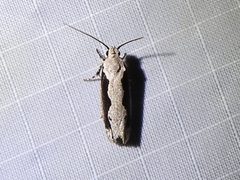
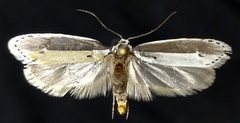
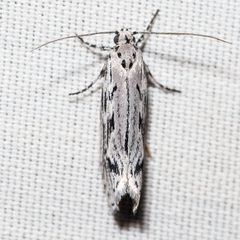
3Ethmiinae is a of small to moderate-sized in the superfamily Gelechioidea. Recent molecular and morphological analyses place it within the Depressariidae, though it has been treated as part of Elachistidae or Oecophoridae in earlier literature. The subfamily has a worldwide distribution with particular diversity in the Neotropics, where intensive inventory work has documented numerous in Rica.
Pronunciation
How to pronounce Ethmiinae: /ˌɛθ.maɪˈaɪniː/
These audio files are automatically generated. While they are not always 100% accurate, they are a good starting point.
Identification
Ethmiinae are small to moderate in size. -level identification relies heavily on examination of male and female genitalia , which has been illustrated and used for species delimitation in taxonomic treatments. has proven effective for distinguishing species, including resolution of cryptic that were previously unrecognized based on morphology alone.
Images
Habitat
In Rica, have been documented in both rain forest and dry forest . The Área de Conservación Guanacaste in northwestern Costa Rica has been a focal site for intensive inventory, yielding records of 42 species. Habitat information for the outside the Neotropics is less documented.
Distribution
Worldwide distribution. Neotropical records span from Argentina north to the southwestern United States (Arizona) and from Florida to Texas, plus the Caribbean. The Rican fauna is particularly well-documented with 45 recorded, 22 of which were described as new in a 2014 synopsis. European records include the Baltic countries, British Isles, and Fennoscandia for at least some species.
Diet
Larvae feed on plants in the Boraginaceae and Gesneriaceae. Boraginaceae represents the most frequently used food plant family worldwide for the , while Gesneriaceae was documented as a new food plant family record in Rica. Specific plants include of Bourreria, Cordia, Varronia (Boraginaceae), and Drymonia (Gesneriaceae).
Host Associations
- Boraginaceae - larval food plantmost frequently used food plant worldwide
- Gesneriaceae - larval food plantnew food plant record discovered in Rica
Life Cycle
Larvae of at least 11 have been described and illustrated, with rearing protocols established for inventory work. Rearing from field-collected larvae on food plants has been successful for 18 species. Last instar caterpillars have been characterized for documented species.
Behavior
are attracted to light and have been collected using light-trapping methods. Prior to the implementation of in 2004, routine light-trapping specimens were sometimes overlooked due to assumptions that they represented common, widespread .
Ecological Role
Caterpillars serve as for , including of Apanteles, forming part of local interactions. The has been a significant component of Lepidoptera inventory efforts in the Área de Conservación Guanacaste, contributing to documentation of tropical biodiversity.
Similar Taxa
- ElachistidaeEthmiinae was treated as a of Elachistidae in literature between 1999 and 2013 before molecular and morphological analyses supported placement in Depressariidae
- OecophoridaeEthmiinae has also been included in Oecophoridae in some classifications, reflecting historical taxonomic uncertainty
More Details
Taxonomic instability
The classification of Ethmiinae has shifted across boundaries in recent decades. It was placed in Elachistidae from 1999 to 2013, has been included in Oecophoridae in some treatments, and is now placed in Depressariidae based on combined molecular and morphological evidence.
DNA barcoding utility
CO1 barcodes have been obtained for numerous and have proven valuable for species identification, including detection of cryptic that were not resolved by traditional morphological approaches.
Sources and further reading
- BugGuide
- GBIF taxonomy match
- iNaturalist taxon
- NCBI Taxonomy
- A Gathering of Lepidopterists: Who's Who of the Butterfly, Moth Experts | Bug Squad
- What's in a Name? Leslie Saul-Gershenz and Norm Gershenz | Bug Squad
- Gelechioidea: Elachistidae: Ethmiinae; Gelechiidae: Anomologinae, Dichomeridinae, Gelechiinae, undetermined subfamily; Oecophoridae: undetermined subfamily; Scythrididae: undetermined subfamily; undetermined family
- Biology and distribution of the declining moth Ethmia pyrausta (Pallas, 1771), with description of the larva (Gelechioidea, Depressariidae, Ethmiinae)
- A synopsis of the genus Ethmia Hübner in Costa Rica: biology, distribution, and description of 22 new species (Lepidoptera, Gelechioidea, Depressariidae, Ethmiinae), with emphasis on the 42 species known from Área de Conservación Guanacaste
- Figure 4 from: Nupponen K, Ahola M, Nieminen M, Juerivete U (2015) Biology and distribution of the declining moth Ethmia pyrausta (Pallas, 1771), with description of the larva (Gelechioidea, Depressariidae, Ethmiinae). Nota Lepidopterologica 38(1): 47-58. https://doi.org/10.3897/nl.38.9034
- Figure 2 from: Nupponen K, Ahola M, Nieminen M, Juerivete U (2015) Biology and distribution of the declining moth Ethmia pyrausta (Pallas, 1771), with description of the larva (Gelechioidea, Depressariidae, Ethmiinae). Nota Lepidopterologica 38(1): 47-58. https://doi.org/10.3897/nl.38.9034
- Figure 10 from: Nupponen K, Ahola M, Nieminen M, Juerivete U (2015) Biology and distribution of the declining moth Ethmia pyrausta (Pallas, 1771), with description of the larva (Gelechioidea, Depressariidae, Ethmiinae). Nota Lepidopterologica 38(1): 47-58. https://doi.org/10.3897/nl.38.9034
- Figure 3 from: Nupponen K, Ahola M, Nieminen M, Juerivete U (2015) Biology and distribution of the declining moth Ethmia pyrausta (Pallas, 1771), with description of the larva (Gelechioidea, Depressariidae, Ethmiinae). Nota Lepidopterologica 38(1): 47-58. https://doi.org/10.3897/nl.38.9034
- Figure 5–8 from: Nupponen K, Ahola M, Nieminen M, Juerivete U (2015) Biology and distribution of the declining moth Ethmia pyrausta (Pallas, 1771), with description of the larva (Gelechioidea, Depressariidae, Ethmiinae). Nota Lepidopterologica 38(1): 47-58. https://doi.org/10.3897/nl.38.9034
- Figure 1 from: Nupponen K, Ahola M, Nieminen M, Juerivete U (2015) Biology and distribution of the declining moth Ethmia pyrausta (Pallas, 1771), with description of the larva (Gelechioidea, Depressariidae, Ethmiinae). Nota Lepidopterologica 38(1): 47-58. https://doi.org/10.3897/nl.38.9034
- Figure 9 from: Nupponen K, Ahola M, Nieminen M, Juerivete U (2015) Biology and distribution of the declining moth Ethmia pyrausta (Pallas, 1771), with description of the larva (Gelechioidea, Depressariidae, Ethmiinae). Nota Lepidopterologica 38(1): 47-58. https://doi.org/10.3897/nl.38.9034
- Supplementary material 3 from: Phillips-Rodríguez E, Powell J, Hallwachs W, Janzen D (2014) A synopsis of the genus Ethmia Hübner in Costa Rica: biology, distribution, and description of 22 new species (Lepidoptera, Gelechioidea, Depressariidae, Ethmiinae), with emphasis on the 42 species known from Área de Conservación Guanacaste. ZooKeys 461: 1-86. https://doi.org/10.3897/zookeys.461.8377
- Supplementary material 2 from: Phillips-Rodríguez E, Powell J, Hallwachs W, Janzen D (2014) A synopsis of the genus Ethmia Hübner in Costa Rica: biology, distribution, and description of 22 new species (Lepidoptera, Gelechioidea, Depressariidae, Ethmiinae), with emphasis on the 42 species known from Área de Conservación Guanacaste. ZooKeys 461: 1-86. https://doi.org/10.3897/zookeys.461.8377
- Figures 81–85 from: Phillips-Rodríguez E, Powell J, Hallwachs W, Janzen D (2014) A synopsis of the genus Ethmia Hübner in Costa Rica: biology, distribution, and description of 22 new species (Lepidoptera, Gelechioidea, Depressariidae, Ethmiinae), with emphasis on the 42 species known from Área de Conservación Guanacaste. ZooKeys 461: 1-86. https://doi.org/10.3897/zookeys.461.8377
- Supplementary material 1 from: Phillips-Rodríguez E, Powell J, Hallwachs W, Janzen D (2014) A synopsis of the genus Ethmia Hübner in Costa Rica: biology, distribution, and description of 22 new species (Lepidoptera, Gelechioidea, Depressariidae, Ethmiinae), with emphasis on the 42 species known from Área de Conservación Guanacaste. ZooKeys 461: 1-86. https://doi.org/10.3897/zookeys.461.8377
- Figures 70–74 from: Phillips-Rodríguez E, Powell J, Hallwachs W, Janzen D (2014) A synopsis of the genus Ethmia Hübner in Costa Rica: biology, distribution, and description of 22 new species (Lepidoptera, Gelechioidea, Depressariidae, Ethmiinae), with emphasis on the 42 species known from Área de Conservación Guanacaste. ZooKeys 461: 1-86. https://doi.org/10.3897/zookeys.461.8377