
Ethmia albicostella
(Beutenmüller, 1889)
Pale-edged Ethmia Moth
Ethmia albicostella is a small in the Depressariidae, distributed across the Rocky Mountains and Sierra Madre Occidental. The species is notable for its distinctive wing pattern featuring a straight longitudinal line dividing dark and pale areas. are active during mid-summer, and larvae feed specifically on Lithospermum species in the Boraginaceae family.
Pronunciation
How to pronounce Ethmia albicostella: /ˈɛθ.mi.ə ˌæl.bɪ.kɒsˈtɛl.lə/
These audio files are automatically generated. While they are not always 100% accurate, they are a good starting point.
Identification
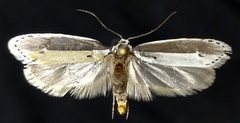
The straight longitudinal dividing line on the forewing separates this from most other Ethmia, which typically show more irregular or spotted patterns. The specific combination of dark costal half grading to whitish at , white area with single basal dark spot, and pale brownish hindwings distinguishes E. albicostella from in the same geographic range. Similar species in the may share the general bicolored forewing pattern but differ in the exact configuration of markings and shading.
Images
Appearance
Small with forewing length of 10.5–13.2 mm. Forewings divided by a straight longitudinal line: costal half is dark to pale brownish gray, darkest at the dividing line, blending to whitish at the ; area is white, lightly tinged with grayish, marked by a single small oblong dark spot at the basal one-fourth. Hindwings pale brownish, slightly darker apically.
Habitat
Moderately high elevations in mountainous regions. Rocky Mountain from southern Canada through the southwestern United States, and montane forests in western Mexico.
Distribution
Widespread in the Rocky Mountains and Sierra Madre Occidental of Mexico. Range extends from southern Manitoba and Saskatchewan (Canada) through Montana and the southern Rocky Mountain states (USA), south through mountains of western Mexico to at least Durango. Canadian records include Alberta, Manitoba, and Saskatchewan.
Seasonality
on wing from mid-June to early August.
Diet
Larvae feed on Lithospermum (Boraginaceae).
Host Associations
- Lithospermum - larval food plant of flowering plants in Boraginaceae
Life Cycle
Complete with , larva, pupa, and stages. Larval stage feeds on Lithospermum. Specific details of site and stage not documented.
Ecological Role
Larval herbivore on Lithospermum . role in not documented.
Human Relevance
No documented economic importance. Occasionally attracted to artificial light sources.
Similar Taxa
- Other Ethmia speciesShare similar small size, Depressariidae, and often bicolored wing patterns, but differ in specific marking configuration, particularly the straight longitudinal dividing line and single basal spot characteristic of E. albicostella
More Details
Taxonomic placement
The Ethmia has been reassigned among multiple times. Previously placed in Coleophoridae, then Elachistidae, now in Depressariidae ( Ethmiinae). Some sources still list the family as Ethmiidae.
Observations
Relatively few documented observations (9 records in iNaturalist as of source date), suggesting the may be underreported or genuinely uncommon despite its broad geographic range.
Sources and further reading
- BugGuide
- Wikipedia
- GBIF taxonomy match
- iNaturalist taxon
- Catalogue of Life
- What's in a Name? Leslie Saul-Gershenz and Norm Gershenz | Bug Squad
- Bug Eric: My Personal National Moth Week, 2017
- Bug Eric: September 2017
- Bug Eric: New Mexico Night Bugs
- Nota Lepidopterologica goes advanced open access with Pensoft Publishers | Blog
- Uncategorized | Blog - Part 22