
Profenusa
MacGillivray, 1914
oak mining sawflies, birch leafmining sawflies
Species Guides
3- Profenusa alumna(red oak leaf-mining sawfly)
- Profenusa canadensis(Hawthorn Leaf-miner Sawfly)
- Profenusa thomsoni(amber-marked birch leaf miner)
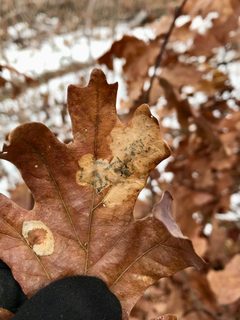
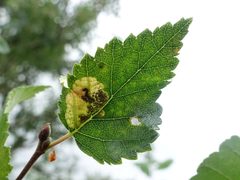
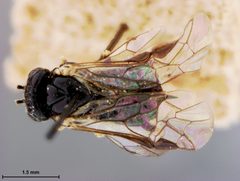
Profenusa is a of leaf-mining sawflies in the Tenthredinidae. in this genus are primarily associated with trees in the genera Quercus (oaks) and Betula (birches), though at least one species, P. japonica, has been documented on Rosa multiflora. Larvae are internal leaf miners that feed on mesophyll tissue, creating blotch mines. Several species are economically significant as forest and urban pests, including the P. pygmaea in Kazakhstan and P. thomsoni in North America.
Pronunciation
How to pronounce Profenusa: /proʊˈfiːnʊsa/
These audio files are automatically generated. While they are not always 100% accurate, they are a good starting point.
Identification
Profenusa are distinguished from other Tenthredinidae by their leaf-mining larval habit and association with specific trees. are small that occur on host trees during spring and early summer. Larvae create blotch mines rather than linear mines, and typically have five instars. Specific species identification requires examination of adult and host association.
Images
Habitat
Forest and urban environments with trees; larvae inhabit leaves of deciduous broadleaf trees, while occurs in soil. are found in oak forests, birch stands, and ornamental plantings in parks and streetscapes.
Distribution
Holarctic distribution with records from Europe (Denmark, Norway, Sweden), Asia (Kazakhstan, Japan), and North America (Canada, United States including Vermont and Alaska).
Seasonality
active in spring and early summer; P. lucifex adults occur in June in Ontario, P. alumna adults emerge in early spring, and P. japonica adults are active in April. Larval activity typically spans late spring through summer, with some showing partial second in fall.
Diet
Larvae feed as internal leaf miners on mesophyll tissue of plant leaves. Documented hosts include Quercus robur, Quercus rubra, Betula , and Rosa multiflora.
Host Associations
- Quercus robur - primary Type for P. pygmaea; severe damage documented in Kazakhstan
- Quercus rubra - primary for P. alumna
- Quercus - General association for multiple Profenusa
- Rosa multiflora - primary Documented for P. japonica; unusual host within
- Betula - for P. thomsoni
Life Cycle
or partially . emerge in spring and oviposit into expanding leaves. Larvae pass through five instars while mining within leaves, then drop to the ground and pupate in soil. occurs as pupae in soil. Some show a small partial second in fall.
Behavior
Female lay singly, likely to reduce larval competition for food resources. Larvae are solitary miners within leaves. Prepupal larvae exit mines and drop to soil for .
Ecological Role
Herbivores and leaf miners that contribute to defoliation of trees. Serve as hosts for , including chalcid that attack and larvae. can cause severe ecological and economic damage to urban forests and native woodlands.
Human Relevance
Several are significant forest and urban pests. P. pygmaea has caused mass in Almaty, Kazakhstan since 2018 with 75-85% crown damage to oaks. P. thomsoni is a notable pest of birch in North America. Subject to efforts using introduced and native .
Similar Taxa
- FenusaBoth contain leaf-mining sawflies in Tenthredinidae; distinguished by morphological characters of and larval mine patterns
- HeterarthrusRelated in Heterarthrinae with similar leaf-mining on birch and other ; differ in structural features
More Details
Invasive species concern
Profenusa pygmaea represents a case study in pest spread through global trade networks, with transport hubs serving as initial establishment points. The ' success in Kazakhstan demonstrates the vulnerability of urban oak plantings to introduced leaf-mining sawflies.
Parasitoid relationships
P. lucifex is known to be attacked by three of chalcid . P. thomsoni has been the target of programs in Alaska evaluating parasitoid species for suppression.
Sources and further reading
- BugGuide
- GBIF taxonomy match
- iNaturalist taxon
- NCBI Taxonomy
- Invasive pest - oak pest (Profenusa pygmaea Klug, 1814)
- Life History of a Red Oak Leaf-Mining Sawfly, Profenusa alumna MacGillivray (Hymenoptera: Tenthredinidae)
- NOTES ON THE BIOLOGY OF THE OAK LEAF-MINING SAWFLY, PROFENUSA LUCIFEX (HYMENOPTERA: TENTHREDINIDAE), IN ONTARIO
- Host plant, oviposition behavior and larval ecology of a sawfly leafminer, Profenusa japonica (Hymenoptera: Tenthredinidae)
- The parasitoid complex of the ambermarked birch leafminer, Profenusa thomsoni Konow (Hymenoptera: Tenthredinidae), in Anchorage, Alaska and each species’ role in biological control