
Fenusa
Leach, 1817
Species Guides
4- Fenusa dohrnii(European alder leafminer)
- Fenusa julia
- Fenusa pumila(birch leafminer)
- Fenusa ulmi(elm leafminer)
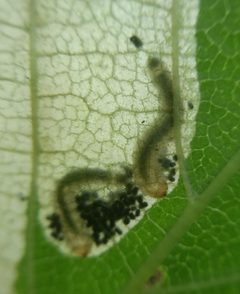
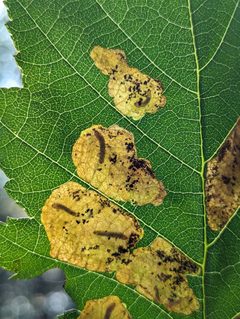
Fenusa is a of common sawflies in the Tenthredinidae containing approximately 11 described . Species in this genus are specialized leaf miners whose larvae feed internally within leaves of trees. Several species are significant economic pests, including the birch leafminer (F. pusilla), elm leafminer (F. ulmi), and European alder leafminer (F. dohrnii). The genus has been extensively studied in contexts due to the damage caused by larval feeding.
Pronunciation
How to pronounce Fenusa: /fɛˈnuː.sa/
These audio files are automatically generated. While they are not always 100% accurate, they are a good starting point.
Identification
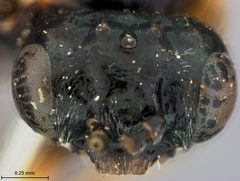
Fenusa are distinguished from other Tenthredinidae by their specialized leaf-mining larval . are small typical of the . Specific identification to species level requires examination of plant association, mine , and adult morphological characters. F. pusilla and F. pumila both mine birch leaves but may be distinguished by mine characteristics and larval feeding patterns—F. pusilla larvae consume both palisade and spongy mesophyll, while related species may differ in tissue preference.
Images
Habitat
Deciduous forests and urban plantings dominated by tree . Larval is strictly within leaf tissue of host trees. habitat includes the and surrounding environment of host trees.
Distribution
occur across the Holarctic region. F. pusilla is native to the Palearctic (central Europe) and introduced to North America, with established in Quebec, Alberta, and New England. F. ulmi occurs in regions with elm trees. Distribution records include Denmark, Norway, Sweden, and Vermont, USA.
Seasonality
Activity is tightly coupled to plant . , initial leafmining, and cessation of leafmining correlate with indicator plant full bloom phenology, enabling prediction models. F. pusilla has two per year in some regions, with distinct first and second generation peaks.
Diet
Larvae are obligate leaf miners feeding internally within leaves of trees. F. pusilla larvae consume both palisade and spongy mesophyll layers. F. ulmi feeds on elm leaves. Specific host plants include birch (Betula spp.), elm (Ulmus spp.), alder (Alnus spp.), and hornbeam (Carpinus spp.) depending on .
Host Associations
- Betula papyrifera - larval plantwhite birch, of F. pusilla
- Betula - larval plantbirch , of F. pusilla and F. pumila
- Ulmus - larval plantelm , of F. ulmi; European elm more susceptible than Asian and North American taxa
- Ulmus glabra - larval planthighly susceptible to F. ulmi
- Ulmus rubra - larval plantonly North American elm susceptible to F. ulmi feeding damage
- Alnus - larval plantalder , of F. dohrnii
- Carpinus - larval planthornbeam , of F. carpinifoliae
- Lathrolestes nigricollis - Ichneumonidae, of F. pusilla; introduced for in North America
- Grypocentrus albipes - Ichneumonidae, of F. pusilla; introduced for with limited establishment
- Priopoda nigricollis - Ichneumonidae, of F. pusilla
Life Cycle
Larvae develop within leaf mines, feeding between upper and lower leaf surfaces. F. pusilla has been documented with two per year in some . occurs in soil or leaf litter. is synchronized with plant leafing .
Behavior
females oviposit into leaf tissue, initiating internal larval mines. Ovipositional differs among : F. pusilla oviposits primarily in unfolding leaves on distally situated, currently expanding shoots, while co-occurring species may use different leaf age classes. Adult and oviposition timing are highly correlated with plant , particularly leaf expansion.
Ecological Role
Herbivore that reduces plant photosynthetic capacity through leaf mining. Serves as host for diverse —22 insect documented for F. pusilla alone. Supports communities including insect predators and birds. Subject to programs due to pest status.
Human Relevance
Several are significant horticultural and forest pests. F. pusilla (birch leafminer), F. ulmi (elm leafminer), and F. dohrnii (European alder leafminer) cause aesthetic and potentially economic damage to ornamental and landscape trees. programs have introduced Palearctic (Lathrolestes nigricollis, Grypocentrus albipes) to North America with documented establishment and variable success in reducing damage. models have been developed for monitoring and management.
Similar Taxa
- Messa nanaCo-occurs with F. pusilla on white birch; distinguished by oviposition in fully expanded leaves on older shoots and larval consumption of only palisade mesophyll versus both palisade and spongy mesophyll in F. pusilla
- ProfenusaRelated of leaf-mining sawflies in Tenthredinidae; requires morphological examination for distinction
More Details
Biological Control History
F. pusilla has been the target of multiple introductions in North America. Lathrolestes nigricollis was released in New England (1979–1980, 1989–1990) and Edmonton, Alberta (1994–1996), achieving widespread establishment and rates exceeding 75% in some areas. Grypocentrus albipes showed limited establishment and . by immune response has been observed at approximately 48% in some .
Host Plant Resistance
Studies of F. ulmi on elm reveal significant variation in susceptibility. European elm taxa (particularly U. glabra, U. elliptica, U. sukaczezii) are highly susceptible, while most Asian and North American taxa show resistance despite synchronous leaf . This asynchrony between leaf phenology and contributes to resistance in some taxa such as U. procera, U. carpinifolia, U. wilsoniana, and U. parvifolia.
Species Diversity
The includes 11 described extant and one fossil species (F. primula). Species are primarily distinguished by plant association: F. pusilla and F. pumila on birch, F. ulmi on elm, F. dohrnii on alder, F. carpinifoliae on hornbeam, F. alaskana, F. altenhoferi, F. julia, and F. laevinota with more restricted or less documented host ranges.
Sources and further reading
- BugGuide
- Wikipedia
- GBIF taxonomy match
- iNaturalist taxon
- NCBI Taxonomy
- Catalogue of Life
- The Life History and Control of the Birch Leaf-mining Sawfly, Fenusa Pumila Klug.
- PARASITES AND PREDATORS OF THE BIRCH LEAF MINER, FENUSA PUSILLA (HYMENOPTERA: TENTHREDINIDAE), IN QUEBEC
- Establishment and spread of two introduced parasitoids (Ichneumonidae) of the birch leafminer, Fenusa pusilla (Lepeletier) (Tenthredinidae)
- Seasonal Activity, Within-Tree Distribution, and Ovipositional and Feeding Preference of the Elm Leafminer, Fenusa ulmi (Hymenoptera: Tenthredinidae)
- Parasitoids (Hymenoptera, Eulophidae) of sawflies of the genera Fenusa, Pontania, and Arge (Hymenoptera, Symphyta) from the middle Volga area
- ESTABLISHMENT, DISTRIBUTION, AND IMPACT IN SOUTHERN NEW ENGLAND OF LATHROLESTES NIGRICOLLIS (THOMPSON) (HYMENOPTERA: ICHNEUMONIDAE), AN INTRODUCED PARASITOID OF THE BIRCH LEAFMINER, FENUSA PUSILLA (LEPELETIER) (HYMENOPTERA: TENTHREDINIDAE)
- OBSERVATIONS ON MATING AND OVIPOSITION BEHAVIOUR OF PRIOPODA NIGRICOLLIS (HYMENOPTERA: ICHNEUMONIDAE), A PARASITE OF THE BIRCH LEAF-MINER, FENUSA PUSILLA (HYMENOPTERA: TENTHREDINIDAE)
- TISSUE PREFERENCE AND DAMAGE BYFENUSA PUSILLAANDMESSA NANA(HYMENOPTERA: TENTHREDINIDAE), LEAF-MINING SAWFLIES ON WHITE BIRCH (BETULA PAPYRIFERA)