
Fenusa ulmi
Sundevall, 1844
elm leafminer
Fenusa ulmi is a in the Tenthredinidae whose larvae mine leaves of elm trees (Ulmus spp.). Native to Europe, it has been introduced to North America where it functions as a pest of ornamental and nursery elms. The shows strong specificity, with European elm being most susceptible to damage. and oviposition are tightly synchronized with host leafing , enabling modeling for monitoring and prediction.
Pronunciation
How to pronounce Fenusa ulmi: //fɛˈnuːsa ˈʌlmaɪ//
These audio files are automatically generated. While they are not always 100% accurate, they are a good starting point.
Identification
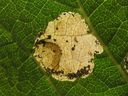
Distinguished from other elm-feeding insects by its leafmining larval habit rather than external feeding. The serpentine or blotch mines are characteristic and differ from the chewing damage of elm leaf beetles or the gall formations of aphids. identification requires examination of wing venation and other morphological features typical of the Fenusa. Molecular identification via may be necessary for definitive identification.
Images
Appearance
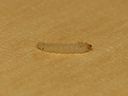
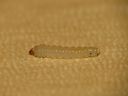
are small, typical of the Tenthredinidae. Larvae are leafminers that create serpentine or blotch mines within elm leaves. The mines are visible as pale, winding trails or discolored blotches on the leaf surface, with (larval excrement) often visible within the mine.
Habitat
Urban, nursery, and landscape settings with elm trees. The is associated with cultivated and ornamental elms rather than natural forest . No specific natural habitat requirements have been documented beyond the presence of suitable trees.
Distribution
Native to Europe (Denmark, Norway, Sweden). Introduced and established in the United States, where it is present in the conterminous 48 states. The has spread through horticultural trade of elm plants and rootstocks.
Seasonality
, initial leafmining, and cessation of leafmining are highly correlated with indicator plant full bloom . Timing varies by location but follows accumulations. Peak adult emergence coincides with leafing phenology of susceptible European elm . In North America, activity begins when susceptible leaf out in spring.
Diet
Larvae feed as leafminers within the mesophyll of elm (Ulmus) leaves. The specific tissue layers consumed are not documented, but leafmining activity involves feeding between the upper and lower leaf .
Host Associations
- Ulmus glabra - highly susceptible European elm showing severe defoliation
- Ulmus elliptica - highly susceptible European elm showing severe defoliation
- Ulmus sukaczevii - highly susceptible European elm showing severe defoliation
- Ulmus laciniata - highly susceptible Only Asian elm showing high susceptibility among 37 evaluated
- Ulmus rubra - susceptible Only North American elm showing susceptibility
- Ulmus procera - less susceptible European elm; leafs out later after peak
- Ulmus carpinifolia - less susceptible European elm; leafs out later after peak
- Ulmus davidiana - with negligible damageAsian elm; leafs out synchronously with susceptible but experiences no damage
- Ulmus japonica - with negligible damageAsian elm; leafs out synchronously with susceptible but experiences no damage
- Ulmus lamellosa - with negligible damageAsian elm; leafs out synchronously with susceptible but experiences no damage
- Ulmus pumila - with negligible damageAsian elm; leafs out synchronously with susceptible but experiences no damage
- Ulmus wilsoniana - with negligible damageAsian elm; leafs out later after peak and oviposition
- Ulmus parvifolia - with negligible damageAsian elm; leafs out later after peak and oviposition
- Elms with Ulmus glabra-wallichiana parentage - highly susceptible Hybrid elms showing severe defoliation
Life Cycle
emerge in spring, with timing correlated to accumulations and indicator plant . Oviposition occurs on elm leaves, timed to coincide with leafing phenology. Larvae develop as leafminers within leaves, creating visible mines. Development from to adult occurs within the same growing season. Specific details on location, stage, and number of per year are not documented in available sources.
Behavior
No consistent pattern of within-tree distribution for oviposition or feeding damage by tree height or cardinal direction. Ovipositional is strongly influenced by , with preferentially selecting hosts whose leafing is synchronized with their . No other specific behaviors have been documented.
Ecological Role
Herbivore and pest of elm trees in ornamental and nursery settings. Causes defoliation damage that can reduce aesthetic value and tree vigor. The has driven interest in utilizing Asian and North American elm for breeding programs. No documented role as prey, for , or other functions has been reported.
Human Relevance
Pest of ornamental and nursery elm trees, causing aesthetic damage through leafmining. The has prompted evaluation of elm for resistance breeding programs. Its introduction to North America appears to have occurred through horticultural trade of elm plants and rootstocks. models based on its phenological correlations have been developed for monitoring and management in nursery and landscape settings.
Similar Taxa
- Stigmella multispicataAnother leafmining insect on elms, but this is a (Lepidoptera: Nepticulidae) rather than a , with much smaller and different mine
- Orchestes steppensisAn weevil that feeds on elm leaves, but causes chewing damage rather than leafmining, and has different seasonal activity
More Details
Phenological Synchronization
The tight correlation between F. ulmi and leafing represents a key factor in host susceptibility. European elms that leaf out synchronously with emergence are most damaged, while those leafing out later escape oviposition. Interestingly, many Asian elms leaf out synchronously but possess resistance mechanisms that prevent damage, suggesting coevolutionary differences between European and Asian elm-sawfly interactions.
Breeding Implications
The identification of numerous Asian and North American elm with resistance to F. ulmi provides a genetic resource for elm breeding programs, particularly for developing - cultivars that also resist leafminer damage.
Sources and further reading
- BugGuide
- Wikipedia
- GBIF taxonomy match
- NCBI Taxonomy
- Gall darn it! Gall insects on hickory, oak, and elm, Phylloxera caryaecaulis, Andricus palustris, Colopha ulmicola — Bug of the Week
- Botanizing at Salt Lick Point Land & Water Reserve | Beetles In The Bush
- 🌿 Botanizing w/ the Webster Groves Nature Study Society (WGNSS) Botany Group at Rockwoods Reservation – 3 Nov 2025 | Beetles In The Bush
- Uncategorized | Blog - Part 28
- Thelypteridaceae | Beetles In The Bush
- entomology | Blog - Part 9
- Seasonal Activity, Within-Tree Distribution, and Ovipositional and Feeding Preference of the Elm Leafminer, Fenusa ulmi (Hymenoptera: Tenthredinidae)