
Orchestes steppensis
Korotyaev, 2016
European Elm Flea Weevil, Elm Flea Weevil
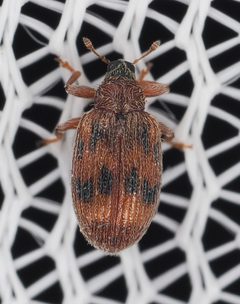
Orchestes steppensis is a small -weevil (2.6–3.2 mm) native to the Eastern Palaearctic Steppe region and now in North America. It is a serious pest of elm trees (Ulmus spp.), with feeding on leaves and larvae mining leaf tissue. The was previously misidentified as O. alni or O. mutabilis in China. It completes one per year in Xinjiang, China, with adults emerging in late March to early April. The species exhibits strong olfactory-mediated location, with documented preferences for specific plant volatiles.
Pronunciation
How to pronounce Orchestes steppensis: /ɔːrˈkɛstɛs stɛˈpɛn.sɪs/
These audio files are automatically generated. While they are not always 100% accurate, they are a good starting point.
Identification
Distinguished from the congeneric European elm weevil Orchestes alni by subtle morphological characters; the two were historically confused. In North America, it can be separated from native elm-feeding beetles by its small size, jumping , and specific association with Ulmus species. Molecular identification may be required for definitive separation from O. alni. The larval leaf mines are characteristic: larvae feed along the main of elm leaves, creating distinctive mining patterns.
Images
Habitat
Desert and semi-desert environments, urban landscapes, windbreak plantations, and sand fixation areas. In its native range, it is strongly associated with elm trees (Ulmus spp.) in steppe and semi-arid regions. In North America, it has established in urban and suburban environments where elm trees are planted.
Distribution
Native to the Eastern Palaearctic Steppe region: widely distributed across China (Anhui, Beijing, Gansu, Hebei, Jiangsu, Jilin, Liaoning, Nei Mongol, Ningxia, Shaanxi, Shandong, Shanghai, Tianjin, Xinjiang), Kazakhstan, Mongolia, and Russia. in North America: Canada (British Columbia, Nova Scotia, Ontario, Quebec) and USA (Arizona, Colorado, Idaho, Illinois, Indiana, Iowa, Kansas, Kentucky, Maryland, Massachusetts, Michigan, Minnesota, Missouri, New Jersey, New Mexico, North Dakota, Ohio, Oregon, Utah, Virginia, Washington, Wisconsin, Wyoming). In European Russia, recorded from Voronezh Province, Saratov Province, and Stavropol Territory.
Seasonality
(one per year) in Xinjiang, China. emerge from hibernation late March to early April. Mating occurs shortly after . are laid along main of elm leaves. New generation adults emerge mid-May. Activity period extends through the growing season of elm trees.
Diet
Oligophagous: feeds exclusively on elm trees (Ulmaceae). feed on leaf tissue. Larvae are leaf miners, feeding heavily within leaf tissue and causing substantial damage. Documented preference hierarchy: Ulmus pumila > Ulmus laevis > Ulmus densa.
Host Associations
- Ulmus pumila - primary Preferred ; highest preference in olfactory and behavioral studies
- Ulmus laevis - secondary Intermediate preference
- Ulmus densa - tertiary Lowest preference among tested
Life Cycle
Complete with one per year (). emerge late March to early April in Xinjiang. After mating, females lay along the main of elm leaves. Larvae develop within leaf mines until . New generation adults emerge mid-May. The overwinters as adults.
Behavior
Exhibits strong with upward convergence and light convergence behaviors observed. Olfactory-mediated location is well-developed: are attracted to specific plant volatiles including 3-hexen-1-ol, 3,7-dimethyl-1,3,6-octatriene, methyl salicylate, 1-hexanol, and 3-hexen-1-ol acetate, and are repelled by nonanal and 2-hexenal. The shows differential host preference, with strong selection for Ulmus pumila over other elm species.
Ecological Role
Serious pest of elm trees causing defoliation, reduced tree vigor, and death of lower small branches. In Xinjiang, it is considered a significant agricultural and forestry pest requiring control. In North America, it is a rapidly spreading causing damage to urban elm plantings. Natural by local enemies in Xinjiang reached approximately 36% on U. pumila in Urumqi in 2016, though this level is currently insufficient for effective .
Human Relevance
Significant economic impact as a pest of ornamental and forestry elm trees. In Xinjiang, China, it requires management. In North America, it represents an emerging threat to urban elm . Seven have been identified as potential agents, with Pteromalus sp. 2 identified as the and most competitive species, though further investigation is needed for implementation.
Similar Taxa
- Orchestes alniHistorically confused with O. steppensis; both are small elm-feeding -weevils. Morphological separation requires detailed examination, and the two were previously misidentified in China and elsewhere.
- Stigmella multispicataAnother Asian associated with Siberian elm in North America; both species feed on Ulmus pumila and co-occur on the same trees, though S. multispicata is a with leaf-mining larvae rather than a .
Misconceptions
Previously misidentified as Orchestes alni (L.) or O. mutabilis Boheman in China. The was also formerly misnamed as the 'European elm weevil' in North American literature before its correct identification as the Eastern Palaearctic species O. steppensis.
More Details
Chemical Ecology
Electrophysiological studies (EAG) and coupled gas chromatography-electroantennographic detection (GC-EAD) have identified 13 active volatile compounds. Attractive compounds include 3-hexen-1-ol, 3,7-dimethyl-1,3,6-octatriene, methyl salicylate, 1-hexanol, and 3-hexen-1-ol acetate. Repellent compounds include nonanal and 2-hexenal. These findings have potential applications in -based pest management.
Natural Enemies
Seven primary solitary attack larval and pupal stages in Xinjiang: Pteromalus sp. 2 ( and most competitive), and six additional species. rates reached ~36% in 2016 but are currently insufficient for effective . The parasitoid complex is under investigation for potential in North America.
Invasion History
The is likely an in Xinjiang, China, having expanded from its native Eastern Palaearctic range. It has established widely in North America, where it was previously misidentified. The spread has been facilitated by the widespread planting of Siberian elm (Ulmus pumila) in urban and suburban environments.
Sources and further reading
- BugGuide
- GBIF taxonomy match
- iNaturalist taxon
- NCBI Taxonomy
- biodiversity | Blog - Part 35
- Orchestes steppensis . [Distribution map].
- Electrophysiological and Behavioral Responses of Orchestes steppensis (Coleoptera: Curculionidae) to Ulmus Plant Volatiles
- New Data on the Distribution of the Flea-Weevil Orchestes steppensis Kor. (Coleoptera, Curculionidae: Rhamphini) in European Russia
- Biological traits and the complex of parasitoids of the elm pest Orchestes steppensis (Coleoptera: Curculionidae) in Xinjiang, China