
Orchestes
Illiger, J.C.W., 1798
flea weevils
Species Guides
6- Orchestes andersoni
- Orchestes fagi(Beech leaf-mining weevil)
- Orchestes mixtus
- Orchestes pallicornis(Apple Flea Weevil)
- Orchestes steppensis(European Elm Flea Weevil)
- Orchestes testaceus(Alder Jumping Weevil)
Orchestes is a of flea weevils (Curculionidae) comprising six in North America and additional species in Eurasia. Members are small beetles (2–4 mm) associated with woody plants, particularly trees in Ulmaceae and Fagaceae. The genus was historically confused with Rhynchaenus, from which it has been redefined. Several species are significant pests: O. steppensis is a destructive of elms in China and North America, O. alni (European elm flea weevil) damages elms in Europe and North America, and O. fagi attacks beech trees. Larval habits vary—most are leaf miners, though O. hustachei uniquely parasitizes galls.
Pronunciation
How to pronounce Orchestes: //ɔːkˈhɛstiːz//
These audio files are automatically generated. While they are not always 100% accurate, they are a good starting point.
Identification
Distinguished from other flea weevil by a combination of rostral shape, antennal insertion position, and hind leg . Separation from the historically confused genus Rhynchaenus requires examination of genitalic characters and tarsal structure. Within the genus, identification relies on association, geographic range, and detailed examination of elytral and color pattern. O. steppensis can be separated from O. alni by more pronounced elytral punctation and different geographic origin.
Images
Appearance
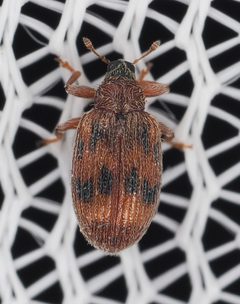
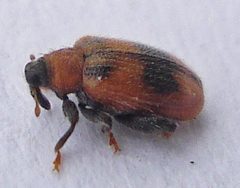
Small beetles, typically 2–4 mm in length, with a compact, rounded body form characteristic of flea weevils. Possess a short, broad rostrum. geniculate with clubbed tips. Hind legs often enlarged, adapted for jumping—hence the 'flea weevil'. Coloration varies by : O. steppensis is dark with pale markings; O. alni has a distinctive pattern of pale and dark .
Habitat
Associated with deciduous trees, particularly elms (Ulmus spp.), beech (Fagus spp.), and related woody plants. Found in urban landscapes, windbreak plantations, natural forests, and semi-desert environments where trees occur. overwinter in bark crevices, moss, or leaf litter near host trees.
Distribution
Holarctic distribution. North America: six including O. alni, O. steppensis, O. pallicornis, O. fagi. Eurasia: multiple species including O. steppensis (native to Eastern Palaearctic steppe), O. alni (Europe), O. fagi (Europe), O. hustachei (Japan), O. betuleti (Europe), O. rusci (Europe). O. steppensis introduced to North America, now established across Canada and northern USA. O. alni introduced to North America, spreading in eastern and western regions. O. fagi introduced to Nova Scotia, Canada.
Seasonality
emerge from in early spring (March–April in temperate regions, earlier in warmer climates). Larval activity peaks in late spring (April–May). New adults appear in late spring to early summer (May–June), with adult feeding damage most visible then. Adults enter by mid-summer, remaining inactive until the following spring.
Diet
feed on plant leaves, creating small shot-hole feeding damage. Larvae are primarily leaf miners, feeding inside leaf tissue between epidermal layers. O. hustachei is uniquely aphidophagous—larvae feed on aphids within galls rather than leaf tissue.
Host Associations
- Ulmus pumila - primary Most preferred of O. steppensis; also used by other
- Ulmus laevis - Secondary for O. steppensis
- Ulmus densa - Least preferred for O. steppensis
- Ulmus davidiana - Native of O. hustachei in Japan
- Fagus sylvatica - Native of O. fagi in Europe
- Fagus grandifolia - Introduced of O. fagi in North America
- Malus - of O. pallicornis (apple -weevil)
- Betula - of O. betuleti
- Ruscus - of O. rusci
- Zelkova serrata - of introduced Paracolopha morrisoni galls used by O. hustachei
Life Cycle
One per year in most . overwinter in sheltered locations near trees. Spring followed by mating and oviposition. laid in leaf tissue, along leaf , or into galls depending on species. Larvae develop through feeding on leaf tissue (mining) or aphids. occurs within the leaf mine or in soil. New generation adults emerge, feed briefly, then enter . O. steppensis in Xinjiang: adults emerge late March to early April, eggs laid along main leaf veins, new adults emerge mid-May.
Behavior
possess jumping ability using enlarged hind legs, facilitating rapid escape from . Strong positive and observed in O. steppensis. location mediated by olfactory response to volatile organic compounds; attracted to green leaf volatiles and herbivore-induced plant volatiles. O. steppensis adults aggregate on preferred host . O. hustachei females show learned host preference based on natal host experience, with evidence of incipient host race formation between using different gall types.
Ecological Role
Herbivores and leaf miners that can significantly impact tree health. O. steppensis causes defoliation, reduced tree growth, and branch death in elm windbreak plantations, affecting desertification control efforts in China. O. fagi damages American beech in Nova Scotia. Serve as hosts for (Hymenoptera: Pteromalidae, Eulophidae), with rates reaching approximately 36% in some . O. hustachei acts as a agent of populations through gall parasitism.
Human Relevance
Several are economically significant pests of ornamental and forestry trees. O. steppensis is a major pest of elms in China and an emerging in North America. O. alni damages elms in urban landscapes. O. fagi threatens American beech forests in Canada. O. pallicornis historically caused significant damage to apple orchards in Illinois and Ohio. Management relies on or using ; monitoring uses colored sticky traps (yellow, green, white most effective). Firewood transport has been identified as a human-mediated for O. fagi.
Similar Taxa
- RhynchaenusHistorically treated as synonymous; now separated based on genitalic and tarsal structure. Rhynchaenus has a more restricted modern definition.
- TachyergesAnother rhamphine flea weevil with similar and habits; requires examination of rostral and antennal characters for separation.
More Details
Taxonomic history
The has undergone significant taxonomic revision. Previously regarded as a synonym of Rhynchaenus, Orchestes was reinstated based on morphological studies, particularly by Anderson (1989). The manuscript name Pedetes (Creutzer, 1799) was never validly published and is unavailable for use.
Invasive species dynamics
Multiple Orchestes have established outside native ranges through human-mediated transport. O. steppensis, native to the Eastern Palaearctic steppe, is now across North America. O. alni, native to Europe, was first detected in North America in 2003 and is spreading. O. fagi, native to Europe, was detected in Nova Scotia by 2012. These invasions follow patterns of plant introduction and firewood movement.
Unique feeding strategy in O. hustachei
Unlike other Orchestes with leaf-mining larvae, O. hustachei larvae are aphidophagous, developing inside galls and feeding on the aphid colony. This represents a distinct ecological shift within the and has facilitated race formation between using different aphid species on different host trees.
Sources and further reading
- BugGuide
- Wikipedia
- iNaturalist taxon
- NCBI Taxonomy
- Catalogue of Life
- biodiversity | Blog - Part 35
- Orchestes steppensis . [Distribution map].
- The Apple Flea-weevil, Orchestes pallicornis Say (Order Coleoptera; Family Curculionidae)
- Electrophysiological and Behavioral Responses of Orchestes steppensis (Coleoptera: Curculionidae) to Ulmus Plant Volatiles
- Parasitoid complex associated with the flea weevil Orchestes alni L. (Coleoptera: Curculionidae) in Bulgaria and a review of host–parasitoid interactions of genus Orchestes Illiger
- A study of biology and parasitoid complex (Hymenoptera: Eulophidae) of leaf miners weevil Orchestes betuleti (Panzer, 1795) (Coleoptera: Curculionidae) in Ulyanovsk region
- Host range and host preference of a flea weevil, Orchestes hustachei, parasitizing aphid galls
- New Data on the Distribution of the Flea-Weevil Orchestes steppensis Kor. (Coleoptera, Curculionidae: Rhamphini) in European Russia
- Resistance of Landscape-Suitable Elms to Japanese Beetle, Gall Aphids, and Leaf Miners, with Notes on Life History of Orchestes alni and Agromyza aristata in Kentucky
- Drastic changes in host preference in a gall‐parasitic flea weevil, Orchestes hustachei , during the last decade
- Biological traits and the complex of parasitoids of the elm pest Orchestes steppensis (Coleoptera: Curculionidae) in Xinjiang, China
- Orchestes alni(L.) (Coleoptera: Curculionidae): New Records from Western North America with Notes on Parasitoids
- Influence of trap colour, type, deployment height, and a host volatile on monitoring Orchestes fagi (Coleoptera: Curculionidae) in Nova Scotia, Canada
- Hitching a ride: firewood as a potential pathway for range expansion of an exotic beech leaf-mining weevil, Orchestes fagi (Coleoptera: Curculionidae)
- Influence of trap colour, type, deployment height, and a host volatile on monitoring Orchestes fagi (Coleoptera: Curculionidae) in Nova Scotia, Canada–ERRATUM
- The genome sequence of the jumping weevil, Orchestes rusci (Herbst, 1795).