
Rhamphini
Rafinesque, 1815
Flea Weevils
Genus Guides
2- Rhamphina
- Tachygonus(flea weevils)
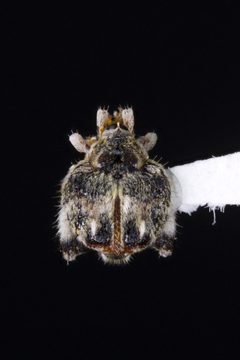
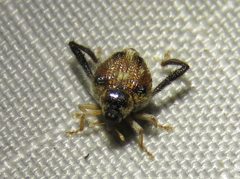
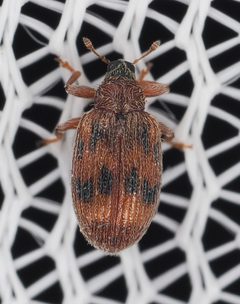
Rhamphini is a tribe of weevils (Curculionidae: Curculioninae) commonly known as flea weevils, characterized by their jumping ability. The tribe includes economically significant leaf-mining that feed on diverse plants including poplars, elms, willows, and various herbs. Members exhibit diverse biogeographic distributions across the Palearctic, Oriental, and Neotropical regions, with notable diversity in Asia and Europe.
Pronunciation
How to pronounce Rhamphini: //ræmˈfaɪnaɪ//
These audio files are automatically generated. While they are not always 100% accurate, they are a good starting point.
Identification
Flea weevils possess enlarged hind adapted for jumping, distinguishing them from most other weevil groups. The tribe is morphologically diverse, with some groups requiring examination of subtle characters including antennal placement on the rostrum, tibial armature, and genital structure for accurate identification. Molecular data (mtCOI) has proven useful for distinguishing cryptic species.
Images
Distribution
Widespread across Palearctic, Oriental, and Neotropical regions. Documented from Europe (including Italy, Russia), Asia (Laos, China, Japan, Sri Lanka, Ethiopia, Namibia, Turkmenistan), and South America (Brazil). Specific records include European Russia (Voronezh, Saratov, Stavropol), Lipetsk Region, and restinga in Rio de Janeiro State, Brazil.
Seasonality
Activity patterns vary by . Tachygonus erythroxyli mines are markedly more abundant in summer but occur year-round in at least half of plants in subtropical Brazil.
Host Associations
- Ulmus pumila - Orchestes steppensis
- Salix fragilis - Isochnus sequensi
- Nepeta nuda - Pseudorchestes stobieckii
- Erythroxylum subsessile - Tachygonus erythroxyli; local monophagy observed
- Populus - Tachyerges seriatosetosus; economically significant pest
Life Cycle
Larval development occurs in leaf mines for many . Tachygonus erythroxyli exhibits three larval instars, each producing a bubble expansion in the mine. stages (larvae and pupae) have been described for some species including Pseudorchestes stobieckii.
Behavior
Females of at least some lay singly on upper leaf surfaces. Larvae are leaf miners, creating distinctive expanded mines. High rates (53% documented) by eulophid occur in some .
Ecological Role
Leaf-mining larvae function as herbivores on woody and herbaceous plants. Some achieve high abundance and frequency on plants. Serve as hosts for (Eulophidae), with Cirrospilus sp. representing 88% of parasitoids in one studied system.
Human Relevance
Some are economically significant pests. Tachyerges seriatosetosus is a notable pest of poplars. Orchestes steppensis affects elm species.
Similar Taxa
- Other Curculioninae tribesRhamphini distinguished by enlarged hind for jumping; other weevil tribes lack this saltatorial
More Details
Taxonomic history
Established by Rafinesque in 1815. Recent taxonomic work has clarified synonymies, established new combinations, and described new including Magorchestes from Laos (2011) and subgenus Labiorchestes for Pseudorchestes stobieckii.
Molecular systematics
Integrative combining and molecular data (mtCOI) has revealed substantial divergences (6.2–14.9%) between morphologically similar , supporting species boundaries in cryptic complexes such as the Rhamphus oxyacanthae group.
Sources and further reading
- BugGuide
- Wikipedia
- iNaturalist taxon
- NCBI Taxonomy
- New Data on the Distribution of the Flea-Weevil Orchestes steppensis Kor. (Coleoptera, Curculionidae: Rhamphini) in European Russia
- Taxonomy, biology and immature stages of the little-known weevil Pseudorchestes (Labiorchestes subgen.n.) stobieckii (Smreczyński, 1957) comb.n. (Coleoptera: Curculionidae: Rhamphini)
- Clarification of the taxonomic status and distribution of a number of Asian species of the tribe Rhamphini (Coleoptera: Curculionidae, Curculioninae)
- Description of two new species of Rhamphus related to R. oxyacanthae (Curculionidae, Curculioninae, Rhamphini) from Italy based on a morphological study supported by molecular data
- A remarkable leaf mine induced by Tachygonus sp.n. (Coleoptera: Curculionidae: Curculioninae: Rhamphini) on Erythroxylum subsessile (Erythroxylaceae) with a description of the new species
- Eulophid Wasps (Hymenoptera, Chalcidoidea: Eulophidae), Parasitoids of Isochnus sequensi (Stierlin) (Coleoptera, Curculionidae: Rhamphini), a Leaf Miner on Salix fragilis L., in the Environs of Saint Petersburg, Russia