
Stigmella multispicata
Rocienė & Stonis in Stonis & Rocienė, 2014
Stigmella multispicata is a pygmy in the Nepticulidae, native to East Asia and in eastern North America. It was first described from a single male from Primorye, Russia in 2014, and subsequently identified as an established in North America through that matched specimens from Beijing, China with found in the United States. The is a leafminer specializing on Siberian elm (Ulmus pumila), distinguished by morphological features including a white collar, entirely dark , and in females an elongated narrow ovipositor adapted for oviposition in hairy leaf axils. It is the only Ulmus-feeding nepticulid in North America with green larvae. First detected in North America around 2010, the species has since spread to ten US states and two Canadian provinces.
Pronunciation
How to pronounce Stigmella multispicata: /ˈstɪɡməˌlɑː mʌltɪspɪˈkɑːtə/
These audio files are automatically generated. While they are not always 100% accurate, they are a good starting point.
Identification
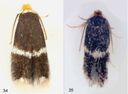
Distinguished from the European Stigmella ulmivora by white collar (versus dark in S. ulmivora) and entirely dark . Separated from native North American elm leafminers Stigmella apicialbella and Ectoedemia ulmella by green larval coloration (other have non-green larvae). Female's elongated narrow ovipositor is distinctive and adapted for oviposition in underside hairy leaf axils, where all mines originate. provides definitive identification and was crucial for linking Asian and North American .
Images
Habitat
Urban and suburban environments where Siberian elm (Ulmus pumila) occurs, including residential areas, parks, arboreta, and nursery settings. Associated with human-modified landscapes where the tree has been planted.
Distribution
Native range: East Asia, including Russia (Primorye) and China (Beijing). range: eastern North America, documented from USA (Illinois, Indiana, Iowa, Maryland, Massachusetts, Minnesota, New York, Ohio, Tennessee, Wisconsin) and Canada (Ontario, Québec). First detected in North America around 2010; spread facilitated by trade of live plants through nurseries is suspected.
Seasonality
records primarily from July to August. Larval activity occurs during growing season of plant. Mass larval descent observed, with larvae descending on silk strands to pupate.
Diet
Larvae feed as leafminers on leaves of Siberian elm (Ulmus pumila), consuming leaf tissue between upper and lower . feeding habits not documented.
Host Associations
- Ulmus pumila - primary Siberian elm; sole documented in North America. All mines start in underside hairy leaf axils where female oviposits.
Life Cycle
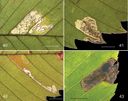
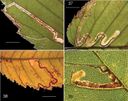
laid in underside hairy leaf axils of leaves using elongated ovipositor. Larvae hatch and mine leaf tissue, creating linear mines. Larvae are green and feed internally. Mature larvae descend en masse from host trees on silk strands to pupate in cocoons. occurs in protected locations. emerge in summer. Multiple per year likely given extended adult period.
Behavior
Larvae exhibit mass occurrence on trees, with synchronized descent on silk strands for . attracted to light (collected in light traps). activity pattern inferred from light trap captures. spread pattern suggests human-mediated via nursery trade.
Ecological Role
Leafminer herbivore of Siberian elm; may compete with native North American elm leafminers Stigmella apicialbella and Ectoedemia ulmella for resources. densities can reach high levels, with mass larval occurrences reported from Long Island, New York. Impact on native elm unknown but flagged as monitoring priority.
Human Relevance
Recognized as in North America, likely introduced via nursery trade of live plants. Subject of citizen science documentation through platforms such as BugGuide and iNaturalist, which contributed to mapping its distribution. Not considered a significant economic pest, though high densities have been observed. Researchers recommend monitoring for potential shifts to native elm .
Similar Taxa
- Stigmella ulmivoraEuropean also feeding on Ulmus; distinguished by dark collar (versus white in S. multispicata) and different genitalia, particularly in females which lack the elongated narrow ovipositor of S. multispicata.
- Stigmella apicialbellaNative North American elm leafminer; distinguished by larval coloration (not green) and different mine .
- Ectoedemia ulmellaNative North American elm leafminer; distinguished by larval coloration (not green) and different mine .
More Details
Invasion history
The was first described in 2014 from a single male collected in Primorye, Russia. Its presence in North America was unrecognized until of a larva from Beijing, China matched specimens from Indiana, USA, revealing the North American as an establishment. The oldest North American records date to 2010, indicating the species was already well established by the time of its formal recognition.
Taxonomic resolution
Identification relies on combination of external (white collar, dark ), genitalia dissection (particularly female ovipositor structure), larval coloration (green), and . The latter was essential for linking geographically disjunct and confirming the status in North America.
Sources and further reading
- BugGuide
- Catalogue of Life
- biodiversity | Blog - Part 35
- Stigmella multispicata Rociene. & Stonis, an Asian leafminer on Siberian elm, now widespread in eastern North America (Lepidoptera, Nepticulidae)
- New Records of Palearctic Stigmella Species (Lepidoptera: Nepticulidae) on Elms (Ulmaceae: Ulmus spp.) in North America, Including New Hosts for S. multispicata Rocienė and Stonis and the First Continental Record for S. Ulmivora (Fologne)