
Xanthogaleruca
Laboissière, 1934
elm leaf beetles
Species Guides
1- Xanthogaleruca luteola(elm leaf beetle)
Xanthogaleruca is a of leaf beetles in the Chrysomelidae, commonly known as . The genus includes approximately ten recognized , with Xanthogaleruca luteola being the most economically significant as a major pest of elm trees worldwide. and larvae feed on elm foliage, causing skeletonization and defoliation that can severely weaken trees. The genus is native to Europe and Asia but has been introduced to North America, Australia, and other regions through human activity. Several species are associated exclusively with Ulmus plants.
Pronunciation
How to pronounce Xanthogaleruca: //zænˌθoʊ.ɡæləˈɹuːkə//
These audio files are automatically generated. While they are not always 100% accurate, they are a good starting point.
Identification
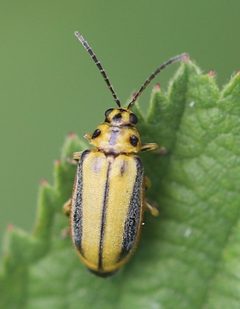
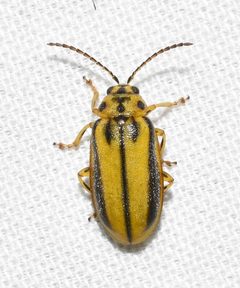
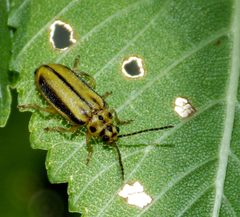
are small beetles, approximately 5–7 mm in length, with yellowish to olive-green bodies marked by dark longitudinal stripes or spots. The bears four dark spots near the bases in some . Larvae are elongated, soft-bodied, and -like, with rows of dark along the sides giving a striped appearance. Pupae are orange to yellow and found in bark crevices or soil. Xanthogaleruca can be distinguished from the related Pyrrhalta by genitalic and subtle differences in elytral coloration patterns.
Images
Habitat
Strictly associated with elm trees (Ulmus spp.), occurring in urban plantings, riparian forests, windbreaks, shelterbelts, and natural elm stands. Found in both native and introduced ranges wherever elms grow.
Distribution
Native to Europe, western Asia, and parts of East Asia. Introduced and established in North America (first detected in the 1930s, now widespread across the United States and southern Canada), Australia, New Zealand, and other regions with elm . Records exist from Scandinavia, the Lower Volga region, Taiwan, and Japan.
Seasonality
overwinter in protected locations including bark crevices, woodpiles, and buildings. Spring coincides with elm leaf flush. Multiple per year occur in warmer climates (2–3 in central and southern North America, up to 3–4 in warm regions), with single generations in cooler northern areas. Activity peaks during spring and summer months.
Diet
Folivorous; chew irregular holes through elm leaves, often creating shothole patterns. Larvae skeletonize leaves by feeding on soft mesophyll tissue between leaf , leaving behind reticulate networks of veins and .
Host Associations
- Ulmus americana - American elm; suitable
- Ulmus glabra - Wych elm; highly suitable European
- Ulmus laevis - European white elm; suitable
- Ulmus minor - Field elm; suitable
- Ulmus pumila - Siberian elm; suitable Asiatic
- Ulmus parvifolia - Chinese elm; poor ,
- Ulmus wilsoniana - Wilson's elm; poor ,
- Zelkova serrata - Japanese zelkova; occasionally attacked
Life Cycle
are laid in yellowish clusters of 5–25 on undersides of leaves, becoming grayish before hatching. Larvae pass through three instars over several weeks, feeding on foliage before descending the trunk to pupate. Prepupal larvae become curled and inactive. occurs in bark crevices or soil at tree bases, lasting approximately 10 days. emerge to feed, mate, and lay eggs; summer complete development more rapidly. occurs as adults in sheltered locations.
Behavior
fly to elm in spring to feed and reproduce. Larvae feed gregariously on leaves before descending tree trunks to pupate, sometimes in large at the base. Adults may enter buildings to overwinter. location and acceptance varies among elm , with clear preferences for European elms over many Asiatic and American species.
Ecological Role
Herbivore and folivore on Ulmus. Serves as for including Oomyzus gallerucae ( parasitoid) and Tetrastichus gallerucae, as well as predatory lady beetles (Coccinellidae) that attack eggs and larvae. can cause cascading effects on urban tree health and associated .
Human Relevance
Major pest of ornamental and street elms worldwide. Repeated defoliation weakens trees, reduces shade value, increases susceptibility to and other , and causes aesthetic degradation. Subject to extensive programs using imported . Some elm and cultivars are promoted as alternatives for urban planting.
Similar Taxa
- PyrrhaltaClosely related galerucine historically confused with Xanthogaleruca; distinguished by genitalic and subtle color pattern differences
- Monocesta coryliLarger elm leaf beetle, native to North America; larger body size, different larval arrangement, and less damaging to urban elms
- TricholochmaeaFormerly considered distinct but now synonymized with Pyrrhalta; historically separated from Xanthogaleruca based on tarsal and genitalic characters
Sources and further reading
- BugGuide
- Wikipedia
- GBIF taxonomy match
- iNaturalist taxon
- NCBI Taxonomy
- These Beetles Don't Want to Hold Your Hand | Bug Squad
- Beautiful beetles and gnarly elm leaves: Larger elm leaf beetle, Monocesta coryli, and elm leaf beetle, Xanthogaleruca luteola — Bug of the Week
- Archive — Bug of the Week
- Suitability of Thirteen Different Host Species for Elm Leaf Beetle, Xanthogaleruca luteola (Coleoptera: Chrysomelidae)
- Host Suitability of Three Asiatic Elms to the Elm Leaf Beetle (Xanthogaleruca luteola) (Coleoptera: Chrysomelidae)
- Distribution features of Xanthogaleruca luteola (Coleoptera: Chrysomelidae) in the protective plantings of the Lower Volga
- New Records of Elm Leaf Beetle, Xanthogaleruca luteola, Parasitoids in Colorado, with Notes on Predators
- Effect of 1,8-cineol on the biology and physiology of elm leaf beetle, Xanthogaleruca luteola (Col.: Chrysomelidae)
- Host location in Oomyzus gallerucae (Hymenoptera: Eulophidae), an egg parasitoid of the elm leaf beetle Xanthogaleruca luteola (Coleoptera: Chrysomelidae)
- Life cycle, parasitism and damage of Xanthogaleruca luteola (Muller) in Valencia (SE Spain): A preliminary study
- Molecular identification and polymerase chain reaction analysis of Xanthogaleruca Luteola (Chrysomelidae) species
- Host preference of three elms and hackberry for elm leaf beetle, Xanthogaleruca (=pyrrhalta) luteola (Coleoptera: Chrysomelidae)
- Revision of the genera Xanthogaleruca Laboissière, 1932 and Pyrrhalta Joannis, 1865 (Coleoptera, Chrysomelidae, Galerucinae) of Taiwan, with type designation of Galerucella lineatipes Takei