
Galerucini
Latreille, 1802
skeletonizing leaf beetles
Genus Guides
19- Brucita
- Coraia
- Derospidea
- Diorhabda(tamarisk beetle)
- Erynephala(beet leaf beetle)
- Galeruca
- Galerucella(leaf beetles)
- Miraces
- Monocesta(larger elm leaf beetle)
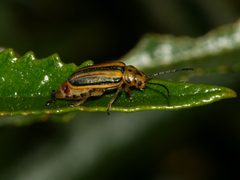
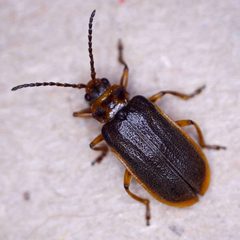
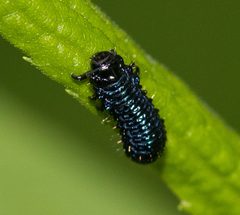
Galerucini is a tribe of leaf beetles in the Galerucinae, Chrysomelidae, commonly known as skeletonizing leaf beetles. The tribe contains over 70 and at least 480 described , distributed across multiple continents. Members of this tribe exhibit diverse feeding habits, with some species specializing on particular plants such as Tamarix (tamarisk) or Atriplex and Chenopodium in saline . Certain species have been studied extensively for their potential as agents against plants.
Pronunciation
How to pronounce Galerucini: /ɡæləˈruːsɪnaɪ/
These audio files are automatically generated. While they are not always 100% accurate, they are a good starting point.
Identification
Galerucini can be distinguished from related tribes within Galerucinae (such as Luperini and Metacyclini) by morphological features detailed in diagnostic keys, including characteristics of male genitalia (endophallic ) and female genitalia (vaginal palpi and internal sternite VIII). Habitus illustrations are available for most . The tribe excludes flea beetles (tribe Alticini), which possess enlarged hind adapted for jumping.
Images
Habitat
vary widely among and include: Mediterranean and temperate forests; warm temperate grasslands, deserts, and forests; Mediterranean woodlands; cold temperate deserts; montane grasslands; warm deserts; maritime subtropical deserts; and saline habitats. Specific habitat associations are species-dependent rather than characteristic of the tribe as a whole.
Distribution
The tribe has a global distribution. The Diorhabda elongata group is primarily Palearctic, ranging from circummediterranean regions (Italy to western Turkey), southern Ukraine to Iraq and western China, France to North Africa and east to Iraq, Mongolia and China west to Russia and south to southern Iran, and southern Pakistan and Iran to Syria. New World distribution includes North, Central, and South America. Some species are outside native ranges; Monoxia obesula, native to the U.S.A., has been introduced to Sardinia, Italy.
Behavior
of Galerucini contain 1,8-dihydroxylated anthraquinones (chrysazin, chrysophanol) and anthrones (dithranol, chrysarobin) that deter . These defensive compounds are produced by rather than by endosymbiotic microorganisms. The tansy leaf beetle (Galeruca tanaceti) has been used as a model organism to study this biosynthetic capability.
Ecological Role
Human Relevance
Several are significant for programs. The Diorhabda elongata species group has been introduced to North America to control Tamarix species. Northern climatypes of D. carinulata are effective in the Great Basin desert; D. elongata is suited to Mediterranean woodlands of northern California; northern climatypes of D. carinata may be best for central U.S. grasslands; and D. sublineata, D. meridionalis, and southern climatypes of D. carinata and D. carinulata are suited to southwestern U.S. areas. with two behaviorally active components have been identified for monitoring purposes, and the beetles respond to green leaf volatiles.
Similar Taxa
- LuperiniBoth are tribes within Galerucinae; distinguished by morphological characters in diagnostic keys including genitalia structure and habitus features. Some taxonomic revisions have transferred between these tribes.
- MetacycliniAnother tribe within Galerucinae; taxonomic revisions have transferred some between Metacyclini and Galerucini, indicating close relationship requiring careful morphological examination to distinguish.
- AlticiniFlea beetles in the same Galerucinae; distinguished by enlarged hind adapted for jumping, a feature absent in Galerucini.
Sources and further reading
- BugGuide
- Wikipedia
- GBIF taxonomy match
- iNaturalist taxon
- NCBI Taxonomy
- Catalogue of Life
- Monoxia obesula Blake, 1939, a species native to the U.S.A. and adventive to Sardinia, Italy (Coleoptera: Chrysomelidae: Galerucinae: Galerucini)
- Taxonomic revision and biogeography of the Tamarix-feeding Diorhabda elongata (Brullé, 1832) species group (Coleoptera: Chrysomelidae: Galerucinae: Galerucini) and analysis of their potential in biological control of Tamarisk
- New World genera of Galerucinae Latreille, 1802 (tribes Galerucini Latreille, 1802, Metacyclini Chapuis, 1875, and Luperini Gistel, 1848): an annotated list and identification key (Coleoptera: Chrysomelidae)
- Anthraquinones as defensive compounds in eggs of Galerucini leaf beetles: Biosynthesis by the beetles?