
Galerucella
Crotch, 1873
leaf beetles
Species Guides
1- Galerucella nymphaeae(water-lily beetle)
Galerucella is a of leaf beetles (Chrysomelidae) described by Crotch in 1873. The genus is widely distributed globally but absent from the Neotropics. Several have been extensively studied for applications, particularly against aquatic plants such as purple loosestrife (Lythrum salicaria) and waterlilies. The genus has become a model system for ecological and evolutionary research, with assemblies available for three species (G. calmariensis, G. pusilla, and G. tenella).
Pronunciation
How to pronounce Galerucella: /ɡəˌlɛrʊˈsɛlə/
These audio files are automatically generated. While they are not always 100% accurate, they are a good starting point.
Identification
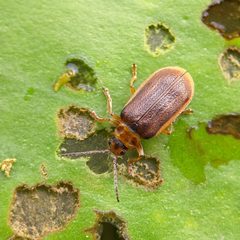
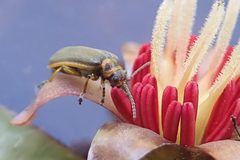
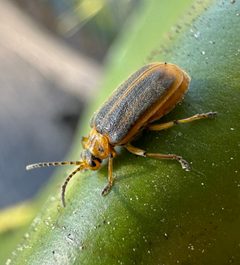
Small (3.5–4.2 mm), oval leaf beetles with convex and yellowish-brown coloration with black abdominal and thoracic markings. Larvae are distinctive with dark transverse bands on yellowish-brown body and black and legs. -level identification requires examination of genitalia and associations.
Images
Habitat
Associated with herbaceous and shrubby plants, particularly in wetland and riparian environments. Some are specialized on aquatic plants including waterlilies (Nymphaeaceae) and purple loosestrife (Lythraceae).
Distribution
Widely distributed across the Palearctic, Nearctic, and Oriental regions; absent from the Neotropics. Specific distribution records include Denmark, Norway, Sweden, and Vermont, USA.
Seasonality
emerge from in late April at temperatures of 13–14°C. laying occurs over 30–45 days beginning during bud extension. One per year; beetles overwinter under plant remains.
Diet
Herbivorous; feeds on leaves of plants. skeletonize leaves and create sinuous holes, occasionally damaging petioles, inflorescences, and flowers. Larvae skeletonize leaves.
Host Associations
- Lythrum salicaria - herbivorepurple loosestrife; major target
- Nymphaeaceae - herbivorewaterlilies; some used for biocontrol of waterlilies
- Fragaria - herbivorestrawberry plants; G. tenella and G. grisescens
- Rosaceae - herbivorevarious herbaceous and shrubby members including Geum and Filipendula
- Trapa natans - herbivorewater chestnut; target for G. birmanica
Life Cycle
Holometabolous with one per year. laid singly or in pairs (1–2 per day) in gnawed holes on leaf undersides; total 150–200 eggs per female. Embryonic development 12–20 days. Larval period 25–30 days, followed by in surface soil near plants. Pupal period 8–12 days. feed briefly before entering winter under plant debris.
Behavior
overwinter under plant remains and emerge in spring when temperatures reach 13–14°C. Females oviposit in feeding damage sites on leaf undersides. Both adults and larvae skeletonize leaves. occurs in soil near plants.
Ecological Role
Herbivore; some function as agents with documented large effects on biodiversity in invaded . are tightly coupled with plant distribution at small spatial .
Human Relevance
Several are used or proposed as agents for plants: G. calmariensis and G. pusilla against purple loosestrife in North America; other species against invasive waterlilies and water chestnut. G. tenella and G. grisescens are crop pests on strawberry. Subject of extensive genomic and evolutionary research.
Similar Taxa
- NeogalerucellaSometimes treated as a separate but currently classified as a subgenus of Galerucella; distinction based on subtle morphological characters
- Other GalerucinaeSimilar leaf beetle distinguished by body shape, coloration, and associations; Galerucella often associated with specific wetland host plants
More Details
Genomic Resources
assemblies available for three : G. calmariensis (588 Mb, 33,794 genes), G. pusilla (460 Mb, 30,302 genes), and G. tenella (intermediate size, 31,588 genes). Assemblies contain 29,202–40,929 scaffolds with N50 values of 31–80 kb.
Blue Light Sensitivity
G. grisescens and pupae are lethally sensitive to blue light irradiation (407–465 nm), with 50–90% mortality depending on wavelength and life stage, suggesting potential for novel pest management approaches.
Subgeneric Classification
Two subgenera recognized: Galerucella (sensu stricto) and Neogalerucella (Chûjô, 1962); the latter sometimes treated as a separate .
Sources and further reading
- BugGuide
- Wikipedia
- GBIF taxonomy match
- iNaturalist taxon
- NCBI Taxonomy
- Distribution and Food Source Analysis of Galerucella nipponensis Laboissiere
- Genome assemblies of three closely related leaf beetle species ( Galerucella spp)
- Host plants forGalerucella grisescensis determined from flavonoids in the leaves
- Growth and Phenology of Three Lythraceae Species in Relation to Feeding by Galerucella calmariensis and Galerucella pusilla: Predicting Ecological Host Range from Laboratory Host Range Testing
- Lethal effect of blue light on strawberry leaf beetle, Galerucella grisescens (Coleoptera: Chrysomelidae)
- Small-scale distributional dynamics of the yellow water-lily and its herbivore Galerucella nymphaeae (Coleoptera: Chrysomelidae)
- Host Plant Phylogeny Does Not Fully Explain Host Choice and Feeding Preferences of Galerucella Birmanica, a Promising Biological Control Herbivore of Trapa Natans