
Diorhabda
Weise, 1883
tamarisk beetle, saltcedar leaf beetle
Species Guides
2- Diorhabda carinulata(Northern Tamarisk Beetle)
- Diorhabda sublineata(Subtropical Tamarisk Beetle)
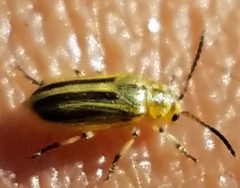
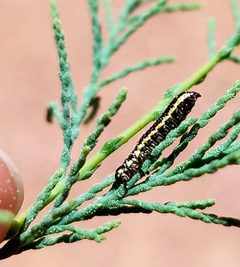
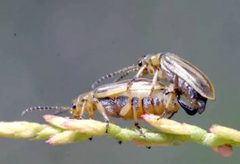
Diorhabda is a of leaf beetles in the Chrysomelidae, Galerucinae. Most within the genus feed on Tamarix (tamarisk or saltcedar), though at least one species, D. tarsalis, is a pest of Chinese licorice (Glycyrrhiza uralensis). The genus is native to Europe and Asia, with several species introduced to North America as agents for Tamarix. The D. elongata species group comprises five specialized on Tamarix: D. elongata, D. carinata, D. sublineata, D. carinulata, and D. meridionalis.
Pronunciation
How to pronounce Diorhabda: //ˌdaɪ.oʊˈræb.də//
These audio files are automatically generated. While they are not always 100% accurate, they are a good starting point.
Identification
within the D. elongata group require dissection and examination of genitalia for reliable identification, including male endophallic and female vaginal palpi and internal sternite VIII. Illustrated keys are available for this species group. External alone is insufficient to distinguish .
Images
Habitat
varies by . Diorhabda elongata favors Mediterranean and temperate forests from Italy to western Turkey. D. carinata inhabits warm temperate grasslands, deserts, and forests from southern Ukraine to Iraq and western China. D. sublineata occupies Mediterranean woodlands from France to North Africa and subtropical deserts east to Iraq. D. carinulata primarily inhabits cold temperate deserts of Mongolia and China west to Russia, extending to montane grasslands and warm deserts in southern Iran. D. meridionalis occupies maritime subtropical deserts of southern Pakistan and Iran to Syria. D. tarsalis has been collected from Chinese licorice fields in Ningxia Hui Autonomous Region, China.
Distribution
Native to the Palearctic region (Europe and Asia). The D. elongata group is primarily Palearctic with distributions ranging from the Mediterranean basin through Central Asia to China. Several species have been intentionally introduced to North America (United States and Mexico) for of Tamarix. D. tarsalis is known from Yinchuan city, Ningxia Hui Autonomous Region, China.
Diet
Most feed on Tamarix (tamarisk or saltcedar) foliage during both and larval stages. Diorhabda tarsalis feeds exclusively on Chinese licorice (Glycyrrhiza uralensis) leaves.
Host Associations
- Tamarix - primary for most in
- Glycyrrhiza uralensis - exclusive D. tarsalis only
Life Cycle
Complete with , larval (three instars), pupal, and stages. Development rates, survival, and are temperature-dependent. Eggs are laid on plants; larvae feed on foliage before pupating. Duration of life stages varies with temperature and .
Behavior
location, oviposition site selection, self-defense, and are regulated by plant volatiles and/or insect . In D. tarsalis, olfactory reception of host volatiles (hexanal, Z-3-hexenal, Z-3-hexenol) is mediated by odorant receptors including the coreceptor Orco; interference with orco expression eliminates host location ability. and larvae are active leaf feeders.
Ecological Role
As agents, several reduce Tamarix through defoliation, potentially affecting riparian structure. D. tarsalis is an agricultural pest causing economic losses to Chinese licorice . The serves as prey for including Zelus tetracanthus.
Human Relevance
Several (particularly D. carinulata, D. elongata, D. sublineata) have been introduced to North America as agents against Tamarix, which threatens waterways and riparian in the western United States. D. carinulata was rejected for introduction in South Africa due to insufficient specificity. D. tarsalis is a pest of medicinal crop Chinese licorice. Hybridization between introduced species has been documented, with variable effects on host specificity that may impact non-target risk assessment.
Similar Taxa
- Trabutina manniparamealybug also introduced for Tamarix , but belongs to Pseudococcidae (Hemiptera) rather than Chrysomelidae
More Details
Species diversity
The contains at least 18 described . The D. elongata species group was revised to include five with distinct geographic ranges and climatic preferences.
Hybridization
Experimental hybridization between D. carinulata, D. elongata, and D. sublineata produced variable effects on life-history traits and specificity across different crosses, with some hybrids showing altered preference for non-target host Tamarix aphylla (athel).
Post-release evolution
Field of D. elongata in California showed increased plant acceptability of Tamarix parviflora compared to source lab colonies, suggesting post-release .
Marking methods
Protein immunolabeling (rabbit or chicken IgG) has been successfully applied to all life stages of D. carinulata for and studies, with IgG transfer from to larva documented.
Sources and further reading
- BugGuide
- Wikipedia
- GBIF taxonomy match
- iNaturalist taxon
- NCBI Taxonomy
- Good Bug, Bad Weed | Bug Squad
- Bug Eric: Wasp Wednesday: Wasp City
- Hybridization affects life-history traits and host specificity in Diorhabda spp.
- Life History Characteristics ofDiorhabda CarinulataUnder Various Temperatures
- Interference with orco gene expression affects host recognition in Diorhabda tarsalis
- Retention of immunolabels by Diorhabda carinulata, a biological control agent of saltcedar
- Hybridization affects life-history traits and host specificity in Diorhabda spp
- Distribution of the subtropical tamarisk beetle,Diorhabda sublineata(Lucas, 1849) (Coleoptera: Chrysomelidae), in Mexico
- Host specificity of different populations of the leaf beetle Diorhabda elongata (Coleoptera: Chrysomelidae), a biological control agent of saltcedar (Tamarix spp.)
- Laboratory and field evidence of post-release changes to the ecological host range of Diorhabda elongata: Has this improved biological control efficacy?
- Host preference between saltcedar (Tamarix spp.) and native non-target Frankenia spp. within the Diorhabda elongata species complex (Coleoptera: Chrysomelidae)
- A successful biocontrol agent in the USA, Diorhabda carinulata (Coleoptera: Chrysomelidae) on Tamarix spp. (Tamaricaceae), rejected in South Africa due to insufficient host specificity
- Development and Life History of Zelus tetracanthus Stål1: A Potential Predator of Diorhabda spp.2 in Tamarix spp. L.3
- Taxonomic revision and biogeography of the Tamarix-feeding Diorhabda elongata (Brullé, 1832) species group (Coleoptera: Chrysomelidae: Galerucinae: Galerucini) and analysis of their potential in biological control of Tamarisk
- Selectivity of a biological control agent, Diorhabda carinulata Desbrochers, 1870 (Coleoptera: Chrysomelidae) for host species within the genus Tamarix Linneaus, 1753
- A satellite model of Southwestern Willow Flycatcher (<em>Empidonax traillii extimus</em>) breeding habitat and a simulation of potential effects of tamarisk leaf beetles (<em>Diorhabda</em> spp.), southwestern United States
- Components and composition of active volatiles attract on Diorhabda tarsalis (Coleoptera: Chrysomelidae) from Glycyrrhiza uralensis (Rosales: Leguminoseae)