
Diorhabda sublineata
(Lucas, 1849)
Subtropical Tamarisk Beetle, Saltcedar Beetle, Saltcedar Leaf Beetle, Tamarisk Leaf Beetle
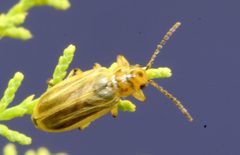
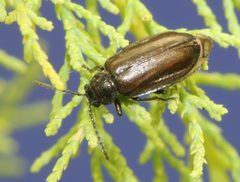
Diorhabda sublineata is a leaf beetle in the Chrysomelidae, commonly known as the subtropical tamarisk beetle. Originally described from Algeria in 1849, it was restored to full status in 2009 after being treated as a or synonym of D. elongata for over a century. It is a feeder on tamarisk (Tamarix spp.) and has been introduced to North America as a agent against saltcedar. The species is particularly adapted to subtropical and Mediterranean climates.

Pronunciation
How to pronounce Diorhabda sublineata: /d̪i.oʊˈɹæbdə sʌbˌlɪniˈeɪtə/
These audio files are automatically generated. While they are not always 100% accurate, they are a good starting point.
Identification
Diorhabda sublineata can be distinguished from its four in the D. elongata group (D. elongata, D. carinata, D. carinulata, and D. meridionalis) by examination of male and female genitalia. Key diagnostic features include male endophallic and female vaginal palpi and internal sternite VIII. Tracy and Robbins (2009) provided illustrated taxonomic keys for separation of these species. Prior to 2009, D. sublineata was frequently misidentified as D. elongata or treated as a color variant.
Images
Habitat
Mediterranean woodlands and subtropical interior desert . In its native range, it occurs from France and Spain through North Africa to the Middle East. In North America, it has established in riparian corridors and floodplain areas where tamarisk grows, particularly along the Rio Grande in Texas and in northern Mexico.
Distribution
Native: Portugal, Spain, France, Morocco, Senegal, Algeria, Tunisia, Egypt, Yemen, and Iraq. Introduced and established: United States (Texas, particularly along the Rio Grande; other southwestern states), Mexico (multiple northern Mexican states). Source for North American introductions originated from Tunisia (approximately 34-35°N latitude).
Seasonality
become active in early spring when tamarisk leaves begin . Multiple occur through spring and fall—up to five generations annually in central Texas. Adults enter in late summer and early fall, ceasing and feeding to build fat reserves before . Daylength sensitivity triggers diapause induction.
Diet
feeder on tamarisk (Tamarix spp.). Field collections confirm feeding on at least five tamarisk including Tamarix gallica. Laboratory studies verify feeding restricted to Tamaricaceae; will complete development on Frankenia shrubs (Caryophyllales) in laboratory and field cage conditions but strongly prefers tamarisk for oviposition.
Host Associations
- Tamarix gallica - primary Hybridizes with T. ramosissima in western North America
- Tamarix ramosissima - primary target in North America
- Tamarix aphylla - non-target Athel tamarisk; used for shade in Presidio, Texas area; also defoliated by STB
- Frankenia - laboratory Distant relative in Caryophyllales; supports development but not preferred for oviposition
Life Cycle
Overwinters as on the ground. laid on tamarisk leaves and bark hatch in approximately one week in warm conditions. Three larval stages feed on tamarisk foliage for about 2.5 weeks, then crawl to ground and spend approximately 5 days as inactive C-shaped before pupating for about one week. Adults emerge to complete cycle in 4–5 weeks during summer. Up to five per year in favorable conditions (central Texas).
Behavior
Males emit a putative that attracts both males and females to specific tamarisk trees. and larvae are sensitive to decreasing daylength as summer progresses, which induces preparation. Adults cease feeding and in late summer to early fall, building before seeking protected sites.
Ecological Role
agent for tamarisk in North American arid and semi-arid . Defoliation can reduce tamarisk by 75–85% over multiple years, though rarely kills trees from single defoliation events. Repeated defoliation depletes root crown reserves, causing severe dieback and eventual tree death. Suppression of tamarisk reduces competition with native riparian flora including willows, cottonwoods, honey mesquite, wolfberry, saltbush, baccharis, and grasses.
Human Relevance
Intentionally introduced to North America for of saltcedar/tamarisk, an shrub threatening riparian and water resources. First releases in Texas occurred in 2005 (failed) and 2009 (successful establishment confirmed 2010). By August 2010, had defoliated approximately 23 miles of tamarisk along the Rio Grande near Presidio, Texas. Concerns exist regarding non-target impacts on athel tamarisk (T. aphylla) used for shade, and potential effects on nesting of the federally endangered southwestern willow flycatcher (Empidonax traillii extimus), which nests in tamarisk. Releases in southern California, Arizona, and western New Mexico currently delayed pending resolution of these safety concerns.
Similar Taxa
- Diorhabda elongataMediterranean tamarisk beetle; historically confused with D. sublineata which was treated as a synonym or until 2009; distinguished by genitalia ; better adapted to Mediterranean woodlands of northern California than subtropical deserts
- Diorhabda carinulataNorthern tamarisk beetle; better adapted to northern cold deserts and widely established in Great Basin; distinguished by genitalia and body form
- Diorhabda carinataLarger tamarisk beetle; better adapted to warm temperate grasslands and deserts; northern climatypes may suit central U.S. grasslands
- Diorhabda meridionalisPrimarily occupies maritime subtropical deserts of southern Pakistan, Iran, and Syria; may also suit southwestern U.S. areas
Misconceptions
Prior to 2009 taxonomic revision, D. sublineata was widely misidentified as D. elongata or treated merely as a or color variant, leading to confusion in literature and release records. The name 'saltcedar ' or 'tamarisk beetle' has been applied loosely to all five , obscuring important climatic and preferences that affect establishment success.
More Details
Taxonomic History
First described as Galeruca sublineata by Hippolyte Lucas in 1849 from Annaba, Algeria. Reiche and Saulcy (1858) erroneously synonymized it under G. elongata. Weise (1893) created Diorhabda and treated it as a variety. Gressitt and Kimoto (1963) proposed status. Tracy and Robbins (2009) restored full status based on genitalia comparisons.
Biocontrol Establishment
Initial 2005 releases from Sfax, Tunisia (~35°N) in south Texas failed to establish. Successful establishment followed 2009 releases from Marith, Tunisia (~34°N) in south and west Texas, with confirmed defoliation by fall 2009 and widespread impact by 2010.
Non-target Concerns
Defoliation of athel tamarisk (Tamarix aphylla), a non-target valued for shade in Texas-Mexico border , has generated local concern. Potential impacts on southwestern willow flycatcher nesting remain unresolved, delaying releases in some areas.
Sources and further reading
- BugGuide
- Wikipedia
- GBIF taxonomy match
- iNaturalist taxon
- NCBI Taxonomy
- Good Bug, Bad Weed | Bug Squad
- Meloidae Holdings | Entomology Research Museum
- Bug Eric: Wasp Wednesday: Wasp City
- Distribution of the subtropical tamarisk beetle,Diorhabda sublineata(Lucas, 1849) (Coleoptera: Chrysomelidae), in Mexico
- Taxonomic revision and biogeography of the Tamarix-feeding Diorhabda elongata (Brullé, 1832) species group (Coleoptera: Chrysomelidae: Galerucinae: Galerucini) and analysis of their potential in biological control of Tamarisk