
Diorhabda carinulata
Desbrochers, 1869
Northern Tamarisk Beetle, Saltcedar Beetle, Saltcedar Leaf Beetle, Tamarisk Leaf Beetle
Diorhabda carinulata is a leaf beetle native to Central Asia, introduced to North America as a agent for saltcedar (Tamarix spp.). and larvae feed exclusively on Tamarix foliage, causing defoliation that can reduce tamarisk by 75–85% over multiple years. The has established successfully in the western United States, with evolving shorter critical day lengths for induction that enable range expansion. Its introduction has generated conservation concerns due to impacts on nesting for the federally endangered southwestern willow flycatcher.
Pronunciation
How to pronounce Diorhabda carinulata: //daɪ.ɔːˈræb.də ˌkæ.rɪˈnjuː.lə.tə//
These audio files are automatically generated. While they are not always 100% accurate, they are a good starting point.
Identification
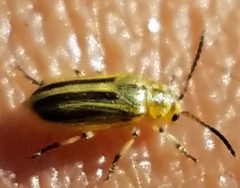
Distinguished from in the D. elongata group by detailed of the male genital ; external morphology alone is insufficient for reliable identification. are small leaf beetles typical of Chrysomelidae. Larvae have four instars and feed openly on foliage. Distinguished in the field from other tamarisk beetles primarily by geographic origin and release location rather than visible traits.
Images
Habitat
Riparian corridors, floodplains, and moist pastures where tamarisk occurs; overwinters as in leaf litter and soil beneath tamarisk . In native range, occupies arid and semiarid regions from southern Russia and Iran to Mongolia and western China.
Distribution
Native: southern Russia, Iran, Kazakhstan, Mongolia, western China. Introduced and established: western United States including Nevada, Utah, Colorado, Wyoming, and parts of California. Native range sourced from Fukang, China (44°N) and Chilik, Kazakhstan were used for North American introduction in 2001.
Seasonality
Multivoltine with two to four per year in Central Asia; in northern introduced range. emerge from in early spring when tamarisk leaves bud. Reproductive activity continues through summer; F2 adults enter reproductive diapause in late summer to early fall as day lengths shorten. Critical day length for diapause induction has evolved to shorter durations in northern , extending the reproductive season by up to 16 days.
Diet
feeder on Tamaricaceae. In nature, feeds on at least 14 of Tamarix and the related Myricaria. In North America, prefers T. ramosissima over T. parviflora. All life stages feed by rasping and scraping leaves and photosynthetic stems. Will feed on Frankenia shrubs (Caryophyllales) in laboratory and cage studies but does not significantly attack them in field conditions.
Host Associations
- Tamarix ramosissima - preferred In North America field and laboratory studies
- Tamarix parviflora - Less preferred than T. ramosissima
- Myricaria - native Native range only
- Frankenia - laboratory onlyNot attacked in field conditions
Life Cycle
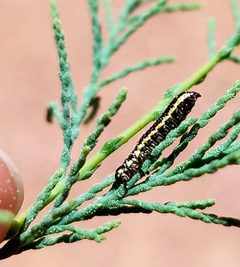
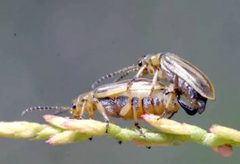
Overwinters as in leaf litter beneath plants. Adults become active in early spring and begin feeding and mating within 4–7 days. laid on leaves hatch in approximately one week at warm temperatures. Larvae progress through three stages (four instars total) feeding on tamarisk foliage for about 2.5 weeks, then drop to ground to form C-shaped for ~5 days before pupating for ~1 week. Complete time ~4–5 weeks in summer. Temperature-dependent development: ~17 days at 35°C to ~70 days at 20°C. occurs in soil or sheltered locations in leaf litter.
Behavior
are highly mobile while reproductive, dispersing up to 25 km per year; ceases upon entering . Males produce (2E,4Z-2,4-heptadien-1-ol) that attracts both sexes equally to specific tamarisk trees. Feeding induces plant volatiles that further attract conspecifics, creating positive feedback for aggregation. Adults and larvae are sensitive to shortening day lengths that induce diapause preparation, including accumulation and seeking protected sites.
Ecological Role
agent for Tamarix spp. Herbivory causes foliar desiccation, defoliation, reduced nonstructural reserves in root crowns, impaired leaf production, reduced root mass, and eventual tree mortality after repeated defoliation. Suppresses tamarisk by 75–85% at equilibrium. Facilitates recovery of native riparian vegetation including willows, cottonwoods, and grasses. However, defoliation temporarily reduces nesting for riparian woodland birds until native flora recovers.
Human Relevance
Introduced intentionally for of saltcedar in North America. Considered the most successful tamarisk biocontrol agent to date, having defoliated tens of thousands of acres in Nevada, Utah, Colorado, and Wyoming. Release programs discontinued in 13 northwestern states by USDA APHIS in 2010 due to concerns for southwestern willow flycatcher (Empidonax traillii extimus) conservation; state programs continue in Colorado. Rejected for introduction in South Africa due to insufficient specificity. Field deployment of enhances control efficacy by concentrating feeding.
Similar Taxa
- Diorhabda elongata in D. elongata group; historically confused with D. carinulata which was synonymized under D. elongata until 1973; Mediterranean origin, released in northern California and West Texas where D. carinulata is poorly adapted
- Diorhabda carinata; larger body size; released in parts of West Texas
- Diorhabda sublineata; subtropical distribution; released in parts of West Texas
- Diorhabda meridionalis; distinguished by male genital
Misconceptions
Frequently misidentified as D. elongata in literature prior to 2009; earlier North American biocontrol literature often refers to China/Kazakhstan beetles as D. elongata or D. elongata deserticola. The 'saltcedar beetle' or 'tamarisk leaf beetle' is applied to multiple Diorhabda , causing confusion about which species is present at a given location.
Sources and further reading
- BugGuide
- Wikipedia
- GBIF taxonomy match
- iNaturalist taxon
- NCBI Taxonomy
- Good Bug, Bad Weed | Bug Squad
- Bug Eric: Wasp Wednesday: Wasp City
- Bug Eric: June 2012
- Life History Characteristics ofDiorhabda CarinulataUnder Various Temperatures
- Retention of immunolabels by Diorhabda carinulata, a biological control agent of saltcedar
- Semiochemicals to enhance herbivory by Diorhabda carinulata aggregations in saltcedar ( Tamarix spp.) infestations
- A successful biocontrol agent in the USA, Diorhabda carinulata (Coleoptera: Chrysomelidae) on Tamarix spp. (Tamaricaceae), rejected in South Africa due to insufficient host specificity
- Selectivity of a biological control agent, Diorhabda carinulata Desbrochers, 1870 (Coleoptera: Chrysomelidae) for host species within the genus Tamarix Linneaus, 1753
- Increased soil salinity has no effect on the host preference and suitability of the Tamarix biological control agent, Diorhabda carinulata
- Evolution of critical day length for diapause induction enables range expansion of Diorhabda carinulata, a biological control agent against tamarisk (Tamarix spp.)
- Release, establishment and realised geographic distribution ofDiorhabda carinulataandD. elongata(Coleoptera: Chrysomelidae) in California, U.S.A.
- An Herbivore-Induced Plant Volatile From Saltcedar (Tamarix spp.) Is Repellent to Diorhabda carinulata (Coleoptera: Chrysomelidae)