
Profenusa thomsoni
(Konow, 1886)
amber-marked birch leaf miner, amber-marked birch leaf-miner sawfly
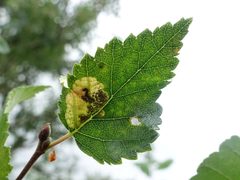
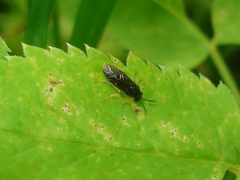
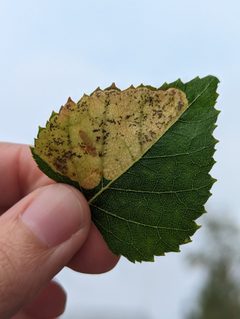
Profenusa thomsoni is a small native to the that has become in North America. are black, approximately 3 mm long, and fly-like in appearance. The is notable for its all-female parthenogenetic and for creating distinctive blotch-shaped leaf mines in birch foliage. Larval feeding damage can cause significant defoliation, though in parts of North America have declined due to pressure.
Pronunciation
How to pronounce Profenusa thomsoni: /proʊˈfinjʊsə ˈtɔmsəni/
These audio files are automatically generated. While they are not always 100% accurate, they are a good starting point.
Identification
Distinguished from the similar Fenusa pumila by mine shape and leaf age: P. thomsoni creates blotch-shaped mines in mature birch leaves that remain undistorted, whereas F. pumila mines young, expanding leaves causing crinkling of the leaf blade. The larva's dark markings on the first thoracic segment and paired black spots on the second and third segments are diagnostic. are small, black, and fly-like, requiring close examination for identification.
Images
Habitat
Associated with birch trees (Betula spp.) and other members of Betulaceae. Larvae develop within leaf blades, typically with laid near the midrib of mature leaves. found in vicinity of trees. occurs in soil chambers.
Distribution
Native to the (Europe and Asia). Introduced to North America in the early twentieth century, becoming . Documented in Canada: Alberta, British Columbia; United States: Alaska. Present in Belgium.
Seasonality
emerge in July and August. Single per year. Larvae active during growing season; overwinter as in soil chambers.
Diet
Larvae feed on mesophyll tissue inside birch (Betula) leaves, creating blotch-shaped mines. do not feed on plant material.
Host Associations
- Betula - larval primary
- Betulaceae - larval -level association
- Lathrolestes luteolator - ichneumonid ; attacks late-stage larvae, develops in
Life Cycle
Six instars. laid inside mature leaf, usually near midrib. Larva hollows out blotch-shaped cavity in mesophyll. Final instar emerges through leaf underside, falls to ground, and forms chamber in soil. Overwinters as . Single per year. emerge July–August.
Behavior
Larvae are leaf miners, feeding internally within leaf tissue. Final instar larvae exit leaves and drop to ground to pupate. is entirely parthenogenetic; no males are produced.
Ecological Role
Herbivore and on birch. Can cause extensive defoliation during . Serves as for , including Lathrolestes luteolator, which has contributed to in parts of North America.
Human Relevance
Pest of ornamental and forest birch trees. in North America where it has caused significant defoliation. Subject of research. declined dramatically in Alberta in the early 1990s following establishment, providing a case study in .
Similar Taxa
- Fenusa pumilaAlso mines birch leaves, but infests young expanding leaves causing crinkling, versus P. thomsoni mining mature leaves with undistorted blotch mines.