
Isodontia exornata
Fernald, 1903
grass-carrier wasp
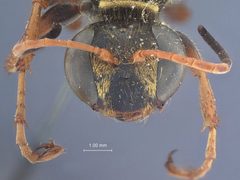
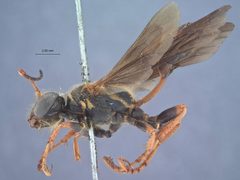
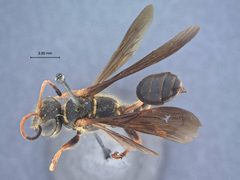
Isodontia exornata is a solitary thread-waisted wasp in the Sphecidae, commonly known as a grass-carrier wasp. Females construct nests using dry grass in pre-existing cavities such as window tracks, hollow stems, or abandoned insect tunnels. They provision each nest with paralyzed tree crickets or katydids as food for their larvae. The is part of the Isodontia, which includes several North American species that have adapted to suburban environments by utilizing human-made structures for nesting.
Pronunciation
How to pronounce Isodontia exornata: //ˌaɪsoʊˈdɒntiə ɛksɔːrˈneɪtə//
These audio files are automatically generated. While they are not always 100% accurate, they are a good starting point.
Identification
Specific diagnostic features for distinguishing Isodontia exornata from such as I. mexicana, I. elegans, I. auripes, and I. harmandi are not documented in available sources. The Isodontia is characterized by a thread-waisted body form and the distinctive of using dry grass to construct and partition nest . typically rest with wings splayed outward rather than folded flat over the , a trait that separates them from many other sphecid .
Images
Habitat
Nests in pre-existing tubular cavities including hollow plant stems, abandoned borings, and—frequently in suburban settings—the tracks of sliding windows. The has been observed to favor dry, protected spaces that can be filled with grass material and provisioned with prey.
Distribution
Recorded from North America; specific regional distribution within this range is not documented in available sources.
Diet
feed on nectar from flowers including sweetclover, sumac, and grape, and have been observed feeding on honeydew secreted by aphids. Larvae consume paralyzed orthopteran prey—primarily tree crickets and small katydids—provided by the female parent.
Life Cycle
Females construct a linear series of within a tubular cavity, provisioning each cell with multiple paralyzed prey items before laying a single . Cells are separated by partitions of dry grass. The larva consumes the fresh prey, then pupates within the cell. Development from egg to likely spans one season in northern climates, with adults emerging the following summer.
Behavior
Solitary nesting; each female constructs and provisions her own nest without cooperation from conspecifics. Non-aggressive toward humans; stinging only occurs if a female is physically restrained. Males lack stingers entirely. The exhibits a distinctive nesting of plugging nest entrances with dry grass, creating a broom-like appearance.
Ecological Role
of tree crickets and katydids; contributes to regulation of orthopteran . Serves as for flies ( Sarcophagidae, satellite flies) and potentially other parasitic . function as through nectar-feeding and may facilitate nutrient cycling through honeydew consumption.
Human Relevance
Frequently encountered by homeowners when nests are built in window tracks, causing concern due to the presence of larvae and accumulated grass and insect remains. The is not a structural pest and does not damage property. Educational value in demonstrating solitary and natural history; can be encouraged to nest in alternative sites such as boxes or bundled bamboo to divert activity from windows.
Similar Taxa
- Isodontia mexicanaShares the grass-carrier nesting and general ; I. mexicana is very common in the eastern United States and is the most frequently documented in window-track nesting studies, whereas I. exornata is less commonly encountered.
- Isodontia elegansAlso a grass-carrier wasp with similar ; I. elegans is documented from western North America including Washington state, with distributional overlap possible in some regions.
- Isodontia harmandiAsian (Japan, Korea) with similar communal in grass-lined nests; distinguished by geographic range and documented larval behavior not reported for North American .
More Details
Taxonomic Note
Isodontia exornata was described by Fernald in 1903. The Isodontia is currently placed in Sphecidae, though higher-level classification of thread-waisted wasps has undergone revision and some authorities recognize different family boundaries.
Nesting Adaptation
Like other Isodontia , I. exornata has shown capacity to exploit anthropogenic . Window tracks may offer advantages over natural cavities: greater space, reduced pressure, and abundant dry grass from lawn maintenance.