
Dipogon
spider wasps
Species Guides
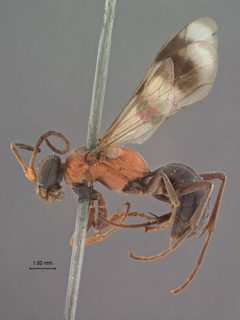
8Dipogon is a of small spider wasps (Pompilidae) characterized by -mimicking dark-banded wings and a distinctive 'beard' of hairs on the maxillary palps used to transport nesting materials. These solitary are primarily forest-dwelling, hunting spiders on tree trunks and constructing multi-celled nests in pre-existing tubular cavities such as tunnels or hollow plant stems. The genus exhibits notable behavioral plasticity in nest construction, using mud, leaf fragments, insect parts, and even stolen provisions to form partitions.
Pronunciation
How to pronounce Dipogon: /ˈdɪp.oʊˌɡɒn/
These audio files are automatically generated. While they are not always 100% accurate, they are a good starting point.
Identification
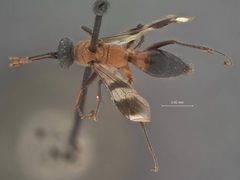
Dark-banded wings creating -like appearance; small size with forewing length typically 5–7.4 mm; reddish front legs in some (e.g., D. calipterus). The hairy maxillary palps ('beard') are diagnostic for the but rarely visible on live specimens. Wing banding pattern and wooded association help distinguish Dipogon from similar pompilid genera.
Images
Habitat
Forest edges and wooded areas; primarily associated with tree trunks and woody vegetation. Nests in pre-existing tubular cavities including abandoned tunnels, soft pith of dead or broken stems (e.g., sumac), and artificial trap-nests. Some occupy pine forests in Japan, while North American species frequent deciduous forest margins.
Distribution
Holarctic distribution with records from North America (eastern and western United States, Canada), Japan (Hokkaido to Kyushu), Russian Far East, Eastern Siberia, and Laos. North American include D. calipterus (Massachusetts to North Carolina, Indiana, Illinois, Georgia, Florida, southern California to Panama), D. sayi (Wisconsin, Maine), and D. variegatus.
Seasonality
Nesting activity from mid-June/early July to mid-September/early October in temperate regions. Partial bivoltinism observed: summer develops in ~21–23 days, generation requires ~8 months with extended . in early August determines generation fate in some .
Diet
Spiders paralyzed or killed and used to provision larval . Prey records include crab spiders (Thomisidae, especially Xysticus), jumping spiders (Salticidae), ground spiders (Gnaphosidae), funnel-web spiders (Agelenidae: Agelena limbata), and hacklemesh weavers (Amaurobiidae: Amaurobius). Females occasionally kill prey for self-feeding rather than offspring provisioning.
Host Associations
- Thomisidae - preyespecially Xysticus
- Salticidae - preyjumping spiders
- Gnaphosidae - preyground spiders
- Agelena limbata - preyfunnel-web spider; confirmed for D. sperconsus
- Amaurobius - preyhacklemesh weaver; recorded for D. calipterus calipterus
Life Cycle
Solitary nesting with females constructing 1–10 per nest ( ~2–3). Each cell contains one paralyzed spider and a single laid on the spider's . Linear nest cavities divided by partitions of mud, sand, leaf fragments, insect parts, or caterpillar . Development: egg (~2 days), larva (~4–5 days), /pupa (~15–16 days for summer ; ~8 months with for generation).
Behavior
Females hunt spiders on tree trunks, capturing prey and transporting it by grasping and sideways or backwards. Males perch on leaves to defend territories and seek females. Both sexes groom and rest on sunlit foliage. Nest construction involves unique use of maxillary palp 'beard' to carry particulate materials; partitions packed with tip. D. variegatus has been observed stealing pollen-nectar provisions from Osmia cornuta nests as novel nesting material.
Ecological Role
of spiders in forest ; contributes to spider . component of trap-nest in Japanese pine forests (60% of Dipogon in some studies). Serves as indicator for insect biodiversity assessment in woody environments.
Human Relevance
Occasionally occupies artificial nest blocks provided for solitary bees. Subject of taxonomic research with new described from citizen science collections. Not known to sting humans unprovoked; too small to be considered medically significant.
Similar Taxa
- AgeniellaSimilar small pompilids with banded wings; distinguished by Dipogon's antennal structure and maxillary palp
- CeropalesCleptoparasitic pompilids that may exploit Dipogon nests; Dipogon distinguished by nest-building and prey transport method
- PompilusLarger spider wasps with different wing venation and ground-nesting tendencies; Dipogon smaller with tree-trunk hunting
More Details
Nesting Material Plasticity
Dipogon exhibits remarkable flexibility in nest construction. While typically using mud and organic debris, D. variegatus has been documented stealing sticky pollen-nectar provisions from solitary nests (Osmia cornuta) as a novel adhesive material for nest plugs, representing behavioral innovation in response to local resource availability.
Ant Mimicry Function
Dark wing bands create visual resemblance to ants, which may reduce given that many avoid ants. This mimicry is enhanced by foraging on tree trunks where traffic is common, making Dipogon difficult to detect among background ant activity.
Taxonomic Complexity
The includes multiple subgenera (e.g., Stigmatodipogon) with limited biological data. Subgenus Stigmatodipogon, distributed in East Asia, had no published nesting or prey records prior to 2018. -level identification often requires examination of male genitalia and subtle color pattern differences.
Sources and further reading
- BugGuide
- Wikipedia
- iNaturalist taxon
- NCBI Taxonomy
- Catalogue of Life
- Bug Eric: Spider wasp, Dipogon calipterus
- Bug Eric: Another Discovery
- Revision of the subgenus Stigmatodipogon Ishikawa of the genus Dipogon Fox (Hymenoptera: Pompilidae: Pepsinae)
- Biology of Dipogon Sayi Banks (Hymenoptera, Pompilidae) in Trap-Nests in Wisconsin
- Life history and nesting ecology of a Japanese tube-nesting spider wasp Dipogon sperconsus (Hymenoptera: Pompilidae)
- Use of a novel nesting material by the spider wasp Dipogon variegatus (Hymenoptera, Pompilidae)
- Habitats and Spider Prey of <i>Dipogon Sayi Sayi</i> (Hymenoptera: Pompilidae) in Washington County, Maine