
Macrocentrinae
Genus Guides
4Macrocentrinae is a of braconid parasitic comprising eight recognized . Members are relatively large braconids characterized by small teeth on the trochantellus and often exhibit pale coloration and habits. They are solitary or gregarious koinobiont endoparasitoids of caterpillars, with documented associations primarily with pyralid larvae. Several have been deployed in programs against agricultural pests.
Pronunciation
How to pronounce Macrocentrinae: //ˌmækroʊˈsɛntrɪniː//
These audio files are automatically generated. While they are not always 100% accurate, they are a good starting point.
Identification
Distinguished from other braconid by the presence of small teeth on the trochantellus. Noncyclostome mouthpart structure separates them from cyclostome braconids. Within the subfamily, Aulacocentrum is recognized by fine transverse striation on the first metasomal tergite and strongly basally bent SC+R1 of the hind wing (except in A. glabrum).
Images
Appearance
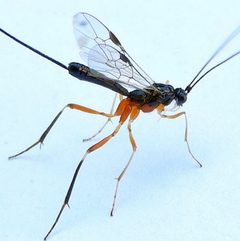
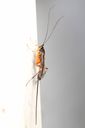
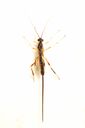
Relatively large braconid wasps with small teeth present on the trochantellus. Many exhibit pale coloration. Belong to the noncyclostome group of braconids. First metasomal tergite in some (e.g., Aulacocentrum) with fine transverse striation. Hind wing with SC+R1 strongly bent basally in most species.
Habitat
Forest including tropical deciduous forest; also recorded from dune vegetation and savannah. Specimens collected by light traps in open forest spaces and by .
Distribution
Worldwide distribution. Documented from Oriental and East Palaearctic regions including Vietnam; also recorded from the Ria Lagartos Reserve in Yucatan, Mexico.
Seasonality
Activity influenced by rainy season in tropical regions, though effects vary among vegetation . habits reported for many .
Host Associations
- Botyodes asialis - Pyralidae
- Chilo suppressalis - Crambidae; rice pest
- Cnaphalocrocis medinalis - Crambidae; rice leaf roller
- Crocidolomia pavonana - Crambidae
- Diaphania pyloalis - Crambidae
- Maruca vitrata - Crambidae; legume pest
- Palpita nigropunctalis - Crambidae
- Spoladea recurvalis - Crambidae
- Ostrinia furnacalis - Crambidae; Asian corn borer
- Pachyzancla sp. - Pyralidae
Life Cycle
Koinobiont endoparasitoid of caterpillars (Lepidoptera larvae). Development occurs within living , with from host larva or pupa. Solitary development reported for some (e.g., Aulacocentrum philippinense); gregarious development also occurs in the .
Behavior
activity reported for many . Phenological patterns vary with seasonal rainfall in tropical .
Ecological Role
agent of economically important pyralid and crambid pests, including rice leaf roller (Cnaphalocrocis medinalis) and Asian corn borer (Ostrinia furnacalis). Contributes to natural suppression of agricultural pest .
Human Relevance
Several used in programs against crop pests. Potential for in rice and other agricultural systems.
Similar Taxa
- other Braconidae subfamiliesMacrocentrinae distinguished by trochantellar teeth and noncyclostome structure; cyclostome (e.g., Braconinae, Doryctinae) have different mouthpart configuration
- AgathidinaeAlso noncyclostome braconids, but differ in associations and morphological details; Agathidinae typically parasitize Lepidoptera but with different structural features
More Details
Taxonomic scope
The contains eight recognized , including Macrocentrus and Aulacocentrum. The genus Aulacocentrum is distributed in the Old World tropics and southern East Palaearctic region.
Collection methods
Effectively collected using light traps and , reflecting activity and patterns in forest .
Sources and further reading
- BugGuide
- Wikipedia
- iNaturalist taxon
- NCBI Taxonomy
- Revisionary notes on the genus Aulacocentrum Brues (Hymenoptera, Braconidae, Macrocentrinae) from Vietnam
- Beta diversity of four braconid subfamilies (Braconidae, Agathidinae, Braconinae, Doryctinae and Macrocentrinae) of the Ria Lagartos Biosphere reserve in Yucatan, Mexico, with some considerations on biological habits