
Maruca vitrata
(Fabricius, 1787)
legume pod borer, maruca pod borer, bean pod borer, soybean pod borer, mung moth, spotted pod borer
Maruca vitrata is a pantropical and major agricultural pest of leguminous crops, particularly affecting cowpea, pigeon pea, mung bean, and soybean. Larvae feed on flower buds, flowers, and young pods, causing yield losses of 20–80% in susceptible cowpea varieties. The has low genetic differentiation across its range due to high , with in India showing evidence of recent demographic expansion. It serves as for several (Braconidae, Ichneumonidae) and flies (Tachinidae) that provide .

Pronunciation
How to pronounce Maruca vitrata: /məˈruːkə vɪˈtrɑːtə/
These audio files are automatically generated. While they are not always 100% accurate, they are a good starting point.
Identification
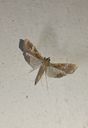
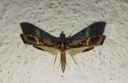
Maruca vitrata is distinguished from similar pod-boring by its association with legume crops and specific feeding damage patterns: larvae web together flower buds, flowers, and pods with silk, creating visible feeding shelters. are small to medium-sized moths with wingspan approximately 20–28 mm; forewings are brownish with distinct white or translucent patches (vitreous or glassy spots) that give the its name. Larvae are pale green to brown with dark spots and stripes, reaching 15–18 mm at maturity. Similar species in the Maruca and related crambid pod borers require genitalia dissection or molecular markers for definitive identification.
Images
Habitat
Agricultural dominated by cultivated legumes, particularly cowpea, pigeon pea, mung bean, blackgram, lablab bean, and soybean. Occurs in tropical and subtropical regions with warm climates suitable for year-round legume production. Thrives in irrigated and rainfed cropping systems where plants are available continuously or in .
Distribution
Pantropical distribution spanning Africa, Asia, Australasia and Pacific Islands, North and South America, and the Caribbean. In Africa: recorded from Angola, Benin, Cameroon, Ethiopia, Ghana, Kenya, Madagascar, Malawi, Mali, Mauritius, Mozambique, Nigeria, Senegal, Sierra Leone, Somalia, South Africa, Sudan, Tanzania, Uganda, Zambia, and Zimbabwe. In Asia: widespread from India and Bangladesh through Southeast Asia to China, Japan, Korea, and Taiwan; includes Indonesia, Philippines, Thailand, and Vietnam. In Australasia and Pacific: Australia (New South Wales, Queensland), Fiji, Hawaii, Papua New Guinea, and numerous Pacific islands. In the Americas: from Mexico and Central America through the Caribbean to South America including Brazil, Colombia, and Argentina. Present in Europe only as occasional introduction.
Seasonality
Active year-round in tropical regions where legumes are available; peaks coincide with flowering and podding stages of host crops. In India, seasonal studies show highest larval populations and pod damage during Rabi (winter) and Kharif (monsoon) cropping seasons, with activity spanning from flower bud initiation through crop maturity. Multiple occur annually with overlapping cohorts in favorable climates.
Diet
Larvae feed on tender tissues of leguminous plants: early instars consume flower peduncles and young stems, later instars feed on flower buds, flowers, and developing pods. plants include cowpea (Vigna unguiculata), pigeon pea (Cajanus cajan), mung bean/greengram (Vigna radiata), blackgram (Vigna mungo), lablab bean (Lablab purpureus), common bean (Phaseolus vulgaris), soybean (Glycine max), and lima bean (Phaseolus lunatus). Feeding inside pods destroys developing seeds; webbing protects larvae from and .
Host Associations
- cowpea - primary most economically significant ; yield losses 20–80%
- pigeon pea - primary major pest constraint in Indian production
- mung bean - primary also called greengram; significant damage in Asia
- blackgram - Vigna mungo; important in South Asia
- lablab bean - Lablab purpureus; studied in India and Africa
- common bean - Phaseolus vulgaris
- soybean - pod feeding damage reported
- lima bean - Phaseolus lunatus
Life Cycle
Complete with , larva, pupa, and stages. Eggs are laid on flowering bodies of plants, particularly on flower buds and flowers. Larval development includes five instars; early instars feed on peduncles and young stems, later instars construct silk webs to bind flowers and pods together while feeding inside. Larval period lasts 10–14 days under favorable conditions. occurs in soil or within crop debris, with pupal duration 7–10 days. Adult lifespan approximately 5–7 days. Multiple overlapping per year in tropical climates; generation time approximately 3–4 weeks at 25–30°C.
Behavior
Larvae exhibit web-building , using silk to bind flower buds, flowers, and pods into protective shelters that facilitate feeding and provide from natural enemies and chemical treatments. This concealed feeding habit makes larvae difficult to target with contact . are with peak activity during flowering periods of crops. Females preferentially oviposit on flowering structures. Continuous feeding on the same host crop across leads to genetic clustering by host plant, though high maintains low overall differentiation.
Ecological Role
Significant agricultural pest reducing yields and quality of legume crops, particularly in smallholder farming systems in Africa and Asia. Serves as for diverse complex including braconid wasps (Apanteles taragamae, Phanerotoma spp.), ichneumonids, and tachinid flies that regulate and provide services for . Susceptible to including Maruca vitrata (MaviNPV), a potential biocontrol agent. Genetic studies indicate endosymbiont in some populations.
Human Relevance
Major economic pest of legume crops causing substantial yield losses and necessitating control expenditures. approaches include (cry protein transgenic cowpeas expressing Bacillus thuringiensis toxins), using , and selective . Transgenic Bt-cowpea has been developed and deployed in some African countries, providing farmers with higher yields and reduced use. The is a target for breeding programs seeking legume varieties.
Similar Taxa
- Maruca subcinereacongeneric with similar and legume-feeding habits; requires genitalia examination for reliable separation
- Etiella zinckenella (limabean pod borer)similar legume pod-boring crambid with overlapping range; distinguished by wing pattern and larval
- Helicoverpa armigera (cotton bollworm) noctuid pest of legumes with similar pod-feeding damage; distinguished by larval coloration, presence of , and different webbing
- Amsacta albistriga (red hairy caterpillar)occasional legume pest in South Asia; distinguished by larval hairiness and gregarious
Sources and further reading
- BugGuide
- Wikipedia
- GBIF taxonomy match
- iNaturalist taxon
- NCBI Taxonomy
- Catalogue of Life
- Maruca vitrata . [Distribution map].
- Genomic and host range studies of Maruca vitrata nucleopolyhedrovirus
- Host induced genetic variation in legume pod borer, Maruca vitrata
- Biology of Pod Borer, Maruca vitrata (Geyer) Infesting Lablab Bean
- Biology and ecology of Apanteles taragamae, a larval parasitoid of the cowpea pod borer Maruca vitrata
- Parasitoid complex of legume pod borer, Maruca vitrata Fabricius (Lepidoptera: Crambidae) on different pulses
- SEASONAL INCIDENCE AND REACTION OF GREENGRAM GENOTYPES AGAINST SPOTTED POD BORER, Maruca vitrata (FABRICIUS)
- Population Genetic Differentiation and Structure of Maruca vitrata (Lepidoptera: Crambidae) in India
- Biology of legume pod borer maruca vitrata (F.) on a semisynthetic diet