
Etiella zinckenella
(Treitschke, 1832)
pulse pod borer moth, Gold-banded Etiella Moth, limabean pod borer
Etiella zinckenella is a pyralid and significant agricultural pest of leguminous crops. Native to southern and eastern Europe, it has spread throughout tropical and subtropical regions of Africa and Asia, with introduced in North America and Australia. Larvae feed internally on developing seeds within pods, causing direct damage to economically important crops including soybean, mung bean, cowpea, pigeonpea, and common bean. The is subject to substantial pressure from multiple hymenopteran .
Pronunciation
How to pronounce Etiella zinckenella: /ɛ.tiˈɛl.la zɪn.kɛˈnɛl.la/
These audio files are automatically generated. While they are not always 100% accurate, they are a good starting point.
Identification
Distinguished from Etiella hobsoni by morphological differences in genitalia and wing pattern details; E. zinckenella has more pronounced chestnut fascia on forewing. Distinguished from other Phycitinae pod borers by association and specific wing pattern combination of yellow-brown ground color with contrasting chestnut band.
Images
Appearance
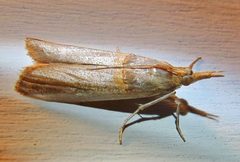
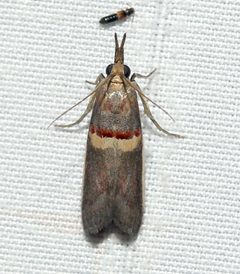
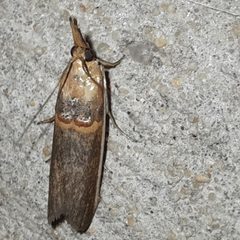
wingspan 22–26 mm. Forewings yellow-brown to brownish-grey with lighter costal stripe and yellowish-chestnut fascia at one-third. Hindwings pale grey with black venation and dark double line before fringe.
Habitat
Agricultural dominated by leguminous crops; recorded in desert steppe with Caragana spp. in China. Larval habitat restricted to developing pods of plants.
Distribution
Native to southern and eastern Europe; widespread in tropics and subtropics of Africa and Asia. Introduced to North America (USA, Canada, Mexico), Australia, New Caledonia, New Hebrides, Papua New Guinea, Western Samoa, Solomon Islands, and Irian Jaya. Present in Central and South America including Brazil, Chile, French Guiana, Galápagos Islands, Paraguay, Peru, Uruguay, and Venezuela. Documented in Greece (Drama Regional Unit) as recent expansion.
Diet
Larvae feed internally on developing seeds within pods of Fabaceae. Documented include: mung bean (Vigna radiata), lima bean (Phaseolus lunatus), common bean (Phaseolus vulgaris), pigeonpea (Cajanus cajan), cowpea (Vigna unguiculata), lablab (Lablab purpureus), soybean (Glycine max), pea (Pisum sativum), chickpea (Cicer arietinum), horse gram (Macrotyloma uniflorum), green gram, black gram, sunn hemp (Crotalaria juncea), Crotalaria micans, Crotalaria saltiana, Crotalaria pallida, grass pea (Lathyrus sativus), and lentil (Lens culinaris). Single record from Catha edulis (Celastraceae).
Host Associations
- Fabaceae - primary larval vast majority of records; internal feeder on developing seeds in pods
- Catha edulis - larval single recorded exception to legume pattern
- Heterospilus etiellae - larval in Puerto Rico (74.2% of parasitized larvae)
- Iconella etiellae - larval only recovered from soybean in Puerto Rico
- Dolichogenidea appellator - larval documented in Greece; identified via
- Bracon sp. - larval ectoparasitoidfirst record from Panama; potential agent
- Trichogramma sp. - low (3% ) in Puerto Rico
- Polistes spp. - preying on larvae
- Anolis spp. - lizard preying on larvae
- Solenopsis geminata - tested ; experiment showed no effect on E. zinckenella attack
Life Cycle
Complete . laid singly on pods, flowers, calyx, and leaves of plants; female 46–65 eggs (mean 56.3). 5.18–5.38 days (mean 5.24). Five larval instars; total larval period mean 16.9 days. Pupal period mean 13.38 days. longevity: males 4.1 days, females 5.6 days. Total 37–45 days under laboratory conditions on lentil.
Behavior
Oviposition involves selective placement of on plant structures associated with developing pods. Larvae exhibit concealed feeding behavior, tunneling into pods to consume seeds, which limits effectiveness of contact . Mating behavior documented but specific details not extracted from available sources.
Ecological Role
Herbivore: significant primary consumer of legume seeds in agricultural systems. for diverse including parasitoids (Trichogramma sp.) and larval parasitoids (multiple Braconidae ). Serves as prey for including Polistes and Anolis lizards. influenced by fragmentation in non-agricultural settings.
Human Relevance
Major agricultural pest causing significant yield and financial losses in legume crops. Damage mechanism: larval feeding on seeds within pods reduces yield directly and diminishes crop marketability. Control challenges arise from concealed larval feeding habit, rendering synthetic often ineffective. Management strategies include: deployment of crop varieties (pod skin thickness and hardness confer resistance), using (Heterospilus etiellae, Iconella etiellae, Dolichogenidea appellator, Bracon sp.), and approaches. Introduced represent established in multiple regions.
Similar Taxa
- Etiella hobsonicongeneric soybean podborer in Indonesia; distinguished by morphological differences in genitalia and wing pattern, with E. zinckenella showing more pronounced chestnut fascia
- Maruca vitrataco-occurring legume pod borer; both share and similar , distinguished by taxonomic placement in different and subtle morphological differences
More Details
Biological Control Potential
Multiple show promise for programs. Heterospilus etiellae was the most abundant larval parasitoid in Puerto Rico surveys. Iconella etiellae is notable as the only species successfully recovered from economically important soybean . Bracon sp. from Panama identified as ectoparasitoid with potential for control programs. Dolichogenidea appellator newly documented in Greece via .
Host Plant Resistance Mechanisms
Studies on common bean (Phaseolus vulgaris) demonstrate that pod skin thickness and hardness are key resistance traits. Varieties with thin, less hardened pod skins suffer higher rates and support larger larval .
Sources and further reading
- BugGuide
- Wikipedia
- GBIF taxonomy match
- iNaturalist taxon
- NCBI Taxonomy
- Catalogue of Life
- Etiella zinckenella . [Distribution map].
- Bracon sp. (Hymenoptera: Braconidae) parasitoide de Etiella Zinckenella en Panama
- Apuntes sobre los enemigos naturales de Etiella zinckenella en Puerto Rico
- Mating Behavior of the Limabean Pod Borer, Etiella zinckenella TREITSCHKE (Lepidoptera : Pyralidae)
- First Occurrence of Etiella zinckenella (Treitschke) (Lepidoptera: Pyralidae) in Greek Soybean Crops and Its Potential Parasitoid Dolichogenidea appellator (Telenga) (Hymenoptera: Braconidae)
- Host-plant factors responsible for oviposition behaviour in the limabean pod borer, Etiella zinckenella Treitschke
- Notes on the Morphology and Distribution of Etiella hobsoni (BUTLER), a New Soybean Podborer in Indonesia, with Special Reference to Comparisons with Etiella zinckenella (TREITSCHKE) : Lepidptera : Pyralidae
- PREFERENSI PENGGEREK POLONG (Etiella zinckenella Tritschke) PADA BEBERAPA VARIETAS TANAMAN BUNCIS (Phaseolus vulgaris Linnaeus)
- Notes on parasitoid assemblage reared from larvae of legume pod borers Maruca vitrata (Fabricius) and Etiella zinckenella Treitschke
- Oviposition Behavior of the Limabean Pod Borer, Etiella zinckenella TREITSCHKE (Lepidoptera : Pyralidae) on the Soybean
- Studies on Biology and Morphometrics of Etiella zinckenella (Lepidoptera) on Lentil under Laboratory Conditions
- Responses of Etiella zinckenella to habitat fragmentation of Caraganas in desert steppe in Ningxia, China
- The role of gut microbiota at different developmental stages in the adaptation of the Etiella zinckenella to a plant host.