
Etiella
Zeller, 1839
snout moths, pod borers, limabean pod borers
Species Guides
1- Etiella zinckenella(pulse pod borer moth)
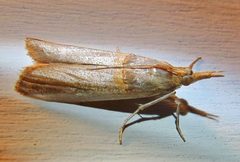
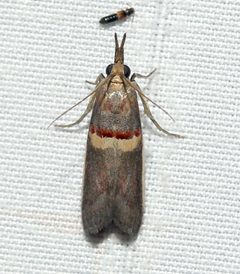
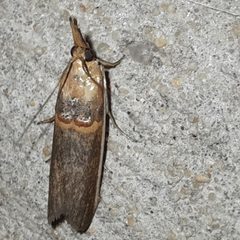
Etiella is a of snout moths (Pyralidae: Phycitinae) described by Philipp Christoph Zeller in 1839. The genus contains approximately seven described , with Etiella zinckenella being the most economically significant as a major pest of legume crops worldwide. Species in this genus are characterized by their larval habit of boring into pods of leguminous plants, causing substantial agricultural damage. The genus has a distribution spanning tropical, subtropical, and temperate regions across multiple continents.
Pronunciation
How to pronounce Etiella: /ˌɛtiˈɛlə/
These audio files are automatically generated. While they are not always 100% accurate, they are a good starting point.
Images
Habitat
Agricultural , particularly legume areas including soybean, peanut, common bean, lima bean, cowpea, pigeon pea, and lentil fields. Also recorded in desert steppe with Caragana vegetation in Ningxia, China.
Distribution
distribution across six continents. Europe: Austria, Bulgaria, Corsica, Czechoslovakia, France, Germany, Greece, Hungary, Italy, Portugal, Romania, Sicily, Spain, Yugoslavia. Asia: Bangladesh, Bhutan, Burma, Cambodia, China, Cyprus, India, Indonesia, Iran, Israel, Japan, Laos, Lebanon, Malaysia, Pakistan, Philippines, Saudi Arabia, Sri Lanka, Taiwan, Thailand, Turkey, Vietnam, USSR region. Africa: Algeria, Botswana, Canary Islands, Cape Verde, Comoro Islands, Egypt, Ethiopia, Ghana, Kenya, Madagascar, Malawi, Mali, Mauritius, Morocco, Nigeria, Príncipe, Réunion, São Tomé, Senegal, Seychelles, Sierra Leone, South Africa, Sudan, Uganda, Zaire. Oceania: Australia, New Caledonia, New Hebrides, Papua New Guinea, Western Samoa, Solomon Islands, Irian Jaya. North America: Canada, Mexico, USA. Central America and West Indies: El Salvador, Nicaragua, West Indies. South America: Brazil, Chile, French Guiana, Galápagos Islands, Paraguay, Peru, Uruguay, Venezuela. Additional records from Panama and Puerto Rico.
Diet
Larvae feed internally on developing seeds within pods of leguminous plants. Documented include: Arachis hypogaea (peanut), Glycine max (soybean), Phaseolus vulgaris (common bean), Phaseolus lunatus (lima bean), Vigna unguiculata (cowpea), Cajanus cajan (pigeon pea/guandú), Lens culinaris (lentil), Pisum sativum (pea), Crotalaria pallida, and Crotalaria juncea (sunn hemp).
Host Associations
- Arachis hypogaea - larval peanut/groundnut; major pest in Indonesia causing up to 90% yield loss
- Glycine max - larval soybean; primary for E. zinckenella and E. hobsoni in Indonesia
- Phaseolus vulgaris - larval common bean; preference for varieties with thin, less hard pod skins
- Phaseolus lunatus - larval lima bean; eponymous for 'limabean pod borer'
- Vigna unguiculata - larval cowpea
- Cajanus cajan - larval pigeon pea/guandú; significant pest in Panama
- Lens culinaris - larval lentil; laboratory studies on and morphometrics
- Pisum sativum - larval pea
- Crotalaria pallida - larval sunn hemp; used in Puerto Rico studies
- Crotalaria juncea - larval sunn hemp
- Caragana - larval desert steppe shrub in Ningxia, China
Life Cycle
Complete with five larval instars. Etiella zinckenella: incubation 5.18–5.38 days (mean 5.24 days); total larval period ~16.9 days; pupal period ~13.38 days; total egg-to- development 37–45 days. Female longevity exceeds male longevity. Females lay 46–65 eggs (mean 56.3), singly on pods, flowers, calyx, and leaves. Eggs hatch in ~5 days. Larvae bore into pods and feed internally on seeds. occurs outside pods or in soil. Adults emerge and mate, with peak mating on the second night after . Repeated mating occurs at very low frequency.
Behavior
Larvae exhibit endophagous feeding , tunneling into pods to consume seeds, which provides protection from external and . Oviposition occurs on pods, flowers, calyx, and leaves. Calling and mating behaviors show temporal patterns with peak activity on the second night after . Interspecific mating does not occur between sympatric (E. zinckenella and E. hobsoni). Virgin females attract males to wing traps. Adults are . Larvae crush pods during feeding, causing characteristic blackened pods and rotten seeds.
Ecological Role
Agricultural pest causing significant yield losses; E. zinckenella can reduce peanut yields by up to 90% and causes substantial damage to soybean, bean, and lentil crops. Serves as for multiple including Hymenoptera (Braconidae: Heterospilus etiellae, Iconella etiellae, Dolichogenidea appellator, Bracon sp.; Ichneumonidae; Chalcidoidea: Trichogramma bactrae-bactrae, Trichogramma sp.). Natural enemy complex includes (Araneida, Coleoptera, Polistes , Anolis lizards) and parasitoids (Hymenoptera, Diptera). Mean larval rates of 33.6% (range 5–91%) observed in Puerto Rico, with H. etiellae parasitizing 74.2% of parasitized larvae.
Human Relevance
Major agricultural pest of legume crops with significant economic impact. Management strategies include: chemical (lambda cyhalothrin, thiametoxam, carbofuran—though some harm natural enemies), ( lecanii), using (Trichogramma spp., Heterospilus etiellae), (soybean as trap plant for peanut pest management), and (varieties with thick, hard pod skins). approaches combining chemical and biological methods show promise for reducing yield losses while preserving natural enemy .
Similar Taxa
- Maruca vitrataBoth are legume pod boring Lepidoptera; share and similar in legume agroecosystems
- Etiella hobsoniSympatric congeneric in Indonesian soybean systems; distinguished by significant differences in developmental periods, longevity, sex ratios, (E. zinckenella more fecund), and copulation duration; reproductive isolation maintained by temporal differences in calling and mating and lack of interspecific mating
More Details
Species diversity
contains seven described : E. behrii (Zeller, 1848), E. chrysoporella (Meyrick, 1879), E. grisea (Hampson, 1903), E. hobsoni (Butler, 1880), E. scitivittalis (Walker, 1863), E. walsinghamella (Ragonot, 1888), and E. zinckenella (Treitschke, 1832). E. zinckenella and E. hobsoni are sympatric soybean pests in Indonesia with distinct biological differences.
Gut microbiota
Recent research (2025) indicates gut plays a role in E. zinckenella to plant at different developmental stages, suggesting microbial may facilitate utilization of legume hosts.
Habitat fragmentation effects
E. zinckenella responses to fragmentation have been studied in desert steppe with Caragana in Ningxia, China, indicating ecological research extends beyond agricultural systems.
Sources and further reading
- BugGuide
- Wikipedia
- GBIF taxonomy match
- iNaturalist taxon
- NCBI Taxonomy
- Catalogue of Life
- Etiella zinckenella . [Distribution map].
- Bracon sp. (Hymenoptera: Braconidae) parasitoide de Etiella Zinckenella en Panama
- VALIDATION OF TECHNOLOGY COMPONENTS FOR PEANUT POD BORER (Etiella zinckenellaTriet.) CONTROL
- Apuntes sobre los enemigos naturales de Etiella zinckenella en Puerto Rico
- Mating Behavior of the Limabean Pod Borer, Etiella zinckenella TREITSCHKE (Lepidoptera : Pyralidae)
- Notes on the Morphology and Distribution of Etiella hobsoni (BUTLER), a New Soybean Podborer in Indonesia, with Special Reference to Comparisons with Etiella zinckenella (TREITSCHKE) : Lepidptera : Pyralidae
- Host-plant factors responsible for oviposition behaviour in the limabean pod borer, Etiella zinckenella Treitschke
- First Occurrence of Etiella zinckenella (Treitschke) (Lepidoptera: Pyralidae) in Greek Soybean Crops and Its Potential Parasitoid Dolichogenidea appellator (Telenga) (Hymenoptera: Braconidae)
- PREFERENSI PENGGEREK POLONG (Etiella zinckenella Tritschke) PADA BEBERAPA VARIETAS TANAMAN BUNCIS (Phaseolus vulgaris Linnaeus)
- Notes on parasitoid assemblage reared from larvae of legume pod borers Maruca vitrata (Fabricius) and Etiella zinckenella Treitschke
- Oviposition Behavior of the Limabean Pod Borer, Etiella zinckenella TREITSCHKE (Lepidoptera : Pyralidae) on the Soybean
- Studies on Biology and Morphometrics of Etiella zinckenella (Lepidoptera) on Lentil under Laboratory Conditions
- A comparison of the developmental and reproductive biology of two soybean pod borers, Etiella spp. in Indonesia
- Responses of Etiella zinckenella to habitat fragmentation of Caraganas in desert steppe in Ningxia, China
- The role of gut microbiota at different developmental stages in the adaptation of the Etiella zinckenella to a plant host.