
Spoladea recurvalis
(Fabricius, 1775)
Beet Webworm Moth, Hawaiian Beet Webworm Moth, Amaranth Leaf-Webber
Spoladea recurvalis is a small crambid with a global tropical and subtropical distribution. The is a documented agricultural pest, with larvae feeding primarily on Amaranthus species (amaranth) as well as spinach, beet, and other crops. require nectar feeding for survival and exhibit temperature-dependent activity. The species has been introduced to temperate regions including Europe and North America, where it continues to expand its range. It serves as for the larval endoparasitoid Apanteles hemara, which has been studied for potential.
Pronunciation
How to pronounce Spoladea recurvalis: /spoˈlade.a reˈkur.valɪs/
These audio files are automatically generated. While they are not always 100% accurate, they are a good starting point.
Identification
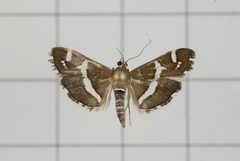
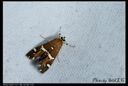
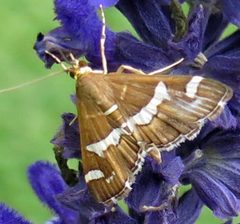
Distinguished from similar crambid by the characteristic recurved white markings on the forewings (the source of the specific epithet 'recurvalis'). The banded wing pattern with contrasting brown and white is distinctive. In Europe, distinguished from native by its tropical origin and association with cultivated amaranth and beet crops. Molecular identification supported by transcriptome data showing highest sequence similarity to Danaus plexippus among reference databases.
Images
Habitat
Agricultural and horticultural environments, particularly where plants (Amaranthus spp., Beta vulgaris, Spinacia oleracea) are cultivated. In tropical and subtropical native range, occurs in diverse agricultural settings. In expanded temperate range, associated with protected and urban gardens where host plants persist.
Distribution
Native to tropical and subtropical regions worldwide. Documented from Africa, Asia, Australasia, Pacific Islands, and the Americas. Expanded distribution into Europe (first records in Italy with subsequent spread to multiple regions; also recorded in Belgium). In North America, established in southeastern USA (Florida, South Carolina, Virginia, New Jersey). Present on oceanic islands including Hawaii, Galápagos, and Atlantic islands. Range expansion ongoing, facilitated by human transport of plants and climate change.
Seasonality
period varies geographically: May to September in temperate regions, year-round activity in tropics. In laboratory conditions, females exhibit pre-oviposition period of 3 days and continue -laying for up to 20 days post-. Temperature strongly influences activity: optimal flight temperature 17–23°C, with some individuals capable of flight at 12°C.
Diet
Larvae are oligophagous herbivores feeding on leaves of Amaranthus (primary ), spinach (Spinacia oleracea), beet/sugar beet (Beta vulgaris), cotton (Gossypium), maize (Zea mays), and soybean (Glycine max). require nectar feeding (honey solution in laboratory; natural nectar sources in field) for survival; even one day without nectar significantly depresses subsequent activity.
Host Associations
- Amaranthus spp. - primary larval plantMain in Africa and Asia; causes complete foliage loss under severe
- Beta vulgaris - larval plantIncludes sugar beet and beetroot; 'Beet Webworm' derives from this association
- Spinacia oleracea - larval plantDocumented
- Gossypium - larval plantCotton
- Zea mays - larval plantMaize
- Glycine max - larval plantSoybean
- Apanteles hemara - larval endoparasitoidMost important natural enemy; solitary braconid that parasitizes young larvae (1–4 days old preferred)
Life Cycle
Complete with , larva, pupa, and stages. Larval development includes web-building on foliage. site not explicitly described in sources but presumably within or near larval shelters. Adult longevity and reproductive period documented in laboratory: females have 3-day pre-oviposition period, lay eggs for up to 20 days. Developmental timing temperature-dependent.
Behavior
Larvae construct silk webs on plant foliage and feed within these shelters, hence 'webworm' . exhibit temperature-dependent activity with optimal range 17–23°C; 10% of females capable of continuous long-duration flight even at 12°C. Females fly more actively during pre-oviposition period. Flight activity not clearly separated from reproductive period. Mating status has no clear effect on flight activity. Adults require frequent nectar feeding to maintain flight capability.
Ecological Role
Herbivore and agricultural pest; can cause complete defoliation of amaranth crops. Serves as for including Apanteles hemara, supporting parasitoid . Expansion into new regions may disrupt local and compete with native herbivores.
Human Relevance
Significant agricultural pest of amaranth, spinach, beet, and other crops in tropics and subtropics; has become established in temperate regions through human-mediated transport. Subject of research for including (certain amaranth accessions show strong ) and using Apanteles hemara. Transcriptome sequencing has been performed to develop molecular tools for pest management. Monitored through citizen science platforms (iNaturalist, observation.org) for tracking range expansion.
Similar Taxa
- Other Spilomelinae crambidsSimilar size and general appearance; distinguished by specific wing pattern with recurved white markings and association with amaranth/beet
- Other 'webworm' mothsLarval web-building shared with many Crambidae; distinguished by plant specificity and wing pattern
More Details
Molecular resources
Transcriptome assembly available with 120,435 contigs; 58,225 sequences with BLASTX annotations. of DH-PBAN ( biosynthesis-activating neuropeptide) characterized at 4,295 with six exons. Forty putative genes related to pheromone production and reception identified, with potential for pheromone-based pest management.
Biological control research
Apanteles hemara, the primary larval endoparasitoid, exhibits Type II to . success highest on 1–2 day old larvae; does not parasitize larvae 7 days or older. Temperature requirements for development (10.3–35.0°C threshold) may limit effectiveness in some climates.
Host plant resistance
Accession VI036227 of Amaranthus shows complete (100% larval mortality within 36 hours) without deterring oviposition, offering promising resistance breeding material.
Sources and further reading
- BugGuide
- Wikipedia
- GBIF taxonomy match
- iNaturalist taxon
- NCBI Taxonomy
- Catalogue of Life
- Spoladea recurvalis . [Distribution map].
- Transcriptome analysis in the beet webworm, Spoladea recurvalis (Lepidoptera: Crambidae)
- Flight activity, reproduction, and adult nutrition of the beet webworm, Spoladea recurvalis (Lepidoptera: Pyralidae)
- THE BEETROOT MOTH SPOLADEA RECURVALIS (FABRICIUS, 1775) (LEPIDOPTERA CRAMBIDAE) EXPANDS ITS SPREAD IN ITALY: NEW RECORDS WITH FIRST OCCURRENCE IN SOME REGIONS
- Beet webworm, Spoladea recurvalis Fabricius (Lepidoptera: Crambidae) new to the Adrar region (south-west of Algeria) with comments on host plants and morphometry
- Effects of Host Age and Density on the Performance of Apanteles hemara (Hymenoptera: Braconidae), a Larval Endoparasitoid of Spoladea recurvalis (Lepidoptera: Crambidae)
- Sex-specific spatial and temporal gene expressions of Pheromone biosynthesis activating neuropeptide (PBAN) and binding proteins (PBP/OBP) in Spoladea recurvalis
- Temperature-dependent development, survival and reproduction ofApanteles hemara(Nixon) (Hymenoptera: Braconidae) onSpoladea recurvalis(F.) (Lepidoptera: Crambidae)
- Expression of Resistance in Amaranthus spp. (Caryophyllales: Amaranthaceae): Effects of Selected Accessions on the Behaviour and Biology of the Amaranth Leaf-Webber, Spoladea recurvalis (Lepidoptera: Crambidae)
- The Effects of Pest-Resistant Amaranth Accessions on the Performance of the Solitary EndoparasitoidApanteles hemara(Hymenoptera: Braconidae) Against the Amaranth Leaf-WebberSpoladea recurvalis(Lepidoptera: Crambidae)
- Temperature dependent immunological responses of Spoladea recurvalis exposed to entomopathogenic fungi.