
Diaphania indica
Saunders, 1851
cucumber moth, cotton caterpillar, leaf roller
Diaphania indica is a widespread occurring primarily in tropical and subtropical regions of the Old World, native to southern Asia. It is a significant agricultural pest of cucurbitaceous crops, with larvae feeding on leaves, stems, and fruits of plants. The species has been documented on multiple continents and is subject to efforts using . Laboratory studies have established detailed demographic parameters and duration.
Pronunciation
How to pronounce Diaphania indica: /daɪəˈfeɪniə ˈɪndɪkə/
These audio files are automatically generated. While they are not always 100% accurate, they are a good starting point.
Identification
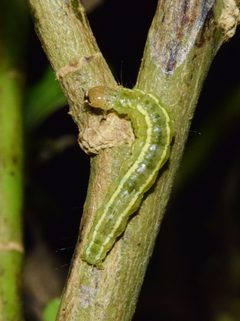
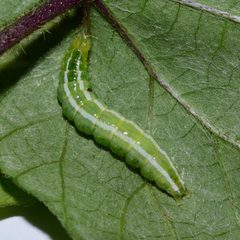
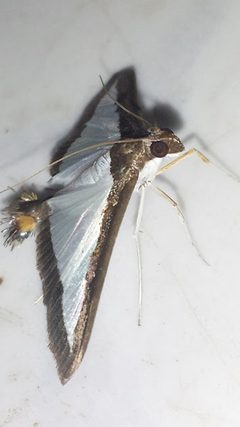
have translucent wings with dark marginal bands; larvae are green with longitudinal white stripes and possess the typical pyralid form with well-developed . Distinguished from related Diaphania by wing pattern and geographic distribution; D. nitidalis () and D. hyalinata () are New World species with overlapping ranges but different wing markings.
Images
Habitat
Agricultural and cultivated areas associated with cucurbit crops; occurs in tropical and subtropical regions. Specific microhabitat preferences beyond crop association have not been documented.
Distribution
Native to southern Asia; widespread across tropical and subtropical Old World regions. Documented presence in Africa (Angola, Democratic Republic of Congo, Bas Congo), Middle East (United Arab Emirates), and Galápagos Islands. Not established in the Americas.
Diet
Larvae feed on cucurbitaceous plants including Cucumis sativus (cucumber), Cucumis melo (melon), Citrullus lanatus (watermelon), Cucurbita moschata (pumpkin), Lagenaria siceraria (bottle gourd), Luffa cylindrica and L. acutangula (sponge gourds), Momordica charantia (bitter gourd), and Trichosanthes dioica (pointed gourd). Momordica charantia appears to contain a toxic factor that inhibits larval development.
Host Associations
- Cucumis sativus - primary major pest of cucumber
- Cucumis melo - most suitable in laboratory studies
- Citrullus lanatus -
- Cucurbita moschata - commonly called pumpkin caterpillar on this
- Lagenaria siceraria -
- Luffa cylindrica -
- Luffa acutangula - least suitable in comparative studies
- Momordica charantia - contains toxic factor inhibiting development
- Trichosanthes dioica -
Life Cycle
Total approximately 25.7 days under laboratory conditions: stage 3.2 days, larval stage 13.5 days, pupal stage 7.9 days, stage 8.6 days. Preoviposition period 3.9 days. Development time and success vary with plant quality.
Behavior
Larvae exhibit leaf-rolling on pointed gourd. show olfactory orientation to plant volatiles; gravid females demonstrate stronger electroantennographic response to plant odors than unmated females or males. Larvae show highest olfactory response to wild coccinia followed by bitter gourd. exhibit significant orientation and landing response to synthetic blends of benzaldehyde and benzyl alcohol.
Ecological Role
Herbivorous pest of cultivated cucurbits requiring . Serves as for larval including Apanteles taragamae (Braconidae), Apanteles machaeralis (Braconidae), and Goniozus sensorius (Bethylidae), supporting local parasitoid in agricultural .
Human Relevance
Significant agricultural pest causing damage to leaves, stems, and fruits of cucurbit crops. Subject to chemical and efforts. Laboratory studies have evaluated plant-derived extracts (Ruta graveolens) for larvicidal and repellent properties, with 3% concentration showing 85% mortality and 5% concentration achieving 100% insecticidal efficacy. Synthetic volatile blends based on plant chemistry show potential for behavioral manipulation in pest management.
Similar Taxa
- Diaphania nitidalis; New World distribution, similar cucurbit-feeding habit, distinguished by wing pattern and geographic range
- Diaphania hyalinata; New World distribution, larvae typically feed on leaves in Florida but show behavioral plasticity feeding on fruits in northeastern US, distinguished by wing markings
Sources and further reading
- BugGuide
- GBIF taxonomy match
- iNaturalist taxon
- NCBI Taxonomy
- Catalogue of Life
- EIVE 1.0 – The largest system of ecological indicator values in Europe | Blog
- Mean ecological indicator values: which system and which weighting approach to use
- How One Entomologist Became a Detective of 'Pest Mysteries'
- STATISTIK DEMOGRAFI DIAPHANIA INDICA SAUNDERS (LEPIDOPTERA: CRAMBIDAE)
- Aspects of the biology of Diaphania indica (Lepidoptera:Pyralidae)
- Infestation of Diaphania indica Saund. on cucurbits
- Host preference and selection of Diaphania indica Saunders (Lep., Pyralidae)
- Host preference and selection of Diaphania indica Saunders (Lep., Pyralidae)
- Mating Behavior of the Cotton Caterpillar, Diaphania indica (SAUNDERS) (Lepidoptera: Pyralidae)
- Olfactory and electrophysiological response of cucumber moth Diaphania indica (Saunders)n(Lepidoptera, Crambidae) to different plants
- Efikasi Ekstrak Inggu (Ruta graveolens L.) terhadap Mortalitas Larva Diaphania indica (Lepidoptera: Crambidae) Di Laboratorium
- Studies on bio-ecology and voracity of leaf roller (Diaphania indica Saunders, Lepidoptera: Pyralidae) on pointed gourd (Trichosanthes dioica Roxb.)
- Biology of Apanteles Taragamae Viereck (Hymenoptera: Braconidae) a Parasitoid of Diaphania Indica (Saunders) (Lepidoptera: Pyralidae)
- Biology and Reproductive Behaviour of Apanteles taragamae Viereck (Hymenoptera: Braconidae), a Larval Parasitoid of Diaphania indica Saunders (Lepidoptera: Crambidae)
- Report of morphomatric and biology of leaf eating caterpillar, Diaphania indica in arid region of India
- Host Larval Body Odours AID Host Location Of Apanteles Machaeralis, A Braconid Larval Endoparasitoid of Cucumber Moth Diaphania Indica
- Biology of Goniozus Sensorius Gordh (Hymenoptera: Bethyudae) A Parasitoid Of The Pumpkin Caterpillar, Diaphania Indica (Saunders) (Lepidoptera: Pyralidae)
- Influence of Host Plants on the Parasitism of Diaphania Indica (Lepidoptera: Pyralidae) by Apanteles Taragamae (Hymenoptera: Braconidae)