
Diaphania
Hübner, 1818
Species Guides
8- Diaphania costata(Orange-shouldered Sherbet Moth)
- Diaphania elegans
- Diaphania hyalinata(melonworm moth)
- Diaphania indica(cucumber moth)
- Diaphania infimalis
- Diaphania lualis
- Diaphania modialis(Cucumberworm Moth)
- Diaphania nitidalis(pickleworm)
Diaphania is a of in the Crambidae, Spilomelinae, containing approximately 30-40 distributed primarily in tropical and subtropical regions of the Americas, with some species extending into temperate North America. Several species are significant agricultural pests of cucurbit crops, including the (D. hyalinata), (D. nitidalis), and cucumber moth (D. indica). These species are characterized by distinctive translucent wing patches and rapid larval development on cucurbitaceous .
Pronunciation
How to pronounce Diaphania: //daɪəˈfeɪniə//
These audio files are automatically generated. While they are not always 100% accurate, they are a good starting point.
Identification
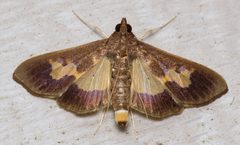
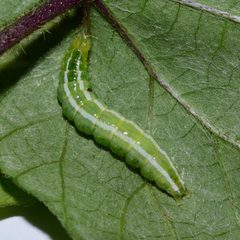
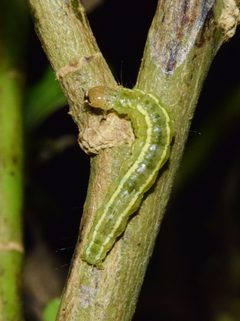
of Diaphania are distinguished from other crambid by translucent or semi-transparent patches on the wings, created by reduced scaling. The forewings typically display a combination of dark brown or black markings with clear windows. Larvae are green with longitudinal white stripes and a dark capsule. D. hyalinata and D. nitidalis are nearly identical morphologically and require dissection or molecular methods for reliable separation; D. indica is distinguished by more extensive dark markings on the wings.
Images
Habitat
Agricultural and natural areas in tropical and subtropical regions. occur in cultivated fields, particularly cucurbit plantings, and adjacent uncultivated vegetation. Permanent persist in frost-free regions; seasonal populations established annually through northward in temperate zones.
Distribution
Native to the Neotropical region, with permanent range extending from South America through Central America, the Caribbean, and into the southern United States (south Florida and possibly south Texas). Seasonal reaches the southeastern United States, occasionally extending to New England and the Great Lakes region. Individual distributions vary: D. hyalinata and D. nitidalis occur throughout this range; D. indica has been recorded in Asia (Sri Lanka, India, Southeast Asia) and Africa (Sudan), suggesting introduced range or broader native distribution.
Seasonality
Year-round activity in tropical and subtropical permanent range. In temperate regions, activity and larval occur primarily during summer months following northward from southern . Multiple per year in favorable climates.
Diet
Larvae feed primarily on plants in the Cucurbitaceae. Documented include Cucumis sativus (cucumber), C. melo (melon), Cucurbita moschata (pumpkin), Citrullus lanatus (watermelon), Lagenaria siceraria (bottle gourd), Luffa cylindrica and L. acutangula (sponge gourds), Momordica charantia (bitter gourd), and Coccinia grandis (ivy gourd). Feeding occurs on leaves, stems, and fruits; fruit feeding is more prevalent in some and regions than others.
Host Associations
- Cucumis sativus - primary Cucumber; preferred for D. indica development and
- Cucumis melo - primary Melon; highly suitable for D. indica and D. hyalinata
- Cucurbita moschata - primary Pumpkin; suitable for larval development
- Citrullus lanatus - primary Watermelon; larval feeding documented
- Lagenaria siceraria - secondary Bottle gourd; suitable for development
- Luffa cylindrica - secondary Sponge gourd; moderate suitability
- Luffa acutangula - secondary Ridge gourd; least suitable documented for D. indica
- Momordica charantia - secondary Bitter gourd; possible toxic factor inhibiting development in D. indica
- Coccinia grandis - secondary Ivy gourd; wild with high larval olfactory response
- Artocarpus heterophyllus - primary Jackfruit; for D. caesalis, a attacking woody hosts
Life Cycle
Complete with four stages: , larva, pupa, . In D. indica at 28°C: egg stage 3.2 days, larval stage 13.5 days, pupal stage 7.9 days, adult longevity 8.6 days, preoviposition period 3.9 days, total time approximately 25-31 days. In D. hyalinata: egg 2.5 days, larva 11.4 days, pupa 7 days, total 20-23 days on preferred . Development rate and survival vary significantly with host plant quality and temperature. Multiple overlapping generations per year in tropical climates.
Behavior
are and attracted to light. Gravid females use olfactory cues to locate plants, with more sensitive to plant volatiles than males. Larvae display feeding plasticity: D. hyalinata larvae typically feed on leaves in Florida but frequently burrow into fruits in Virginia and northeastern populations. larvae can survive 24-64 hours without food, enabling from natal host plants. occurs in soil or concealed locations on host plants.
Ecological Role
Herbivore and agricultural pest. Larval feeding reduces photosynthetic capacity and marketability of cucurbit crops. Serves as for including Trichogramma chilonis ( parasitoid), Apanteles stantoni (larval parasitoid), and Palmistichus elaeisis (pupal parasitoid). Provides food source for in agroecosystems.
Human Relevance
Major economic pest of cucurbit vegetable production in the Americas, particularly affecting cucumber, melon, squash, and pumpkin crops. Direct damage from larval feeding on fruits renders produce unmarketable. Management relies on combining monitoring, with and ( rileyi), (neem, pongamia), and selective insecticides. Behavioral manipulation through push-pull cropping systems has been investigated but larval feeding plasticity complicates implementation.
Similar Taxa
- LygusBoth are agricultural pests of cucurbits, but Lygus are true bugs (Hemiptera: Miridae) with , not leaf-feeding caterpillars; nymphs lack the distinct green coloration with white stripes and dark capsule of Diaphania larvae.
- AcaloleptaSome cerambycid beetles are cucurbit pests, but have hardened forewings () unlike the scaled, membranous wings of Diaphania; larvae are wood-borers with C-shaped , not foliar feeders.
More Details
Taxonomic history
Diaphania was originally described by Hübner in 1818. The has been classified in Pyralidae historically, but modern molecular places it in Crambidae, Spilomelinae. -level remains challenging due to morphological similarity, particularly between D. hyalinata and D. nitidalis.
Behavioral plasticity
Documented geographic variation in feeding of D. hyalinata: Florida feed primarily on leaves with rare fruit , while Virginia and northeastern populations frequently burrow directly into squash fruits. This plasticity affects pest management strategies and across regions.
Olfactory biology
Gravid female D. indica show highest electroantennographic response to bitter gourd extracts, while unmated females prefer cucumber. A synthetic blend of benzaldehyde and benzyl alcohol elicits significant orientation and landing responses, with potential application for monitoring or .
Sources and further reading
- BugGuide
- Wikipedia
- GBIF taxonomy match
- iNaturalist taxon
- NCBI Taxonomy
- Catalogue of Life
- Diaphania hyalinata Archives - Entomology Today
- How One Entomologist Became a Detective of 'Pest Mysteries'
- Melonworm, Diaphania hyalinata Linnaeus (Insecta: Lepidoptera: Pyralidae)
- STATISTIK DEMOGRAFI DIAPHANIA INDICA SAUNDERS (LEPIDOPTERA: CRAMBIDAE)
- Aspects of the biology of Diaphania indica (Lepidoptera:Pyralidae)
- Host preference and selection of Diaphania indica Saunders (Lep., Pyralidae)
- Diaphania nitidalis species complex. [Distribution map].
- Evaluation of IPM Modules Against Diaphania caesalis (Walker) in Jack Fruit
- Olfactory and electrophysiological response of cucumber moth Diaphania indica (Saunders)n(Lepidoptera, Crambidae) to different plants
- A new species of Diaphania H bner, 1818 from Ecuador (Lepidoptera: Crambidae: Spilomelinae)
- Biology of the Melon Worm, Diaphania hyalinata L. (Lepidoptera:Pyralidae), on Cucurbits in Gezira State, Sudan
- Potential of Diaphania hyalinata and Tenebrio molitor as alternative host for mass rearing of Palmistichus elaeisis (Hymenoptera: Eulophidae)
- Host preference and selection of Diaphania indica Saunders (Lep., Pyralidae)
- Pickleworm (Diaphania nitidalis Cramer) Neonate Feeding Preferences and the Implications for a Push-Pull Management System
- Infestation of Diaphania indica Saund. on cucurbits
- Two hymenopteran parasitoid species of the jackfruit borer Diaphania caesalis (Lepidoptera: Pyralidae) in China.