
Diaphania hyalinata
(Linnaeus, 1767)
melonworm moth, melonworm
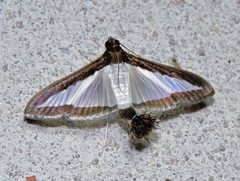
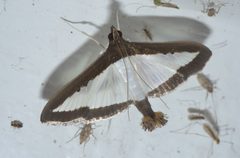
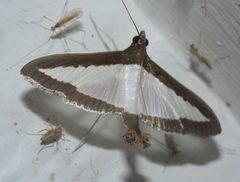
, commonly known as the , is a crambid moth and a significant agricultural pest of cucurbit crops. Native to the Neotropics, it has established permanent in the southern United States and disperses northward annually during warmer months. The species exhibits behavioral plasticity in feeding habits: in Florida and tropical regions, larvae primarily feed on leaves, while in more northern latitudes such as Virginia, they frequently burrow directly into fruits. Laboratory studies indicate a complete of approximately 20–23 days under warm conditions.
Pronunciation
How to pronounce Diaphania hyalinata: /daɪəˈfeɪniə ˌhaɪəˈleɪnətə/
These audio files are automatically generated. While they are not always 100% accurate, they are a good starting point.
Identification
have a wingspan of 27–30 mm. The can be distinguished from the closely related (Diaphania nitidalis) by morphological features and association patterns, though specific diagnostic characters for field identification are not detailed in available sources.
Images
Habitat
Agricultural and cultivated environments, specifically cucurbit crop fields. The thrives in warm, humid conditions typical of tropical and subtropical regions. In the United States, permanent persist in south Florida and possibly south Texas, with seasonal expansion into temperate areas during summer months.
Distribution
Native range extends throughout Central and South America, the Caribbean, and Suriname. In North America, permanent range reaches the southern United States (south Florida, possibly south Texas). northward occurs during summer, with reaching the southeastern United States; occasional dispersal extends to New England and the Great Lakes region. Observations recorded from the Galápagos Islands and Vermont.
Seasonality
are active October to November in the northern part of the range. In Florida and areas further south, adults occur year-round with multiple annually. Seasonal abundance peaks correlate with warm growing seasons in temperate regions.
Diet
Larvae feed on cucurbit leaves and fruits. Documented include snake cucumber, squash, pumpkin, sweet melon, watermelon, and tibish. Feeding varies geographically: in Florida, larvae primarily consume leaves with rare fruit feeding; in Virginia and more northern areas, larvae frequently burrow into squash fruits. First instar larvae cannot survive on fruits alone and require foliage; fifth instar larvae are capable of penetrating fruit rinds to consume flesh.
Host Associations
- snake cucumber - preferred for oviposition; supports faster larval development on leaves than fruits
- squash - foliage and fruit consumed; major crop in Florida and southeastern US
- pumpkin - foliage and fruit consumed
- sweet melon - preferred for oviposition
- watermelon - foliage and fruit consumed
- tibish - foliage and fruit consumed
Life Cycle
Under laboratory conditions (28±1.2°C, 20–25% RH), mean developmental durations are: 2.5±0.25 days; larva 11.4±0.13 days (five instars); pupa 7±0.15 days. Total from egg-laying to averages 21.37±0.22 days on snake cucumber leaves. Colombian field studies (26.8°C, 84% RH) report: egg incubation 3.0±1.0 days with 98.4%±1.5% ; five larval instars totaling 12.3±0.6 days; pre-pupa 2.0±0.2 days; pupa 7.8±0.4 days; total egg-to-pupa duration 23.2±0.85 days. Sex ratio approximately 1:0.8 male to female. Food substrate significantly affects development rate, with leaves supporting faster development than fruits.
Behavior
Exhibits pronounced behavioral plasticity in feeding correlated with geography and availability. Oviposition preference demonstrated for snake cucumber and sweet melon over other tested cucurbits. northward from permanent tropical and subtropical into temperate regions during warm months. First instar larvae are foliage-obligate; fruit-feeding capacity develops by fifth instar.
Ecological Role
Herbivorous pest of cultivated cucurbits, reducing photosynthetic area through defoliation and causing direct fruit damage. Serves as for multiple including Trichogramma atopovirilia, T. pretiosum, Trichospilus diatraeae, and Palmistichus elaeisis, supporting programs. can trigger elevated use with associated non-target effects.
Human Relevance
Major economic pest of cucurbit agriculture in the Americas, causing yield losses through defoliation and fruit damage. Subject to research including with , banker plant systems, and selective evaluation. Documented case studies of grower assistance through pest identification and management planning. Potential alternative for mass rearing of beneficial parasitoids for agricultural and forest pest management programs.
Similar Taxa
- Diaphania nitidalis; congeneric with overlapping range and geographic distribution, similar and , often co-occurs on cucurbit crops
Misconceptions
Literature descriptions stating that feed primarily on leaves and rarely damage fruits do not hold across all geographic regions; field observations in Virginia demonstrate frequent and damaging fruit-feeding , indicating that feeding plasticity is greater than previously recognized.
More Details
Parasitoid Complex
Multiple utilize D. hyalinata as : Trichogramma spp. attack (T. pretiosum shows higher rates than T. atopovirilia); Trichospilus diatraeae and Palmistichus elaeisis attack pupae. The latter two species show successful development with 60–99% parasitism rates in laboratory studies, supporting potential for .
Pesticide Susceptibility
Synthetic furanone and phthalide compounds show to (up to 91% mortality), with some compounds exhibiting selectivity toward predatory ants (Solenopsis saevissima) but not toward (Tetragonisca angustula), suggesting potential for reduced-risk pest management with careful application timing.
Sources and further reading
- BugGuide
- Wikipedia
- GBIF taxonomy match
- iNaturalist taxon
- NCBI Taxonomy
- How One Entomologist Became a Detective of 'Pest Mysteries'
- Diaphania hyalinata Archives - Entomology Today
- Trigona hyalinata Archives - Entomology Today
- Eavesdropping Bees Encouraged by "Whispers," Deterred by "Shouts"
- Melonworm, Diaphania hyalinata Linnaeus (Insecta: Lepidoptera: Pyralidae)
- Potential of Diaphania hyalinata and Tenebrio molitor as alternative host for mass rearing of Palmistichus elaeisis (Hymenoptera: Eulophidae)
- Biology of the Melon Worm, Diaphania hyalinata L. (Lepidoptera:Pyralidae), on Cucurbits in Gezira State, Sudan
- Ciclo de Vida, Consumo Foliar Y Daño En Frutos Del Melón Por Diaphania Hyalinata (L.) (Lepidoptera: Pyralidae)
- Seasonal Abundance and Spatial Distribution ofDiaphania hyalinata(Lepidoptera: Crambidae) on Yellow Squash in South Florida
- Reproduction ofTrichospilus diatraeae(Hymenoptera: Eulophidae) in the Pupae ofDiaphania hyalinata(Lepidoptera: Crambidae) of Various Ages
- DESEMPENHO DE TRICHOGRAMMA SPP. (HYMENOPTERA: TRICHOGRAMMATIDAE) EM OVOS DE DIAPHANIA HYALINATA (L.) (LEPIDOPTERA: PYRALIDAE) TRATADOS COM METARHIZIUM ANISOPLIAE E BEAUVERIA BASSIANA
- Density ofTrichospilus diatraeae(Hymenoptera: Eulophidae) ParasitizingDiaphania hyalinata(Lepidoptera: Crambidae) Pupae
- Toxicity to Diaphania hyalinata, selectivity to non‐target species and phytotoxicity of furanones and phthalide analogues