
Diaphania nitidalis
(Stoll, 1781)
pickleworm, pickleworm moth
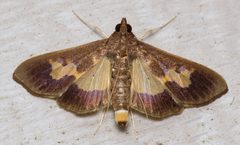
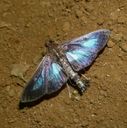
is a significant agricultural pest of cucurbit crops, particularly damaging to squash, cucumbers, and melons. are with iridescent brown wings marked by yellow bands and white borders. Larvae feed voraciously on reproductive tissues, flowers, and fruits, often burrowing into fruit flesh. The is tropical in origin and intolerant of cold temperatures, limiting its permanent range to southern North America and tropical regions, though it migrates northward seasonally.
Pronunciation
How to pronounce Diaphania nitidalis: /diːəˈfeɪniə nɪˈtɪdəlɪs/
These audio files are automatically generated. While they are not always 100% accurate, they are a good starting point.
Identification
distinguished from similar Diaphania by combination of iridescent brown wings with yellow central band and white borders, plus white legs and white-tufted tip. Larvae initially thin white caterpillars with numerous small black spots; mature larvae become plump, darker, and lose spots. Distinguished from (Diaphania hyalinata) by adult color pattern and larval spotting; melonworm larvae retain green coloration and different spot pattern.
Images
Habitat
Tropical and subtropical agricultural regions; cucurbit cropping systems including field and protected . Requires warm temperatures; does not tolerate cold.
Distribution
Native to tropical Americas. Permanent in southern United States (Florida, Georgia, Gulf Coast), Central America, Caribbean, and South America (Brazil, Argentina, Chile, Peru, Suriname). Seasonal northward occurs to Mid-Atlantic and northeastern states during summer. Documented in Hawaii.
Seasonality
Multiple per year in warm climates (up to four generations). Activity ceases in cold conditions. Earlier plantings in southern United States experience less damage than later plantings.
Diet
feeder on Cucurbitaceae. Larvae consume flowers, buds, new shoots, and fruits. feed on vegetative tissues, buds, and flowers; older larvae preferentially feed on fruits or tunnel stems when fruit unavailable. do not feed.
Host Associations
- Cucurbita pepo - primary squash, including summer and winter varieties
- Cucumis melo - cantaloupe, melons
- Citrullus lanatus - watermelon
- Cucumis sativus - cucumber
- Cucurbita moschata - butternut squash, kabocha
Life Cycle
laid in small clusters on growing plant tissues (flowers, shoots, leaf buds) at night. Larvae emerge after few days, feed for approximately two weeks. occurs within crumpled dead leaves or debris for 8–10 days. Total duration 22–55 days depending on temperature. Multiple overlapping in suitable climates.
Behavior
strictly ; inactive during daylight. Oviposition occurs exclusively at night. highly mobile, capable of moving 30 cm in under one hour. Neonates can survive 24–64 hours without food, enabling searching. Feeding experience induces behavioral plasticity: prior feeding on non-host foods increases subsequent acceptance of those foods. Attracted to germacrene D (host plant volatile); weakly repelled by (R)-(+)-limonene and 2-heptanone.
Ecological Role
Primary consumer of cucurbit plants. Serves as for Lixophaga sp. (Diptera: Tachinidae), with field rates of 26.2% observed in Brazil. Pest status drives management interventions including applications and efforts.
Human Relevance
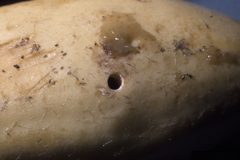
Major economic pest of cucurbit production causing direct damage to marketable fruits and indirect damage via destruction of flowers and shoots. Damage include absence of flowers/new growth and fruit entry holes with accumulation. Management relies on , varieties (butternut, Golden Hubbard, Improved Green Hubbard show partial resistance), and cultural practices. Summer squash varieties particularly susceptible. Subject of research on push-pull cropping systems and plant volatile manipulation for behavioral management.
Similar Taxa
- Diaphania hyalinata; similar size and but larvae typically feed on leaves rather than fruit (though behavioral plasticity observed geographically); have different wing pattern lacking yellow central band
- Diaphania indicaRelated cucurbit pest with overlapping distribution; distinguished by wing pattern and larval
Sources and further reading
- BugGuide
- Wikipedia
- GBIF taxonomy match
- iNaturalist taxon
- NCBI Taxonomy
- How One Entomologist Became a Detective of 'Pest Mysteries'
- Diaphania nitidalis Archives - Entomology Today
- Diaphania nitidalis species complex. [Distribution map].
- Pickleworm (Diaphania nitidalis Cramer) Neonate Feeding Preferences and the Implications for a Push-Pull Management System
- Squash leaf glandular trichome volatiles: Identification and influence on behavior of female pickleworm moth [Diaphania nitidalis (Stoll.)] (Lepidoptera: Pyralidae)
- OCORRÊNCIA DE LIXOPHAGA SP. (DIPTERA: TACHINIDAE) PARASITANDO LAGARTAS DE DIAPHANIA NITIDALIS (L.) (LEPIDOPTERA: CRAMBIDAE) EM CUCURBITA MOSCHATA NO BRASIL