
Cheloninae
Förster, 1862
chelonine wasps
Genus Guides
5Cheloninae is a of braconid , distinguished by a distinctive metasomal formed from the fusion of the first three tergites. Members are solitary koinobiont endoparasitoids that primarily attack Lepidoptera, particularly Pyraloidea and Tortricoidea. They are -larval parasitoids, ovipositing into eggs but completing development only after the caterpillar hatches and matures. Chelonines carry that aid in suppressing host immune responses.
Pronunciation
How to pronounce Cheloninae: //kɛˈloʊ.nɪˌniː//
These audio files are automatically generated. While they are not always 100% accurate, they are a good starting point.
Identification
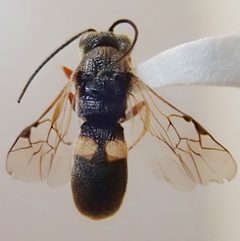
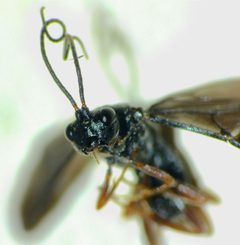
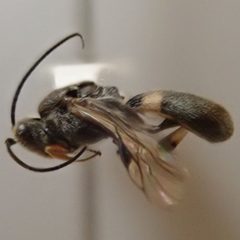
Most Cheloninae are small and uniformly colored. The is readily recognized by the characteristic metasomal : the first three tergites (urotergites) are dorsally into a single plate that conceals the remaining abdominal segments, giving the the appearance of consisting of only one segment. The surface retains more normal segmentation. This structure distinguishes Cheloninae from other braconid subfamilies and from superficially similar ichneumonid wasps, which can be separated by differences in wing venation and abdominal structure.
Images
Distribution
distribution. Documented from North America (approximately 139 of Chelonus alone north of Mexico), Central India (Chhattisgarh and Maharashtra), South-eastern Brazil, South-eastern Iran, China, South Africa, Australia, Vietnam, Angola, and the Malagasy subregion.
Seasonality
have been observed on late summer and fall flowers such as wild carrot. Activity patterns likely vary by region and availability.
Host Associations
- Lepidoptera - primary groupespecially Pyraloidea and Tortricoidea
- Spodoptera frugiperda - fall armyworm (Noctuidae), documented for Chelonus insularis
- Conopomorpha sinensis - litchi fruit borer (Gracillariidae), for Phanerotoma conopomorphae
- Ectomyelois ceratoniae - carob (Pyralidae), for Phanerotoma carobivora in South Africa
- stem-boring, bud-boring, and fruit-boring Lepidoptera larvae - broad range including larvae that bore in stems, buds, or fruits
Life Cycle
-larval development. Females oviposit into eggs using a hair-like ovipositor. The larva hatches but remains in its first instar while the host caterpillar matures. Development resumes only when the host prepares to pupate or spin a cocoon, at which point the wasp larva consumes the host. This koinobiont strategy allows the to exploit the host's growth while minimizing resource competition. At least one documented case shows host alteration, with parasitized caterpillars attempting to pupate earlier than normal.
Behavior
Solitary. Females search for , often on flowers or plant tissues where hosts have oviposited. The larva exhibits developmental arrest (-like first instar) synchronized with host maturation.
Ecological Role
Important that regulate of Lepidoptera, particularly agricultural and forest pests. Play an effective role in balancing by controlling insect pest populations. Some show significant rates (e.g., 86% in laboratory conditions for Chelonus insularis) and have potential as agents.
Human Relevance
Significant potential for of lepidopteran pests in agriculture and forestry. such as Chelonus insularis are important biological control agents against fall armyworm in maize. Some promising species are under study for mass rearing techniques and field application.
Similar Taxa
- IchneumonidaeSuperficially similar ; distinguished by wing venation and abdominal structure differences
- other Braconidae subfamiliesCheloninae uniquely identified by first three tergites forming a metasomal
Sources and further reading
- BugGuide
- Wikipedia
- iNaturalist taxon
- NCBI Taxonomy
- Bug Eric: Wasp Wednesday: Chelonus
- Bug Eric: 2010
- RECORD OF CHELONUS PANZER (BRACONIDAE: CHELONINAE) FROM CENTRAL INDIA
- The kariotype of the parasitoid Chelonus insularis Cresson (Hymenoptera, Braconidae, Cheloninae)
- A new species of Adelius Haliday (Hymenoptera, Braconidae, Cheloninae) from the Afrotropical Region
- New species of Chelonus (Microchelonus) Szépligeti, 1908 (Hymenoptera: Braconidae: Cheloninae) from Brazil
- Revision of Megascogaster (Hymenoptera, Braconidae, Cheloninae), with a new species from Sulawesi, Indonesia
- New data on braconid wasps (Hymenoptera: Braconidae: Cheloninae, Opiinae, Rogadinae) of South-Eastern Iran
- New species and records of the genus Chelonus Panzer, 1806 (Braconidae: Cheloninae) from China
- A new species of Phanerotoma Wesmael (Hymenoptera: Braconidae: Cheloninae) parasitoid of the carob moth in South Africa
- New data on African Cheloninae (Hymenoptera, Braconidae) show a strong biogeographic signal for taxa with spined propodea
- A taxonomic review of the parasitoid wasp genera Furcidentia Zettel and Pseudophanerotoma Zettel (Hymenoptera: Braconidae: Cheloninae) from the Neotropics with the description of four new species
- New records of Cheloninae (Förster, 1862) and Braconinae (Nees, 1811) (Insecta: Hymenoptera: Braconidae) from Iran
- Endocrine Interaction between Host (Lepidoptera) and Parasite (Cheloninae: Hymenoptera): Is the Host or the Parasite in Control?
- Systematics of the parasitic wasp genus Phanerotomella Szépligeti (Hymenoptera: Braconidae: Cheloninae) for Australia, with descriptions of 18 new species
- A new species of Phanerotoma Wesmael (Hymenoptera: Braconidae: Cheloninae), a parasitoid of Conopomorpha sinensis Bradley (Lepidoptera: Gracillariidae) from South China
- New records of rare genera of the subfamily Cheloninae (Hymenoptera: Braconidae), with description of two new species from Vietnam
- DNA Barcodes and Morphology Reveal Five New Species of Phanerotoma (Hymenoptera, Braconidae, Cheloninae) from China.
- New species of Phanerotomella (Hymenoptera, Braconidae, Cheloninae) based on morphological and molecular evidence.
- Review of the genus Paradelius De Saeger, 1942 of East Asia (Hymenoptera, Braconidae, Cheloninae, Adeliini) with the description of a new species from South Korea.