
Ascogaster
Wesmael, 1835
Ascogaster is a of braconid wasps comprising -larval endoparasitoids that attack tortricid pests. Females oviposit into eggs, and developing larvae consume host reproductive organs—a process termed host castration—before eventually killing the host. This developmental strategy redirects host resources from to somatic growth, increasing host size and improving conditions for development. Several have been studied for applications, particularly against the codling moth (Cydia pomonella) and smaller tea tortrix (Adoxophyes spp.).
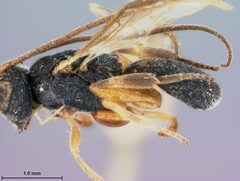
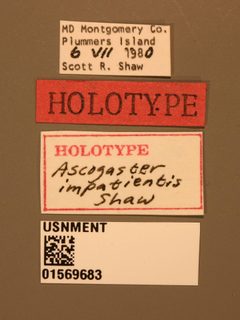
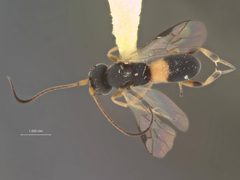
Pronunciation
How to pronounce Ascogaster: /ˌæskoʊˈɡæstər/
These audio files are automatically generated. While they are not always 100% accurate, they are a good starting point.
Identification
Ascogaster can be distinguished from other braconid -larval by their association with tortricid and the characteristic castration of their larvae. Specific morphological diagnostic features for the are not documented in the provided sources.
Images
Distribution
Records from Denmark (DK), Norway (NO), and Sweden (SE) documented in GBIF. Specific preferences not described in available sources.
Host Associations
- Tortricidae (Lepidoptera) - -larval -level association; female oviposit into host
- Cydia pomonella (codling moth) - Documented for A. carpocapsae and A. quadridentata; major pest of apple and other pome fruits
- Adoxophyes spp. (smaller tea tortrix) - Documented for A. reticulatus
- Sparganothis sulfureana - Documented for A. mimetica; major cranberry pest in North America
- Choristoneura parallela - nonhostCranberry pest tested against A. mimetica; rejected based on surface chemistry
Life Cycle
-larval : females oviposit into eggs. Larval development occurs within the host, with larvae eventually consuming host reproductive organs (functional castration) before killing the host.
Behavior
Females exhibit sequential -searching : antennal searching upon approaching host masses, followed by ovipositor searching upon contact. Host recognition relies on water-soluble kairomonal cues on egg surfaces; hexane-soluble cues play a weaker role. A. mimetica spends substantially more time drumming and probing on host eggs (S. sulfureana) versus nonhost eggs, with rates correspondingly higher on appropriate hosts.
Ecological Role
agent of tortricid . castration redirects host resources from to growth, altering host and potentially affecting of pest .
Human Relevance
Several evaluated or introduced for of agricultural pests, particularly codling moth in apple orchards and cranberry pests. A. carpocapsae was introduced to British Columbia apple-growing districts for this purpose. A. quadridentata has been studied for nutritional supplementation via flowering plants to enhance effectiveness.
Similar Taxa
- Other Braconidae (egg-larval parasitoids)Distinguished by specific associations with Tortricidae and documented host castration ; other may lack this specific combination of traits
More Details
Kairomone chemistry
In A. reticulatus, kairomonal activity is present in female pupa, meconium, , wings, and haemolymph (stronger in females than males). Female abdominal contents and ovary show highest activity. Active compounds are extractable with water and 70% ethanol, heat-stable, and comprise at least two components with different molecular weights.
Sex pheromone
A. quadridentata produces a ; source and chemistry documented in dedicated studies.
Learning behavior
A. reticulatus has demonstrated capacity to learn plant contact chemicals, potentially enhancing foraging .
Hyperparasitism
A. quadridentata recorded as subject to hyperparasitoids in Argentina, indicating complex trophic interactions in introduced contexts.
Sources and further reading
- BugGuide
- GBIF taxonomy match
- iNaturalist taxon
- NCBI Taxonomy
- Catalogue of Life
- Host Castration by Ascogaster spp. (Hymenoptera: Braconidae)
- In vitro release of ecdysteroids by an endoparasitoid, Ascogaster reticulatus Watanabe
- Kairomone of the Egg-Larval Parasitoid, Ascogaster reticulatus WATANABE (Hymenoptera : Braconidae)
- Sex Pheromone of Ascogaster quadridentata, a Parasitoid of Cydia pomonella
- Biological traits of Ascogaster quadridentata an endoparasitoid of the codling moth
- Detection of hiperparasitoids of Mastrus ridens (Hymenoptera: Ichneumonidae) and Ascogaster quadridentata (Hymenoptera: Braconidae) in the Alto Valle del Río Negro, Argentina
- Flowering plants serve nutritional needs of Ascogaster quadridentata (Hymenoptera: Braconidae), a key parasitoid of codling moth
- LABORATORY BREEDING OF ASCOGASTER CARPOCAPSAE VIER. WITH NOTES ON BIOLOGY AND LARVAL MORPHOLOGY
- Learning of Plant's Contact Chemicals by the Egg-Larval Parasitoid, Ascogaster reticulatus WATANABE (Hymenoptera: Braconidae)
- Host Discrimination and Competition in the Egg-Larval Parasitoid, Ascogaster reticulatus WATANABE(Hymenoptera : Braconidae)
- Source of sex pheromone of the egg-larval parasitoid,Ascogaster reticulatus Watanabe (Hymenoptera: Braconidae)
- Embryonic castration of the codling moth, Cydia pomonella by an endoparasitoid, Ascogaster quadridentata
- Granulosis Virus Infection of the Smaller Tea Tortrix (Lepidoptera: Tortricidae): Effect on the Development of the Endoparasitoid,Ascogaster reticulatus(Hymenoptera: Braconidae)
- Sparganothis sulfureana (Lepidoptera: Tortricidae) egg surface characteristics stimulate parasitism by Ascogaster mimetica (Hymenoptera: Braconidae)
- Searching Behavior and Oviposition of the Egg-Larval Parasitoid, Ascogaster reticulatus WATANABE (Hymenoptera : Braconidae)