
Sparganothis sulfureana
(Clemens, 1860)
sparganothis fruitworm moth, blueberry leafroller
Sparganothis sulfureana is a tortricid and major agricultural pest of cranberry (Vaccinium macrocarpon) in North America. Larvae cause economic damage through two distinct feeding : spring feeding on new foliar growth reduces photosynthetic capacity, while second- larvae bore into enlarging berries, with each larva destroying 3–5 berries. The is , as first-instar larvae, and has been documented on multiple plants including blueberry, apple, alfalfa, celery, and pine. Management relies on strategies including models for timing applications, flooding, and developing -based .
Pronunciation
How to pronounce Sparganothis sulfureana: /spɑːrɡəˈnoʊθɪs sʌlfjʊˈriːənə/
These audio files are automatically generated. While they are not always 100% accurate, they are a good starting point.
Identification
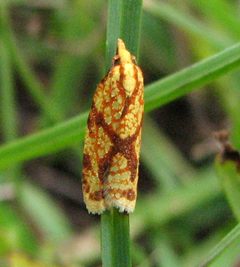
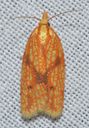
can be distinguished from similar tortricids by the combination of small size (10–20 mm wingspan), yellowish-sulfurous forewing coloration, and distribution in eastern North America. Larvae are recognized by their presence in webbed leaf shelters or within cranberry berries during summer. Accurate identification to level typically requires dissection and examination of genitalia or molecular confirmation.
Images
Habitat
Commercial cranberry marshes and cultivated cranberry (Vaccinium macrocarpon) production systems in northern United States and southeastern Canada. Natural include wetlands and areas supporting plants such as blueberry, loosestrife, and other forbs and woody plants. Seasonal flooding of cranberry beds inhibits development and is used as a management practice.
Distribution
Eastern North America from Canada (Alberta, Manitoba, Saskatchewan) through the northern United States, with highest pest pressure in Wisconsin (produces ~60% of US cranberries) and New Jersey. Also recorded from Cuba. GBIF records confirm presence in Vermont and Canadian provinces.
Seasonality
with two per year. emerge in spring during cranberry bloom, with peak predicted at approximately 430 (base 10°C, upper 30°C) from 50% cranberry tip biofix. Peak laying occurs at ~554 degree-days. Second generation adults active mid-summer. Climate change projections suggest peak flight may occur up to one week earlier by 2050 in New Jersey.
Diet
Highly larvae feed on cranberry (Vaccinium macrocarpon), blueberry (Vaccinium spp.), apple (Malus spp.), alfalfa (Medicago sativa), celery (Apium graveolens), pine (Pinus spp.), and loosestrife (Lythrum spp.). Within cranberry beds, prefers cranberry, blueberry, and loosestrife. First feeds on new foliar growth in spring; second generation bores into enlarging berries.
Host Associations
- Vaccinium macrocarpon - primary major commercial pest; larvae destroy 3–5 berries each
- Vaccinium spp. - blueberry
- Malus spp. - apple
- Medicago sativa - alfalfa
- Apium graveolens - celery
- Pinus spp. - pine
- Lythrum spp. - loosestrife; preferred weed within cranberry beds
- Ascogaster mimetica - -larval ; recognizes by egg surface
Life Cycle
Overwinters as first-instar larva. Completes two annually; rarely a third generation may occur in fall. First generation: larvae feed on new foliar growth in spring, reducing photosynthetic capacity. occurs in webbed shelters. Second generation: larvae bore into enlarging berries, each destroying 3–5 berries through feeding and . Development from to completed without significant differences in duration among cranberry cultivars. laid in masses (~60 eggs per mass) with surface deposited from female body.
Behavior
Larvae weave upright cranberry stems together with silk to create leaf tents for shelter. Second- larvae web berries together, creating protected feeding shelters within the fruit cluster. production visible at webbed sites indicates active feeding. mate soon after ; females deposit with surface that serve as for recognition.
Ecological Role
Major economic pest of cranberry requiring intensive . Increasing resistance to documented in some East Coast . Broad-spectrum insecticide applications for management harm beneficial insects including and natural enemies. Serves as for -larval Ascogaster mimetica, which locates hosts using chemical and tactile cues from egg surface .
Human Relevance
Significant agricultural pest causing direct yield losses in cranberry production through fruit damage and . Management costs include monitoring, flooding operations, applications, and development of technologies. Projected climate change effects may alter and increase management complexity.
Similar Taxa
- Choristoneura parallelaCo-occurs in cranberry bogs; lack surface that characterize S. sulfureana, resulting in reduced by Ascogaster mimetica
More Details
Degree-day model refinement
Standard biofix of 1 March is unsuitable for warmer regions where winter flooding inhibits development. Alternative biofixes of 15 April (average drainage date) or individual bed drainage dates (521–525.5 ) provide improved prediction for peak timing.
Cultivar susceptibility
Laboratory studies found no significant resistance among major cranberry cultivars ('Stevens', 'Ben Lear', 'GH-1', 'HyRed', 'Mullica '). Mid-instar larval weight differences on 'Ben Lear' and 'Mullica Queen' did not correlate with pupal weight, development time, or survival rates, failing to explain field differences observed in prior studies.
Parasitoid host recognition
surface deposited by female during oviposition serve as critical for Ascogaster mimetica recognition. Hexane washing of eggs to remove scales reduces drumming and probing/ovipositing to levels comparable with nonhost eggs, demonstrating the essential role of these chemical and tactile cues.
Sources and further reading
- BugGuide
- Wikipedia
- GBIF taxonomy match
- iNaturalist taxon
- NCBI Taxonomy
- Catalogue of Life
- Hot Competition: Climate Change, Invasive Fly Displace a Native Blueberry Pest
- Development of Sparganothis sulfureana (Lepidoptera: Tortricidae) on Cranberry Cultivars
- Sparganothis sulfureana (Lepidoptera: Tortricidae) egg surface characteristics stimulate parasitism by Ascogaster mimetica (Hymenoptera: Braconidae)
- Refining Degree-Day Models for Sparganothis Fruitworm in Cranberry by Biofix and Variety