
Sparganothis
Hübner, [1825], 1816
Sparganothis fruitworm
Species Guides
29- Sparganothis azulispecca
- Sparganothis bistriata(Two-striped Sparganothis Moth)
- Sparganothis boweri
- Sparganothis caryae(Netted Sparganothis Moth)
- Sparganothis demissana
- Sparganothis distincta(Distinct Sparganothis Moth)
- Sparganothis flavibasana
- Sparganothis lindalinea
- Sparganothis lycopodiana
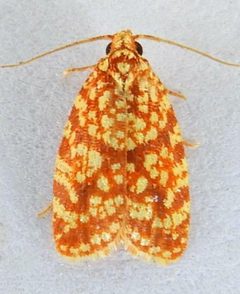
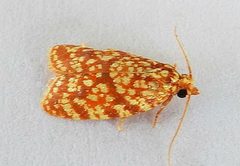
Sparganothis is a of tortricid moths in the Tortricinae. Several are significant agricultural pests, particularly of cranberries, blueberries, and grapes. The genus includes the economically important Sparganothis sulfureana, a major cranberry pest in North America, and S. pilleriana, a grape leaf-roller in European vineyards. Species exhibit with larvae that feed on fruit and foliage, causing direct yield losses in commercial production systems.
Pronunciation
How to pronounce Sparganothis: //ˌspɑːrɡəˈnɒθɪs//
These audio files are automatically generated. While they are not always 100% accurate, they are a good starting point.
Identification
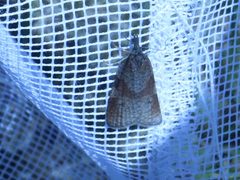
are small tortricid moths with characteristic wing patterns typical of the ; larvae are distinguished by leaf-rolling or fruit-boring . Sparganothis sulfureana larvae can be separated from congeneric Choristoneura parallela by association and surface characteristics. Accurate identification often requires examination of adult genitalia or larval host association; the true S. pettitana was historically confused with a cryptic congeneric species until resolved through comparison.
Images
Habitat
Agricultural and natural systems including commercial cranberry bogs, blueberry fields, vineyards, and adjacent wetland vegetation. occupy where plants of the Ericaceae (cranberry, blueberry), Rosaceae (apple), Fabaceae (alfalfa), Pinaceae (pine), and Vitaceae (grape) occur.
Distribution
North America (United States, Canada) and Europe (Denmark, Norway, Sweden, Romania). Specific records from Vermont and other US states, with S. sulfureana concentrated in northern US cranberry production regions and southeastern Canada. S. pilleriana documented in southern and western Romanian vineyards.
Seasonality
with activity timed to plant . First adults active during bloom; second generation coincides with fruit enlargement. Peak in cranberry systems predicted at approximately 521-525 from biofix dates (15 April or water draw date). Climate change projections indicate peak flight may occur up to one week earlier by 2050 in New Jersey cranberry beds.
Diet
Larvae are highly , feeding on cranberry (Vaccinium macrocarpon), blueberry (Vaccinium spp.), apple (Malus spp.), alfalfa (Medicago sativa), celery (Apium graveolens), pine (Pinus spp.), and loosestrife (Lythrum spp.). Second larvae cause most economic damage by boring into enlarging fruit.
Host Associations
- Vaccinium macrocarpon - primary plant (cranberry)major commercial for S. sulfureana
- Vaccinium spp. - plant (blueberry)
- Malus spp. - plant (apple)
- Medicago sativa - plant (alfalfa)
- Apium graveolens - plant (celery)
- Pinus spp. - plant (pine)
- Lythrum spp. - plant (loosestrife)weed within cranberry beds
- Ascogaster mimetica - -larval ; most common parasitoid of S. sulfureana in New Jersey; recognizes eggs via surface deposited during oviposition
- Choristoneura parallela - congeneric competitorco-occurs with S. sulfureana in cranberry systems; lack recognition cues for A. mimetica
- Brachymeria tibialis - larval/pupal of S. pilleriana in Romania
- Nemorilla maculosa - larval/pupal of S. pilleriana
- Diadegma germanicum - larval/pupal of S. pilleriana
- Goniozus claripennis - larval/pupal of S. pilleriana; for secondary parasitoids
Life Cycle
; overwinters as early instar larva. First : larvae feed on new foliar growth in spring, reducing photosynthetic capacity; emerge during bloom and mate, with laid around fruit set. Second generation: larvae bore into enlarging berries, hollow out 3-5 berries per larva, causing primary economic damage; developed emerge from late-instar larvae. Rare third generation may occur in fall.
Behavior
First larvae weave upright stems together into leaf tents. females deposit on surfaces during oviposition; these scales serve as enabling recognition by egg-larval Ascogaster mimetica. Removal of surface cues via hexane washing eliminates parasitoid recognition and reduces to rates comparable with nonhost .
Ecological Role
Major agricultural pest causing direct yield losses in cranberry, blueberry, and grape production. Serves as for diverse complexes that contribute to (20.77% reduction documented for S. pilleriana in Romania). Target for programs including monitoring, , flooding, and targeted applications.
Human Relevance
Significant economic pest of commercial cranberry (primary concern in Wisconsin and New Jersey production) and blueberry. Management relies on models for timing interventions; climate change complicates management by advancing and increasing growth potential. Subject of ongoing research on , enhancement, and improved predictive modeling.
Similar Taxa
- CenopisTaxonomic synonymy disputed; treated as synonym of Sparganothis by some authorities, as valid by others. Historical confusion in literature requires careful verification of assignments.
- Choristoneura parallelaCo-occurs with S. sulfureana in cranberry systems; congeneric tortricid with similar use but lack surface that enable Ascogaster mimetica recognition.
- Sparganothis pettitana (sensu lato)Historically included two cryptic now recognized as distinct; resolved through comparison with and original description illustration.
More Details
Taxonomic Uncertainty
The relationship between Sparganothis and Cenopis remains unresolved; different treatments exist in current literature. Users should verify current classification when consulting older sources.
Climate Vulnerability
models project S. sulfureana peak advancement of up to one week by 2050 under climate change scenarios, with spring temperature variation strongly influencing year-to-year . This creates challenges for management timing and may increase growth potential.
Parasitoid-Host Chemical Ecology
The surface recognition system in S. sulfureana-A. mimetica interaction represents a well-documented tritrophic relationship; hexane washing experiments demonstrate that surface chemistry rather than physical texture mediates acceptance.
Sources and further reading
- BugGuide
- Wikipedia
- GBIF taxonomy match
- iNaturalist taxon
- NCBI Taxonomy
- Catalogue of Life
- Hot Competition: Climate Change, Invasive Fly Displace a Native Blueberry Pest
- Development of Sparganothis sulfureana (Lepidoptera: Tortricidae) on Cranberry Cultivars
- PARASITOIDS OF SPARGANOTHIS PILLERIANA (DEN. ET SCHIFF.) (LEPIDOPTERA: TORTRICIDAE) IN SOUTHERN VINEYARDS OF ROMANIA
- Sparganothis sulfureana (Lepidoptera: Tortricidae) egg surface characteristics stimulate parasitism by Ascogaster mimetica (Hymenoptera: Braconidae)
- Refining Degree-Day Models for Sparganothis Fruitworm in Cranberry by Biofix and Variety
- A New Species ofSparganothisAllied toS.pettitana(Rob.), with Descriptions of Larvae and Adults of Both Species (Lepidoptera: Tortricidae)