
Adoxophyes
Meyrick, 1881
Summerfruit tortrix moths
Species Guides
2- Adoxophyes furcatana
- Adoxophyes negundana(Shimmering Adoxophyes Moth)
Adoxophyes is a of tortricid moths in the tribe Archipini, established by Meyrick in 1881. The genus includes economically significant agricultural pests, most notably Adoxophyes orana (summerfruit tortrix), which damages fruit crops across Europe and Asia. in this genus are characterized by their polyvoltine , larval feeding on buds, leaves, and fruits of numerous plants, and the use of for mate location. Several species have been introduced to new regions, causing significant damage to orchards and requiring .
Pronunciation
How to pronounce Adoxophyes: //ædɒkˈsɒfiˌiːz//
These audio files are automatically generated. While they are not always 100% accurate, they are a good starting point.
Identification
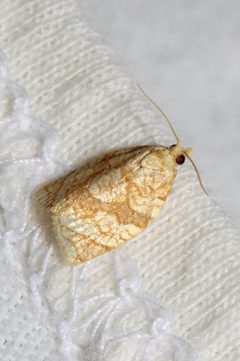
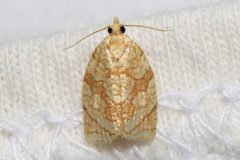
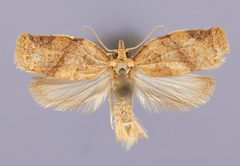
Adoxophyes are small tortricid moths with wingspans ranging from 15–22 mm. Males of A. orana have yellow ochre to reddish forewings with distinct rusty-red markings including a basal darker brown area and two large darker stripes; the stripe extends from the basal third of the to the tornus, while a preapical stripe may appear as a triangular spot. Females are typically darker, with blackish-brown forewings and dimmer, less distinct markings. Hind wings are light grey in males and grey-brown in females. Fully grown larvae are 18–20 mm long, green with a light brown , and resemble larvae of Archips rosanus but can be distinguished by their polyvoltine .
Images
Habitat
Orchards and agricultural areas with fruit trees, particularly apple, pear, peach, and cherry. Also found in supporting wild plants including of Betula, Crataegus, Cydonia, Ligustrum, Lonicera, Populus, Quercus, Ribes, Rubus, Rosa, Salix, Syringa, Tilia, Ulmus, and Vaccinium.
Distribution
Europe: Austria, Belgium, Britain, Bulgaria, Denmark, Finland, France, Germany, Hungary, Italy, Netherlands, Norway, Poland, Romania, Spain, Sweden, Switzerland, former Yugoslavia, Greece (first recorded 1985). Asia: China, Japan, USSR. North America: Vermont, United States.
Seasonality
Polyvoltine with geographic variation: two per year in Switzerland ( emerge late May–early June), three flights in Greece with second and third overlapping. Diapausing larvae hibernate in the third instar and resume development in spring.
Diet
Larvae feed primarily on young leaves and shoots; occasionally feed on fruit surfaces. Also feed on buds, leaves, and green or ripe fruits. range includes cultivated and wild plants: Malus (apple), Prunus persica (peach), Prunus (cherry), Pyrus (pear), Vitis vinifera (grapevine), and numerous woody and herbaceous .
Life Cycle
laid in batches on fruits or leaves; oviposition site varies by (both leaf sides on peach and cherry, upper side only on apple). Larvae develop through multiple instars with three periods of larval activity per year. Diapausing third-instar larvae abandon feeding sites in early October and spin hibernating webs near auxiliary buds and in bark crevices to overwinter. emerge following temperature-dependent development in spring.
Behavior
Males locate females using , exhibiting upwind , non-orientated wing fluttering, and orientated fluttering when detecting female odor. Sexually active males inhibit the sexual of downwind males through olfactory signals, causing downwind males to increase the lateral component of their search path. This behavior may increase probability of finding females in natural conditions.
Ecological Role
Larvae are significant defoliators and fruit feeders in orchards, causing severe economic damage to apple, pear, peach, and cherry crops. The damage potential is such that established would be readily detected by growers. Serves as for including Ascogaster reticulatus (Braconidae). Subject to by (AdorNPV, AdhoNPV) and targeted by programs.
Human Relevance
Major agricultural pest requiring monitoring and control in fruit orchards. Management methods include visual examination of flower clusters and shoots, trapping, temperature-based models for timing treatments, classical (most effective at after first ), (fenoxycarb effective against larvae), granulosis viruses, and techniques under study.
Similar Taxa
- Archips rosanusLarva resembles Adoxophyes orana in appearance (green body, light brown ) but distinguished by monovoltine versus polyvoltine cycle in Adoxophyes.
Sources and further reading
- BugGuide
- Wikipedia
- GBIF taxonomy match
- iNaturalist taxon
- NCBI Taxonomy
- Catalogue of Life
- Adoxophyes orana . [Distribution map].
- Summerfruit tοrtriχ, Adoxophyes orana: life cycle, warning system and control
- First records of the summerfruit tοrticid, Adoxophyes oranα F. ν .R. in Greece
- Effect of parasitism byAscogaster reticulatus [Hym.: Braconidae] on growth of the host,Adoxophyes sp. [Lep.: Tortricidae]
- Genomic sequence and biological characterization of a nucleopolyhedrovirus isolated from the summer fruit tortrix, Adoxophyes orana
- Olfactory Interactions Between Sexually Active Males in Adoxophyes Orana (F.V.R.) (Lepidoptera: Tortricidae)
- Calling behavior and pheromone titer in the smaller tea tortrix moth,Adoxophyes sp. (Lepidoptera: Tortricidae)
- Plant responses induced by Adoxophyes honmai oviposition in host tea plants and non-host Arabidopsis thaliana