
Liometopum apiculatum
Mayr, 1870
Escamolera Ant, Velvet Tree Ant
Liometopum apiculatum is a Neotropical dolichoderine with significant ecological and economic importance. Colonies are large and polydomous, ranging from a few hundred to hundreds of thousands of . The is notable for its distinctive carton-like nest construction and its role as a traditional food source in Mexico, where the larvae and pupae (escamoles) are harvested. It inhabits diverse arid and semi-arid vegetation types across southwestern North America.
Pronunciation
How to pronounce Liometopum apiculatum: /ˌli.oʊˈmɛt.oʊ.pʌm ˌæp.ɪˈkjuː.leɪ.təm/
These audio files are automatically generated. While they are not always 100% accurate, they are a good starting point.
Identification
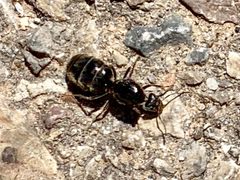
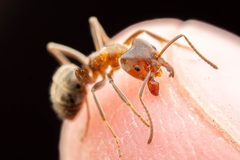
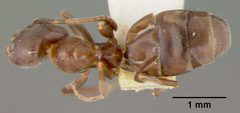
Distinguished from L. luctuosum by finer carton nest material and by being replaced by L. luctuosum at higher elevations in zones of overlap. Distinguished from L. occidentale by less erratic movement at high temperatures. The pointed petiole and dense are diagnostic morphological traits.
Images
Habitat
Occupies arid and semi-arid regions including desert scrub, thorn scrub, oak forests, pinyon pine zones, ponderosa pine-riparian areas, creosote bush scrub, and grasslands. Prime is oak forests around 2,000 m elevation. Nests occur in diverse substrates: soil (especially clay), under rocks and boulders, in decaying logs, at bases of trees and shrubs, among roots of xerophytes (Agave, Opuntia, Yucca, Prosopis), and occasionally in human-made containers. Nests are typically underground with distinctive hollowed chambers filled with branched networks of carton-like material made from agglomerated soil and oral secretions.
Distribution
Southwestern United States (Colorado, Texas, New Mexico, southeastern Arizona) and Mexico (extending to Quintana Roo). New records from Zacatecas, San Luis Potosí, Nuevo León, and Coahuila. Elevation range: 1,316–2,500 m in U.S.; 2,000–3,000 m in some Mexican regions; absent below 1,800 m in studied Mexican regions despite apparently favorable conditions.
Seasonality
Foraging occurs from March to September. Maximal activity between 12 p.m. and 12 a.m. during summer months. occur during the day after heavy rain in April or May. reproductives present in nests May–August; males and collected outside nests June–August; founding queens collected July–August.
Diet
Opportunistic omnivore: honeydew from hemipterans (membracids, aphids, scale insects including Cinara spp., Dysmicoccus brevipes, Saissetia oleae), extrafloral nectar, floral nectar and pollen (from bear grass, Agave scabra, Agave chisosensis, Yucca spp.), seeds, insect prey (dead insects, insect pupae), crustaceans, annelids, mollusks, dead vertebrates, and animal droppings. Larger colonies are more . Hemipteran exudates often constitute the bulk of the diet.
Host Associations
- Toumeyella martinezae - mutualism insect tended by ants for honeydew; protects scale from
- Vanduzea segmentata - mutualismMembracid tended for honeydew
- Pogonomyrmex barbatus - /food solicitation observed soliciting food from this
- Camponotus sayi - /food solicitation observed soliciting food from this
- Solenopsis xyloni - /food solicitation observed soliciting food from this
- Agave scabra - food sourceNectar/pollen and substances from outside of ovaries consumed
- Agave chisosensis - food sourceNectar/pollen and substances from outside of ovaries consumed
- Yucca filifera - nesting substrate and food sourceNests in decaying stalks; nectar/pollen source
- Prosopis juliflora - nesting substrateRoots used as nesting site
- Myrtillocactus geometrizans - nesting substrateRoots used as nesting site
- Senecio praecox - nesting substrateRoots used as nesting site
- Schinus molle - nesting substrateRoots used as nesting site
Life Cycle
Haplometrotic colony foundation: single fertile founds each colony. Founding queens lay (consumed as food) initially, then delay further oviposition until first reach pupal stage; once first emerge, queen stops laying trophic eggs. Eggs laid year-round. Colony development: founding queens may live 17–316 days under laboratory conditions (though wild longevity likely greater). Males live 15–37 days; virgin queens 19–268 days. Some virgin queens emerge, remove wings, and establish nests without mating, laying and consuming eggs to survive. Colonies become polydomous with satellite nests; size ranges from few hundred to 250,000+ workers. Colonies exploited for escamoles contain 65,000–85,000 individuals; undisturbed colonies may reach 250,000. Productive for human harvesting for 4–12 years.
Behavior
Mass foraging on conspicuous trails 2–3 cm wide on soil surface. Trail-following, alarm, aggression, and nestmate recognition mediated by (32 identified). exhibit temperature-dependent foraging: cease activity at midday when temperature rises sharply, seeking shelter under stones. Speed increases exponentially with temperature (0.44 to 6.60 cm/s over 30°C increase). Foraging areas average 612 m² but only 16–30% used at any time; distribution strongly correlated with location of hemipteran-infested shrubs and trees. Pre- : workers become agitated, leave nest, run rapidly in zig-zag pattern, bite legs and wings of to force them to climb vegetation, excite alates with bites until wing-beating begins; alates initiate individually rather than in swarm. Mating occurs in air; mated pairs fall to earth still attached.
Ecological Role
Significant ecological engineer through soil modification and nest construction. Key mutualist for honeydew-producing hemipterans, facilitating their growth and potentially disrupting . Contributes to nutrient cycling through decomposition activities and seed . Gut (Proteobacteria, Firmicutes, Actinobacteria) degrade recalcitrant compounds and phthalates, contributing to nutrient release from plant material and potential bioremediation. and scavenger in .
Human Relevance
Traditional food source in central Mexico: larvae and pupae (escamoles) harvested as delicacy with high market value. Nutritional composition: 42–51% protein, 30–35% lipid, 6–8% minerals on dry basis. Overharvesting has led to declines; assessed as "Subject to Special Protection" under Mexican conservation methodology. Potential for sustainable harvesting exists but requires management. Biotechnological interest in gut for lignocellulosic hydrolysis and bioremediation applications.
Similar Taxa
- Liometopum luctuosumReplaced by L. apiculatum at higher elevations; co-occurs in some Mexican regions 2,000–3,000 m. Distinguished by coarser carton nest material and longer lifespan (though lower productivity). L. apiculatum nests at higher densities.
- Liometopum occidentaleWestern with more erratic movement at high temperatures; L. apiculatum movement is less erratic under thermal stress.
More Details
Semiochemical Communication
32 identified in nests, foraging trails, and gasters; induce trail-following, alarm, aggression, and nestmate recognition. traffic and semiochemical profiles vary across pre-season, season, and post-season of larval collection.
Conservation Status
Mexican Risk Assessment Methodology (MER) scores: restricted distribution (3), apt (1), low biological vulnerability (1), medium human impact (3). Total score places species in "Subject to Special Protection" category, informing management policies for edible insect conservation.
Gut Microbiota
Complex bacterial consortium enables survival in food-limited arid environments through biopolymer degradation and detoxification capabilities, with biotechnological applications for processing and bioremediation.
Sources and further reading
- BugGuide
- Wikipedia
- GBIF taxonomy match
- iNaturalist taxon
- NCBI Taxonomy
- Catalogue of Life
- The Bee and the Ant | Bug Squad
- Intriguing Topic: Social Evolution in Social Insects | Bug Squad
- Bug Squad
- Review of the Current State of Knowledge on Liometopum apiculatum Mayr, 1870 (Hymenoptera: Formicidae)
- Biodegradation of recalcitrant compounds and phthalates by a consortium of Liometopum apiculatum gut microbiota
- Influence of environmental conditions on insect reproduction and chemical composition of escamoles (Liometopum apiculatum M)
- First detailed description and comparative morphology of male and female genitalia of Liometopum apiculatum (Hymenoptera: Formicidae)
- New geographic distribution records of Liometopum apiculatum Mayr, 1870 (Hymenoptera, Formicidae) in central northern Mexico
- Volatile organic compounds in the habitat of the escamolera ant (Liometopum apiculatum Mayr) in Zacatecas, Mexico
- Semiochemical Compounds of <em>Liometopum apiculatum</em> (Mayr) (Hymenoptera: Formicidae: Dolichoderinae) during the Development of Larvae of the Reproductive Caste
- DETERMINATION OF THE CONSERVATION STATUS OF THE “ESCAMOLERA” ANT (Liometopum apiculatum MAYR) IN MEXICO BY THE SPECIES RISK ASSESSEMENT METHODOLOGY – MER
- Structural and physicochemical changes due to proteolytic deterioration of escamoles (Liometopum apiculatum) a traditional Mexican food
- Effects of Parasitism on the Population Growth of Toumeyella martinezae (Coccidae) in the Presence of Its Mutualistic Ant Liometopum apiculatum (Formicidae) in an Arid Region of Central Mexico.