
Liometopum occidentale
Emery, 1895
velvety tree ant, Western Velvety Tree Ant
Liometopum occidentale, commonly known as the velvety tree , is a of ant in the Dolichoderinae native to western North America. The species is frequently misidentified as carpenter ants (Camponotus spp.) due to shared morphological traits including polymorphic , a smooth convex thoracic profile, and wood-excavating . This misidentification has led to underreporting of its significance as a structural pest in California, Oregon, and Washington. Colonies are large and polydomous, with worker estimated between 40,000 and 60,000 individuals.


Pronunciation
How to pronounce Liometopum occidentale: //ˌlaɪ.oʊˈmɛtəpəm ˌɑksɪˈdɛnteɪli//
These audio files are automatically generated. While they are not always 100% accurate, they are a good starting point.
Identification
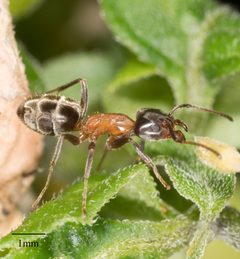
Liometopum occidentale can be distinguished from carpenter ants (Camponotus spp.) by careful examination of key morphological features. are polymorphic in size, ranging from approximately 3 to 6 mm. The has a smooth, convex profile without the distinct metanotal groove present in many Camponotus . The petiole is single-noded. The body surface appears velvety due to dense . When crushed, workers emit a distinct odor variously described as rotten coconut or citronella-like, a trait absent in carpenter ants. The is often darker than the and thorax, creating a bicolored appearance.
Images
Habitat
Found from sea level to over 1,840 m elevation, with elevation range varying by latitude. In Oregon, colonies occur as low as 7 m elevation, while in California they extend up to 1,700 m. The is the most common and in oak and pine forests of the southwestern United States. Nests occur in soil, crevices of living trees (oaks, alders, elms, cottonwoods, creosote), and under bark of dead trees. Nest locations are often cryptic; some colonies may nest deep under large boulders or among roots of large trees.
Distribution
Coastal and adjacent regions from southern Washington through Oregon and California to northern Mexico. Core range includes the western United States, with significant in California, Oregon, and Washington.
Seasonality
of reproductives observed throughout May. Foraging activity occurs year-round in suitable climates, with massive above-ground trails visible even on hot days between 24 and 38°C.
Diet
Opportunistic omnivores. tend hemipterans for honeydew and carry prey insects to the nest. Documented attendance of hemipterans in citrus groves. Specific feeding preferences remain insufficiently studied for development of effective baits.
Life Cycle
productivity for a colony of 40,000–60,000 is estimated at 2–2.8 kg of per year, sustained for 4–8 years. Colony foundation has not been studied in detail. Workers lacking a will lay unfertilized that are either consumed or develop into males.
Behavior
Forms massive foraging trails extending 60 m or more from the nest. Foraging occurs in very shallow underground galleries (1–2 cm deep), in leaf litter, and on above-ground trails. Foraging territories average 740 m² of actively used space within total home ranges up to 2,000 m². exhibit minimal aggression between colonies separated by significant distances, suggesting large polydomous colony structures without territorial boundaries. Wood excavation resembles that of carpenter ants.
Ecological Role
in oak and pine forest of the southwestern United States. Tending of hemipterans may influence plant health and dynamics in agricultural settings including citrus groves, though specific impacts remain undetermined.
Human Relevance
Significant but underreported structural pest in California, Oregon, and Washington due to wood-excavating and misidentification as carpenter ants. Damage to wooden structures occurs through nest excavation. Effective pest management is hindered by lack of knowledge regarding feeding preferences and optimal .
Similar Taxa
- Camponotus spp.Carpenter ants share polymorphic , smooth convex thoracic profile, and wood-excavating , leading to frequent misidentification. Distinguished by presence of metanotal groove, absence of velvety , and lack of characteristic odor when crushed.
- Liometopum apiculatumCongeneric with which L. occidentale was once synonymized; differs in foraging territory utilization patterns and geographic distribution.
Misconceptions
Commonly misidentified as carpenter ants by homeowners and pest management professionals, leading to underreporting of its structural pest status and potentially inappropriate control measures.