
Oxybelus
Latreille, 1797
spiny digger wasps
Species Guides
5- Oxybelus bipunctatus(square-headed wasp)
- Oxybelus cressonii(square-headed wasp)
- Oxybelus emarginatus(square-headed wasp)
- Oxybelus sericeus
- Oxybelus uniglumis(square-headed wasp)
Oxybelus is the largest in the Crabronidae, comprising approximately 264 described of solitary commonly known as spiny digger wasps. The genus has a distribution, occurring worldwide except in the Australasian region, with particular diversity in the Palearctic. Species are specialized of flies (Diptera), exhibiting distinctive prey capture and transport . Multiple species have been studied for their unique sting and reduced paralyzing sting sequence relative to other digger wasps.

Pronunciation
How to pronounce Oxybelus: /ˌɒk.sɪˈbiː.ləs/
These audio files are automatically generated. While they are not always 100% accurate, they are a good starting point.
Identification
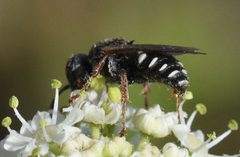
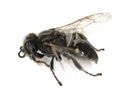
Oxybelus can be recognized by their slender, often metallic bodies and the characteristic spiny appearance of the propodeum (the part of the ), which gives the group its . The sting apparatus is morphologically distinctive: Oxybelus uniglumis possesses a single valvillus (rather than the double valvillus found in all other known ), and lacks distinct borders between the rostral process and second valvula. These are generally smaller than related crabronid such as Philanthus (beewolves) and Bembix (sand wasps).
Images
Habitat
nest in varied substrates including soil, sand, and human-made structures. Oxybelus variegatus has been documented nesting in crevices between paving stones in agricultural wasteland. Nests are typically excavated using , legs, and , consisting of a main burrow with one or rarely two .
Distribution
Worldwide distribution excluding the Australasian realm. Particularly well-represented in the Palearctic region. Documented in North America (including southeastern United States and Colorado), Europe, and other regions. Twenty-four are recorded from Europe including O. uniglumis, O. argentatus, O. trispinosus, and O. bipunctatus.
Seasonality
Nesting shows seasonal variation. Oxybelus bipunctatus exhibits documented seasonal changes in nesting activity. have been observed visiting flowering trees for nectar, with activity patterns that may segregate temporally among sympatric .
Diet
Specialized of flies (Diptera). Oxybelus variegatus provisions with paralyzed male flies of Delia platura (Anthomyiidae), averaging approximately 11 flies per cell. Oxybelus argentatus and O. trispinosus hunt for different prey types where sympatric. Prey are paralyzed using a reduced sting sequence: typically a single thoracic sting behind one foreleg base, rather than the multiple stings used by orthopteran-hunting .
Life Cycle
The stage lasts approximately two days. Larvae develop in individual nest provisioned with paralyzed flies. The mature larva of O. variegatus has been described. Development occurs in underground or crevice nests with one or rarely two cells per nest. Some nests are subject to kleptoparasitism by dipteran such as Senotainia conica.
Behavior
Females hunt flies and paralyze them with a single thoracic sting, matching the reduced ganglionic structure of dipteran prey. Uniquely among studied digger wasps, Oxybelus uses the sting apparatus for prey carriage to the nest, resulting in morphological adaptations including the single valvillus and strengthened of the valvula. Males have been observed guarding nests in some . Sympatric species segregate by activity time, prey type, and nesting . visit flowers for nectar.
Ecological Role
of dipteran , potentially providing of fly including agricultural pests such as Delia platura (seedcorn maggot). Serve as prey for kleptoparasitic flies. may contribute to pollination through nectar feeding.
Human Relevance
Potential biocontrol agents for pest fly . Nesting in paved areas can bring them into proximity with human activity. One European , O. cocacolae, was described in 1968 with an unconventional epithet referencing the Coca-Cola company.
Similar Taxa
- PhilanthusBoth are crabronid , but Philanthus (beewolves) prey on bees rather than flies, are generally larger, and possess the standard double valvillus sting structure.
- BembixBoth are sand-nesting crabronids, but Bembix are typically larger, lack the distinctive spiny propodeum, and have different prey preferences.
- TachytesBoth are crabronid found in similar , but Tachytes hunt different prey (typically Orthoptera or other insects) and do not use the sting for prey carriage.
More Details
Sting morphology
Oxybelus uniglumis exhibits intraspecific variability in sting skeleton structure, previously unrecorded in Hymenoptera, possibly reflecting mechanical demands of prey carriage .
Prey paralysis mechanism
Unlike orthopteran-hunting that deliver multiple stings to match thoracic ganglia, Oxybelus delivers a single thoracic sting corresponding to the ganglionic mass of dipteran prey.
Kleptoparasitism
Nests are frequently visited by kleptoparasitic dipteran females, though actual rates may be low.
Sources and further reading
- BugGuide
- Wikipedia
- iNaturalist taxon
- NCBI Taxonomy
- Catalogue of Life
- Bug Eric: Wasp Wednesday: The Wasp Tree Part II
- Behavioral Observations on Oxybelus in Southeastern North America1
- SEASONAL VARIATION IN NESTING BEHAVIOR OF OXYBELUS BIPUNCTATUS (HYMENOPTERA: SPHECIDAE)
- Small–scale sympatric digger wasps Oxybelus argentatus and Oxybelus trispinosus segregate activity, hunt for different prey, and diverge in nesting behaviour
- Seasonal Variation in Nesting Behavior of Oxybelus bipunctatus (Hymenoptera: Sphecidae)
- Nesting Behavior of Nearctic Species of Oxybelus (Hymenoptera: Sphecidae)1,2
- Life History of Oxybelus variegatus Wesmael, 1852 (Hymenoptera: Crabronidae) with a Description of the Mature Larva
- Morphology of the sting apparatus of the digger wasp Oxybelus uniglumis (Linnaeus, 1758) (Hymenoptera, Crabronidae), with emphasis on intraspecific variability and behavioural plasticity
- Digger wasp predatory behavior (Hymenoptera, Sphecidae): fly hunting and capture by Oxybelus uniglumis (Crabroninae: Oxybelini); a case of extremely concentrated stinging pattern and prey nervous system
- Nesting Biology of Oxybelus Sericeus With a Discussion of Nest Guarding by Male Sphecid Wasps (Hymenoptera)
- Nesting Behavior of <I>Oxybelus lamellatus</I> Olivier (Hymenoptera: Sphecidae)