
Delia platura
(Meigen, 1826)
seedcorn maggot, bean seed fly
Delia platura is a pest in the Anthomyiidae, commonly known as the or bean seed fly. It attacks germinating seeds and seedlings of over 40 plants including corn, soybeans, beans, peas, and cruciferous vegetables. Larvae typically feed on decaying organic matter but will invade healthy plant tissue when cool, wet spring conditions delay crop germination, causing significant agricultural losses. The is also a documented of bacterial , including Erwinia amylovora which causes fire blight in apple and pear trees. Two cryptic genetic lines (H-line and N-line) with distinct distributions and mating have been identified, with H-line females showing strong mate selectivity.
Pronunciation
How to pronounce Delia platura: /ˈdɛl.i.ə ˈplæ.tʊr.ə/
These audio files are automatically generated. While they are not always 100% accurate, they are a good starting point.
Identification
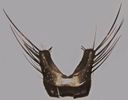
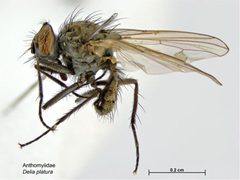
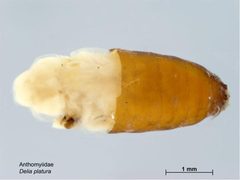
are small gray flies approximately 5-7 mm in length with a humpbacked appearance typical of anthomyiid flies. Larvae are legless, creamy-white maggots up to 8 mm long with a tapered end and two dark mouth hooks visible at the tip. are small, football-shaped, and brown, typically found in the upper 10 cm of soil. The is morphologically identical between its two genetic lines (H and N), requiring molecular methods for differentiation. Similar to other Delia species such as D. radicum (cabbage maggot) and D. antiqua (onion maggot), but distinguished by broader range and preference for germinating seeds over established root systems.
Images
Habitat
Agricultural fields with newly planted seeds, particularly in cool, moist soils with high organic matter. Larvae develop in soil around plant roots, feeding on germinating seeds and seedling tissues. feed on nectar from spring-blooming plants. In Mexico, found in cultivated crucifer crops (broccoli, cabbage, turnip, radish) and associated wild crucifers including wild radish (Raphanus raphanistrum), field mustard (Brassica campestris), and London rocket (Sisymbrium irio).
Distribution
distribution across temperate and subtropical regions. Documented in Europe (including UK, France, Germany, Italy, Spain), North America (USA, Canada, Mexico), Central and South America (Argentina, Brazil, Chile, Peru), Asia (China, India, Japan, Korea), Africa (Algeria, Egypt, Kenya, South Africa), and Australasia (Australia, New Zealand, Hawaii). In North America, particularly problematic in the northeastern United States and eastern Canada. Two genetic lines show distinct distribution patterns: H-line and N-line have been identified in Québec, Canada with different geographic ranges.
Seasonality
emerge in early spring from in soil. Multiple occur annually in temperate regions; in Maryland, 3-4 generations per year have been observed. Peak adult activity coincides with spring planting periods. models have been developed to predict spring and first in New York State, aiding in timing of management interventions. Activity declines as summer temperatures rise, though continued breeding occurs if soil moisture and availability permit.
Diet
Primarily saprophagous, feeding on decaying organic matter in soil. Under favorable conditions, larvae feed on germinating seeds and root tissues of living plants. Documented include: soybeans, corn, beans, peas, cucumber, melon, onion, pepper, potato, lima bean, spinach, dry bean, broccoli, cabbage, turnip, radish, and other cruciferous vegetables. feed on nectar from spring-flowering plants.
Life Cycle
Complete with , three larval instars, pupa, and stages. Eggs are laid in soil, with oviposition stimulated by germinating seeds and associated microorganisms. Larvae hatch and feed on seed contents or decaying matter; third instar larvae have limited movement, remaining within upper 10 cm of soil. occurs in soil within football-shaped . Development from egg to adult can occur in approximately one month under favorable temperatures. occurs as puparium in soil. Rearing studies indicate successful development at 26 ± 2 °C with 60 ± 10% relative humidity and 12:12 .
Behavior
form high- mating swarms with male-biased sex ratios. H-line females exhibit strong mate choice, rarely accepting N-line males, while N-line females are less selective. This pre-mating isolation mechanism contributes to maintenance of distinct genetic lines. Adults are attracted to rich soils with high organic content for oviposition. Larvae are difficult to control due to soil-dwelling habit and location inside plant tissues where contact cannot easily reach. Susceptible to fungus Entomophthora muscae, which manipulates infected flies to climb to elevated positions on vegetation before death to enhance spore .
Ecological Role
Agricultural pest causing direct damage to crop seeds and seedlings, with reported plant losses of 30-60% in affected fields despite typically low rates. Serves as for including Aphaereta pallipes (Braconidae), Trybliographa rapae (Figitidae), and Aleochara bimaculata (Staphylinidae), which may provide services. Acts as for bacterial plant , particularly Erwinia amylovora, facilitating transmission of fire blight in rosaceous crops through external carriage of bacterial on fly bodies for up to 5 days.
Human Relevance
Significant agricultural pest requiring integrated management strategies. Management approaches include: delaying spring planting until soils warm sufficiently for rapid seed germination; using (neonicotinoids such as clothianidin, imidacloprid, thiamethoxam; or anthranilic diamides including chlorantraniliprole); crop to non- crops; and maintenance of weed-free fields to reduce alternate hosts. No-till fields are generally less attractive to -laying females. potential exists through conservation of . The is also subject to research on sterile insect technique and release methods, though these must account for strong and mate choice .
Similar Taxa
- Delia radicumCabbage maggot; similar appearance and but more specialized on Brassicaceae root crops rather than germinating seeds of diverse
- Delia antiquaOnion maggot; closely related anthomyiid with similar but restricted to Allium
- Delia planipalpisCo-occurring anthomyiid pest of crucifers in Mexico, shares and similar damage , distinguished by preferences and subtle morphological differences
Sources and further reading
- BugGuide
- Wikipedia
- GBIF taxonomy match
- Catalogue of Life
- Pre-emergence insect control - AgriLife Extension Entomology
- Anthranilic Diamides Can Potentially Replace Neonicotinoid Seed Treatments in Vegetable Crops
- Archive — Bug of the Week
- Playing mind games with the seedcorn maggot, Delia platura — Bug of the Week
- Dead flies - seed corn maggot, Delia platura — Bug of the Week
- Delia platura Archives - Entomology Today
- Delia platura . [Distribution map].
- Seedcorn maggot, Delia platura (Meigen) (Insecta: Diptera: Anthomyiidae)
- Parasitoids of Delia planipalpis (Meigen) and Delia platura (Stein) (Diptera, Anthomyiidae) in Mexico
- Reproductive compatibility of two lines of Delia platura
- Founding and maintaining a seedcorn maggot (Delia platura) colony
- REPRODUCTIVE COMPATIBILITY OF TWO LINES OF DELIA PLATURA (DIPTERA: ANTHOMYIIDAE)
- THE EFFECT OF SEX RATIO AND GROUP DENSITY ON THE MATING SUCCESS OF TWO LINES OF DELIA PLATURA (DIPTERA: ANTHOMYIIDAE)
- The effect of sex ratio and group density on the mating success of two lines of Delia platura (Diptera: Anthomyiidae)
- Interactions Between Delia platura and Erwinia amylovora Associated with Insect-Mediated Transmission of Shoot Blight
- Degree-day models for predicting adult Delia platura (Diptera: Anthomyiidae) spring flight and first emergence in New York State.