
Delia
Robineau-Desvoidy, 1830
root maggot flies, seedcorn maggot flies
Species Guides
3- Delia platura(seedcorn maggot)
- Delia pluvialis
- Delia radicum(cabbage root fly)
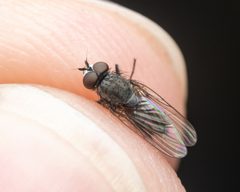
Delia is a of flies in the Anthomyiidae, commonly known as flies. Several are significant agricultural pests, particularly of cruciferous crops and seedlings. The genus includes economically important species such as Delia platura () and (cabbage maggot), whose larvae feed on seeds, roots, and developing plant tissues. are small, drab flies that feed on nectar and are often mistaken for house flies.
Pronunciation
How to pronounce Delia: /ˈdɛ.li.ə/
These audio files are automatically generated. While they are not always 100% accurate, they are a good starting point.
Identification
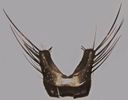
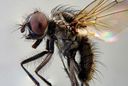
Delia flies resemble small house flies but can be distinguished by their more compact body, striped , and specific wing venation patterns. The is most reliably identified by microscopic examination of male genitalia, particularly the shape of the surstyli and pregonites. Larvae are distinguished from other root-feeding maggots by their pointed end and characteristic cephalopharyngeal skeleton. within Delia are notoriously difficult to separate based on external alone; accurate identification requires dissection of male terminalia or .
Images
Habitat
Agricultural fields, particularly those with cruciferous crops, legumes, and solanaceous vegetables. Also found in weedy field margins, gardens, and areas with decaying organic matter. Larval is soil around plant roots and germinating seeds. frequent flowers for nectar feeding.
Distribution
distribution with native to and introduced across temperate and subtropical regions worldwide. Particularly diverse in the Holarctic region. Individual species ranges vary: D. platura occurs globally, while others have more restricted distributions.
Seasonality
activity generally peaks in spring and early summer, with timing varying by and latitude. Multiple per year are common in temperate regions, with continuous breeding possible in warmer climates. from typically coincides with spring planting and crop germination.
Diet
Larvae feed on germinating seeds, roots, and hypocotyls of plants; some also feed on decaying organic matter. feed on nectar from flowers.
Host Associations
- Brassica oleracea - larval broccoli, cauliflower, cabbage varieties
- Brassica napus - larval canola/rapeseed
- Raphanus sativus - larval radish
- Zea mays - larval damage to germinating corn
- Phaseolus vulgaris - larval snap beans
- Allium cepa - larval onion
- Solanum tuberosum - larval potato
- Glycine max - larval soybean
Life Cycle
Complete with four stages: , larva, pupa, . Eggs laid in soil near plants or in decaying organic matter. Larvae pass through three instars, feeding on roots or seeds. occurs in soil within a hardened . Adults emerge to feed on nectar and mate. time approximately 3-6 weeks depending on temperature; multiple generations per year typical.
Behavior
are and visit flowers for nectar. Females exhibit oviposition targeted at soil with high organic content or near germinating seeds. Larvae are subterranean and move through soil to locate plant tissues. Adults of some are known to be manipulated by the fungus Entomophthora muscae, which causes infected flies to climb to elevated positions before death to facilitate spore .
Ecological Role
Larvae function as primary consumers of plant material and decomposers of organic matter. Some are significant agricultural pests causing direct damage to crop seedlings and roots. serve as when visiting flowers for nectar. The is subject to natural by fungi, particularly Entomophthora muscae, and various .
Human Relevance
Major agricultural pest causing millions of dollars in crop losses annually. Delia platura (), D. radicum (cabbage maggot/), and D. antiqua (onion maggot) are among the most economically damaging . Larval feeding destroys seeds and damages roots, leading to stand reduction, stunting, and plant death. Management relies on cultural practices (timing of planting, soil conditions), with , and . Some species have developed .
Similar Taxa
- Musca domestica Delia resemble house flies in size and general appearance, but differ in thoracic striping pattern, more compact body, and specific wing venation; also differ in and
- HylemyaAnother anthomyiid with similar ; distinguished by subtle differences in male genitalia and larval spiracular disc structure
- PegomyaAnthomyiid containing leaf-mining rather than root-feeders; similar but larvae create distinctive leaf mines rather than root damage
- FanniaSmall flies with similar drab coloration, but distinguished by distinctive wing venation with a marked bend in M and different larval
More Details
Taxonomic Complexity
The Delia contains numerous that are morphologically cryptic, making identification challenging. Recent studies have employed molecular techniques (COI barcoding) to clarify species boundaries and confirm identifications based on male genitalia .
Fungal Pathogen Interaction
Delia platura and related are susceptible to by the fungus Entomophthora muscae. Infected flies exhibit behavioral manipulation, climbing to elevated positions on vegetation before death—a phenomenon that has generated public interest when dead flies accumulate on plants in spring.
Integrated Pest Management
Research is ongoing to develop reduced-risk management strategies for Delia pests, including anthranilic diamide as alternatives to neonicotinoids, and optimization of planting dates to avoid peak periods.
Sources and further reading
- BugGuide
- Wikipedia
- iNaturalist taxon
- NCBI Taxonomy
- Catalogue of Life
- Playing mind games with the seedcorn maggot, Delia platura — Bug of the Week
- Dead flies - seed corn maggot, Delia platura — Bug of the Week
- Delia platura Archives - Entomology Today
- Anthranilic Diamides Can Potentially Replace Neonicotinoid Seed Treatments in Vegetable Crops
- Archive — Bug of the Week
- Figure 1 from: Meraz-Álvarez R, Bautista-Martínez N, Illescas-Riquelme CP, González-Hernández H, Valdez-Carrasco JM, Savage J (2020) Identification of Delia spp. (Robineau-Desvoidy) (Diptera, Anthomyiidae) and its cruciferous hosts in Mexico. ZooKeys 964: 127-141. https://doi.org/10.3897/zookeys.964.53947