
Aphaereta
Förster, 1862
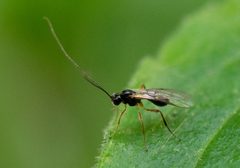
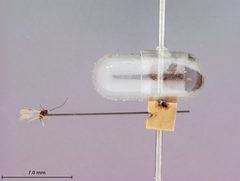
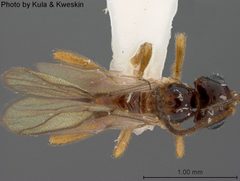
Aphaereta is a of braconid wasps in the tribe Alysiini, comprising approximately 48 described worldwide. Members are endoparasitoids of Diptera, with documented associations including -breeding flies, blow flies, shore flies, and fruit flies. The genus has been recorded across multiple continents including Europe, Asia, North America, South America, and Oceania. Several species have been studied for their potential in programs targeting pest flies.
Pronunciation
How to pronounce Aphaereta: /ˌæfɪˈriːtə/
These audio files are automatically generated. While they are not always 100% accurate, they are a good starting point.
Images
Distribution
. Documented from: Austria; Czech Republic (formerly Czechoslovakia); Germany; Hungary; Japan; Netherlands; Poland; Russia; Spain; United Kingdom; China (Xinjiang Region); India; New Zealand; Australia; Brazil; Azores (Portugal); Canada (Quebec, Ontario); United States (Missouri).
Host Associations
- Scatella stagnalis - Shore fly of A. debilitata
- dung-breeding flies (Diptera) - of A. aotea
- Hylemya antiqua (onion maggot) - of A. pallipes
- Hylemya brassicae (cabbage maggot) - of A. pallipes
- Ceratitis capitata (Mediterranean fruit fly) - of A. ceratitivora
- Peckia (Euboettcheria) collusor - of A. pallipes in Brazil
- Musca domestica (house fly) - of A. pallipes
- blow flies (Calliphoridae) - of Aphaereta sp.
Ecological Role
Endoparasitoid of various Diptera, particularly in , carrion, and agricultural settings. Some contribute to natural suppression of pest fly .
Human Relevance
Several investigated for potential, including A. debilitata for shore fly management in greenhouses and A. aotea for -breeding fly control. A. pallipes has been studied as a mortality agent for onion maggot and other agricultural pests.
Sources and further reading
- BugGuide
- Wikipedia
- GBIF taxonomy match
- iNaturalist taxon
- NCBI Taxonomy
- Catalogue of Life
- APHAERETA AOTEA SP. N. (HYMENOPTERA: BRACONIDAE), AN ALYSIINE PARASITE OF DUNG BREEDING FLIES
- HISTOCHEMISTRY OF THE EXCRETORY SYSTEM OF THE ENDOPARASITOID APHAERETA PALLIPES (SAY) (HYMENOPTERA: BRACONIDAE)
- Two new records from China: Aphaereta (Atopandrium) debilitata Morley and Elasmosoma berolinense Ruthe (Hymenoptera, Braconidae)
- On the oviposition behaviour, host selection, and developmental period of the hymenopterous parasite of blow flies, Aphaereta sp.
- Host Range and Eclosion Success of the Parasite Aphaereta pallipes (Hymenoptera: Braconidae) Among Dung-Breeding Diptera in Central Missouri1
- Figures 14–25 from: Oliveira L, van Achterberg K, Teixeira T (2012) Aphaereta ceratitivora sp. n. (Hymenoptera, Braconidae), a new parasitoid of Ceratitis capitata (Wiedemann) (Diptera, Tephritidae) from the Azores. ZooKeys 222: 1-9. https://doi.org/10.3897/zookeys.222.3618
- Aphaereta ceratitivora sp. n. (Hymenoptera, Braconidae), a new parasitoid of Ceratitis capitata (Wiedemann) (Diptera, Tephritidae) from the Azores
- Corrigendum to "A new parasitoid wasp, Aphaereta vondelparkensis sp. n. (Braconidae, Alysiinae), from a city park in the centre of Amsterdam"
- Notes on Anatomy, Life-history, and Behaviour ofAphaereta pallipes(Say) (Hymenoptera: Braconidae), a Parasite of the Onion Maggot,Hylemya antiqua(Meig.)
- The Importance of Being Large: The Relationship between Size and Fitness in Females of the Parasitoid Aphaereta minuta (Hymenoptera: Braconidae)
- On the occurrence of a Palaearctic species of the genus Aphaereta Foerster (Braconidae, Alysiinae) and description of a new species of the genus Leiophron Nees (Braconidae, Euphorinae) from central India
- Testing a candidate parasitoid in the glasshouse: control efficacy of Aphaereta debilitata (Hymenoptera: Braconidae) against shore fly populations
- Figures 1–13 from: Oliveira L, van Achterberg K, Teixeira T (2012) Aphaereta ceratitivora sp. n. (Hymenoptera, Braconidae), a new parasitoid of Ceratitis capitata (Wiedemann) (Diptera, Tephritidae) from the Azores. ZooKeys 222: 1-9. https://doi.org/10.3897/zookeys.222.3618
- Reactions of Musca domestica L. (Diptera: Muscidae) to parasitism by Aphaereta pallipes (Say) (Hymenoptera: Braconidae), with special reference to host diet and parasitoid toxin
- Aphaereta pallipes (Hymenoptera: Braconidae) and Dirhinus anthracia (Hymenoptera: Chalcididae) associated with Peckia (Euboettcheria) collusor (Diptera: Sarcophagidae) in Brazil