
Oxybelus bipunctatus
Olivier, 1812
square-headed wasp
A square-headed wasp in the Crabronidae with a broad geographic distribution spanning Africa, Europe, Northern Asia (excluding China), and North America. The exhibits seasonal variation in nesting and is known to provision nests with paralyzed flies. Two are recognized: O. b. bipunctatus and O. b. thermophilus.


Pronunciation
How to pronounce Oxybelus bipunctatus: /ˌɒksɪˈbiːləs ˌbaɪpʌŋkˈteɪtəs/
These audio files are automatically generated. While they are not always 100% accurate, they are a good starting point.
Identification
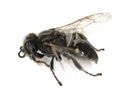
Distinguished from other Oxybelus by the characteristic pair of punctures on the propodeum that give the species its name. The square-headed is typical of the , with a transverse ridge on the propodeum. Females can be observed carrying flies in a distinctive manner, grasping prey by the mouthparts.
Images
Habitat
Sandy soils suitable for burrow excavation. Often found in proximity to fresh manure, which attracts the muscoid flies that serve as prey.
Distribution
Africa; Europe and Northern Asia (excluding China); North America. Present on multiple continents with established in temperate and subtropical regions.
Seasonality
Nesting varies seasonally; activity patterns shift across the year though specific seasonal timing varies by region.
Diet
Muscoid flies (Muscidae), including house flies and related filth flies. Females paralyze prey with a sting and transport them to nest .
Life Cycle
Females excavate burrows 30–50 cm deep in sandy soil, terminating in one to ten individual . Each cell is provisioned with four to nine paralyzed flies; an is laid on the last victim. Cells are closed with an earthen plug while the main tunnel entrance remains open during hunting.
Behavior
Solitary nesting that hunts in the vicinity of fresh manure. Females stalk prey in a creeping manner, pouncing to pin the fly's wings before stinging underneath the body. Once subdued, the wasp turns the fly over and grasps it by the mouthparts for transport. Males establish territories near manure and intercept females for mating.
Ecological Role
of muscoid flies, potentially contributing to of filth fly .
Human Relevance
Potential value as a agent for pest flies associated with livestock and rural , though are generally too sparse for practical application.
Similar Taxa
- Mellinus arvensisSimilar size (8–10 mm), , and fly-hunting ; distinguished by -level morphological characters and geographic distribution primarily in Europe.
- Other Oxybelus speciesShare square-headed and fly-hunting ; distinguished by the paired propodeal punctures characteristic of O. bipunctatus.
Sources and further reading
- BugGuide
- Wikipedia
- GBIF taxonomy match
- iNaturalist taxon
- NCBI Taxonomy
- Catalogue of Life
- Meloidae Holdings | Entomology Research Museum
- Bug Eric: Wasp Wednesday: Mellinus
- Bug Eric: Wasp Wednesday: The Wasp Tree Part II
- SEASONAL VARIATION IN NESTING BEHAVIOR OF OXYBELUS BIPUNCTATUS (HYMENOPTERA: SPHECIDAE)
- Seasonal Variation in Nesting Behavior of Oxybelus bipunctatus (Hymenoptera: Sphecidae)