
Ectemnius cephalotes
(Olivier, 1792)
Large Ectemnius
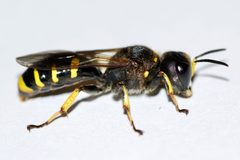
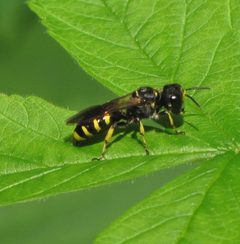
Ectemnius cephalotes is a of square-headed wasp in the Crabronidae. It is a solitary, that constructs underground nests. The species has a broad distribution spanning Europe, Northern Asia (excluding China), and North America. It is one of the larger members of the Ectemnius, which comprises approximately 80 species worldwide.
Pronunciation
How to pronounce Ectemnius cephalotes: /ɛkˈtɛm.ni.əs kɛˈfæ.loʊ.tiːz/
These audio files are automatically generated. While they are not always 100% accurate, they are a good starting point.
Identification
Distinguished from other Ectemnius by its larger size, which is reflected in its "Large Ectemnius." Separation from similar such as Crabro, Lestica, and Anacrabro requires examination of abdominal sternites and wing venation. Unlike Anacrabro, which has a very concave underside of the , Ectemnius species lack this extreme concavity. Accurate identification to species level often requires examination of male genitalia or detailed facial patterns.
Images
Appearance
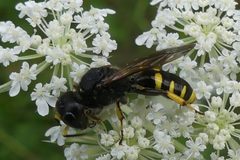
A relatively large member of the Ectemnius. The body is robust with a distinctly square or rectangular shape, characteristic of the tribe Crabronini. Coloration typically includes black and yellow markings. The mesosoma and metasoma show patterning consistent with other Ectemnius , though specific markings vary by region.
Habitat
Found in diverse open including meadows, gardens, forest edges, and anthropogenic environments. Nests are constructed in soil, often in sandy or loamy substrates that permit excavation. frequently visit flowers for nectar, particularly umbellifers such as wild carrot (Daucus carota) and goldenrod (Solidago).
Distribution
Europe; Northern Asia (excluding China); North America. Present across temperate regions of the Holarctic.
Seasonality
are active during the warmer months, typically from late spring through summer. Activity patterns vary by geographic region, with northern active later in the season.
Life Cycle
Solitary with nesting . Females excavate burrows in soil, constructing individual provisioned with prey. Development proceeds through complete : , larva, pupa, and . Specific details of prey preference and cell provisioning for this are not well documented in available sources.
Behavior
Females are solitary nesters that dig underground burrows for rearing offspring. of both sexes visit flowers to feed on nectar. Males may patrol nesting areas or vegetation to locate females. The does not exhibit social .
Ecological Role
As a member of Crabronidae, this likely functions as a of other insects, provisioning nests with paralyzed prey for larval development. contribute to pollination through nectar feeding at flowers.
Human Relevance
Like many solitary , this is not aggressive toward humans and stings only if handled. It may contribute to of insect in gardens and agricultural settings, though specific pest suppression data are lacking.
Similar Taxa
- Ectemnius continuusSimilar size and coloration; distinguished by subtle differences in facial punctuation and male genitalia
- Ectemnius lapidariusOverlapping distribution and use; requires examination of clypeal structure and propodeal for separation
- Crabro speciesSimilar overall appearance and nesting ; Crabro typically have different proportions and wing structure
- Anacrabro ocellatusSimilar black and yellow coloration and size range; distinguished by Anacrabro's very concave abdominal underside and exclusive prey preference for Miridae plant bugs
More Details
Taxonomic Note
The Ectemnius was formerly placed in the Sphecidae but is now classified in Crabronidae following molecular phylogenetic studies. The was originally described by Olivier in 1792.
Nomenclature
The specific epithet 'cephalotes' refers to the (Greek: kephalē), alluding to the characteristic head shape of the .
Sources and further reading
- BugGuide
- Wikipedia
- GBIF taxonomy match
- iNaturalist taxon
- NCBI Taxonomy
- Catalogue of Life
- ESA Entomology Games Are Both Educational and Entertaining | Bug Squad
- Meloidae Holdings | Entomology Research Museum
- Prime Time for Learning | Bug Squad
- Ant Fossils from Europe Resemble Modern Asian Ants
- Bug Eric: Wasp Wednesday: Anacrabro ocellatus
- Why Fungus-Farming Ants Could Be a Source for New Antimicrobial Compounds