
Anacrabro ocellatus
Packard, 1866
square-headed wasp
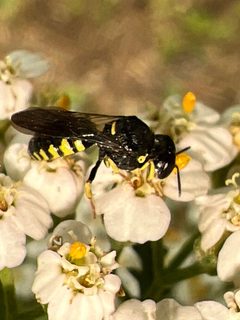
Anacrabro ocellatus is a small (6-7 mm) in the Crabronidae. Unlike most related in tribe Crabronini that hunt flies, this specializes in capturing plant bugs (family Miridae) to provision its subterranean nest . It is widespread east of the Rocky Mountains in North America, with three recognized . The species is notable for its potential role in of agricultural pests.
Pronunciation
How to pronounce Anacrabro ocellatus: //ˌænəˈkreɪbroʊ oʊˈsɛlətəs//
These audio files are automatically generated. While they are not always 100% accurate, they are a good starting point.
Identification
Can be distinguished from similar-looking such as Ectemnius, Lestica, and Crabro by the very concave underside of the . Females are most readily identified by their of transporting plant bugs in the Miridae, particularly of Lygus lineolaris (Tarnished Plant Bug), as prey. In North America, a small black and yellow wasp carrying a mirid bug is likely to be this .
Images
Appearance
Habitat
Found in open areas with weedy vegetation. Nests in soil, often in areas with overhanging vegetation that conceals the entrance. frequently visit flowers for nectar, particularly wild carrot (Daucus carota), goldenrod (Solidago), and milkweed (Asclepias).
Distribution
Widespread east of the Rocky Mountains in North America. Also recorded in Central America. Two in North America: A. o. ocellatus (eastern) and A. o. micheneri; A. o. boerhaviae occurs in the extreme southwestern United States and Mexico.
Seasonality
active during summer months. One observation record from August 6, 2009 in Massachusetts.
Diet
feed on nectar from flowers including wild carrot (Daucus carota), goldenrod (Solidago), and milkweed (Asclepias). Females provision nest with 4-9 adult plant bugs ( Miridae), almost exclusively Lygus lineolaris (Tarnished Plant Bug), as food for larvae.
Host Associations
- Lygus lineolaris - preyTarnished Plant Bug; primary prey item for larval provisioning
- Daucus carota - food sourcewild carrot, Anne's Lace; nectar source for
- Solidago - food sourcegoldenrod; nectar source for
- Asclepias - food sourcemilkweed; nectar source for
Life Cycle
Females dig nearly vertical burrows 9-16 cm deep in soil. Shaft may wind or loop in hard-packed soil. Short side tunnels may occur halfway down, or longer side burrows diverge near the bottom. Very short passages radiate from side tunnels, each terminating in a single . Each cell receives 4-9 prey and contains one larva. Nests contain 1-10 cells. Females may construct multiple nests.
Behavior
Solitary, nesting . Females disperse excavated soil to conceal nest entrance. Between hunting and nest-digging, visit flowers for nectar. Suffers relatively little from nest ; ants occasionally prey on contents.
Ecological Role
of plant bugs, particularly Lygus lineolaris, a significant agricultural pest that feeds on over half of all cultivated plant in the continental United States. Serves as a natural agent for this pest species.
Human Relevance
Potential value as a agent for Tarnished Plant Bug (Lygus lineolaris), a feeder that causes severe damage to crops and garden plants. No negative impacts to humans documented.
Similar Taxa
- EctemniusSimilar appearance; distinguished by less concave abdominal underside and different prey (flies rather than plant bugs)
- LesticaSimilar appearance; distinguished by less concave abdominal underside and different prey (flies rather than plant bugs)
- CrabroSimilar appearance; distinguished by less concave abdominal underside and different prey (flies rather than plant bugs)
- HylaeusYellow-faced bees may be mistaken for this due to similar size and coloration; distinguished by and (bees carry pollen, this wasp carries plant bugs)
More Details
Subspecies
Three recognized: Anacrabro ocellatus ocellatus Packard, 1866 (nominate subspecies, eastern North America); Anacrabro ocellatus boerhaviae Cockerell, 1895 (extreme southwestern U.S. and Mexico); Anacrabro ocellatus micheneri Leclercq, 1973.
Nesting Biology
Based on Kurczewski & Peckham (1970), females take care to disperse excavated soil and conceal nest entrances under overhanging vegetation, apparently as anti- strategies.
Sources and further reading
- BugGuide
- Wikipedia
- GBIF taxonomy match
- iNaturalist taxon
- NCBI Taxonomy
- Catalogue of Life
- Bug Eric: Wasp Wednesday: Anacrabro ocellatus
- Guest blog post: Unique feeding behaviour of Asian kukri snakes gutting frogs and toads | Blog
- La Reserva Ecologica Costanera Sur | Beetles In The Bush
- Nesting Behavior of Anacrabro ocellatus ocellatus (Hymenoptera: Sphecidae)