
Ectemnius
Dahlbom, 1845
Species Guides
19- Ectemnius arcuatus(square-headed wasp)
- Ectemnius borealis
- Ectemnius centralis(square-headed wasp)
- Ectemnius cephalotes(Large Ectemnius)
- Ectemnius continuus(Common Ectemnius)
- Ectemnius decemmaculatus
- Ectemnius dilectus
- Ectemnius dives
- Ectemnius lapidarius
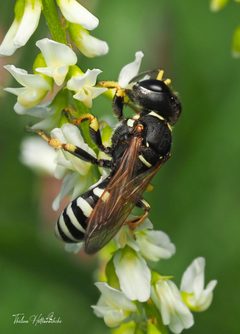
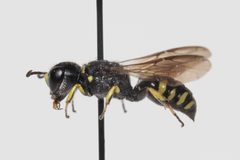
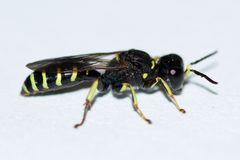
Ectemnius is a large of solitary digger wasps in the Crabronidae, comprising approximately 188 distributed worldwide except for limited representation in Australia. Species are characterized by black bodies with yellow markings and nest construction in dead wood cavities. They provision nests with paralyzed flies for their larvae.
Pronunciation
How to pronounce Ectemnius: //ɛkˈtɛm.ni.əs//
These audio files are automatically generated. While they are not always 100% accurate, they are a good starting point.
Identification
Distinguished from similar in tribe Crabronini (Anacrabro, Lestica, Crabro) by the convex or flat underside of the ; Anacrabro has a very concave abdominal underside. -level identification requires examination of antennal structure in males, mandibular , and precise pattern of yellow markings.
Images
Appearance
Small to medium-sized with black bodies and yellow markings on scapes, pronotum, tibiae, and tergites. The is covered with shining silver hairs. Unusually for wasps, males lack an additional antennal segment, with both sexes possessing 12 antennal segments. Some exhibit reduced yellow markings on specific tergites or longitudinal striations on the .
Habitat
Woodlands, gardens, farmland, and forested areas. Nests are constructed in pre-existing cavities in dead wood including tree stumps, fallen trunks, rotting logs, standing dead wood, fence posts, and occasionally building timbers.
Distribution
Worldwide distribution with greatest diversity in the Holarctic region; common across Europe and North America. Australia has only two .
Seasonality
period varies by ; E. continuus active from early May to late September (likely in southern UK); E. lituratus has a later flight period from June to September. Most species .
Diet
females hunt medium-sized Diptera (flies) including Syrphidae, Muscidae, Calliphoridae, Tabanidae, Therevidae, Anthomyiidae, and Cordyluridae. Adults visit flowers of umbellifers (wild carrot, hogweed, wild parsnip, angelica, cow parsley, fennel, water-dropwort) for nectar.
Host Associations
- Anthomyiidae - preyhunted by E. lituratus
- Cordyluridae - preyhunted by E. lituratus
- Syrphidae - preyhunted by E. continuus
- Muscidae - preyhunted by E. continuus
- Calliphoridae - preyhunted by E. continuus
- Tabanidae - preyhunted by E. continuus
- Therevidae - preyhunted by E. continuus
Life Cycle
or depending on and latitude. Females construct nests in dead wood cavities, with nest structure varying from straight to branching and containing up to 10 . Each cell is provisioned with 6-8 paralyzed flies for a single larva.
Behavior
Females excavate or modify nest tunnels in dead wood using ; nesting can be large and dense with multiple females sometimes sharing a common nest entrance. are strongly associated with umbellifer flowers for both nectar and hunting prey.
Ecological Role
of medium-sized Diptera; and flower visitor of umbellifer plants. Contributes to of fly .
Human Relevance
Potential biocontrol agents for pest fly ; no significant negative impacts to humans. Nest construction in wooden structures may occasionally occur but is not considered economically damaging.
Similar Taxa
- AnacrabroSimilar black and yellow coloration; distinguished by very concave underside of and prey preference for plant bugs (Miridae) rather than flies
- LesticaSimilar appearance in tribe Crabronini; distinguished by abdominal structure and nesting
- CrabroSimilar appearance in tribe Crabronini; distinguished by morphological details of and
More Details
Nesting biology
Nests are constructed in pre-existing cavities rather than excavated de novo; females modify old burrows and similar cavities in dead wood. This distinguishes Ectemnius from some related that excavate soil burrows.
Antennal morphology
The absence of an additional antennal segment in males is unusual among and represents a derived condition within the . This trait is consistent across multiple Ectemnius studied.