
Crabro
Fabricius, 1775
Shield-handed Wasps, Square-headed Wasps
Species Guides
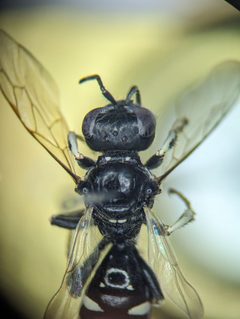
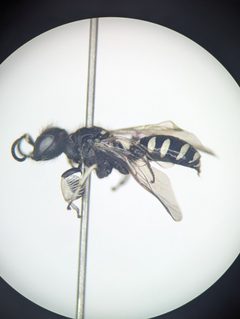
9Crabro is a of solitary in the Crabronidae, commonly known as shield-handed or square-headed wasps. The genus contains at least 80 described distributed across the Nearctic and Palaearctic regions (Holarctic). These wasps nest in sandy soils, constructing multi-celled burrows provisioned with flies (Diptera) for their larvae.
Pronunciation
How to pronounce Crabro: /ˈkra.broʊ/
These audio files are automatically generated. While they are not always 100% accurate, they are a good starting point.
Identification
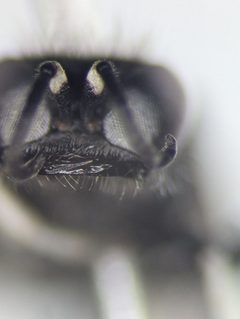
Members of Crabro can be distinguished from similar in the tribe Crabronini by the shape of the : the underside is very concave, unlike the flatter surface seen in Ectemnius, Lestica, and Anacrabro. The "square-headed wasps" refers to the broad, somewhat flattened shape characteristic of the genus.
Images
Habitat
Sandy soil environments suitable for excavation of burrow nests. Nests are typically constructed in open, well-drained areas where females can dig vertical tunnels 9–16 cm deep with radiating side burrows and terminal .
Distribution
Holarctic distribution, occurring in the Nearctic (North America) and Palaearctic (Europe and Asia) regions. Records exist from Denmark, Norway, Sweden, the United States (including Vermont), and other northern temperate areas.
Diet
provision nest exclusively with flies (Diptera) as food for their larvae. Specific prey records include various fly ; some Crabro species show flexibility in prey selection while others exhibit more stereotyped preferences.
Life Cycle
Females are solitary nesters. Each constructs a nearly vertical burrow in sandy soil, with short side tunnels near the bottom terminating in individual . Each cell is provisioned with 4–9 paralyzed flies and sealed with sand and debris after a single is laid. Nests typically contain 1–10 cells. Development proceeds through egg, larva, pupa, and stages within the sealed cells.
Behavior
nesting : females dig burrows, provision with prey, and seal them. Some exhibit behavioral flexibility in nest architecture and prey selection, while others show more stereotyped patterns. Temporal partitioning in daily activity has been observed between sympatric species. Females disperse excavated soil to conceal nest entrances and may use overhanging vegetation for additional concealment. visit flowers for nectar, particularly umbellifers such as wild carrot (Daucus carota), goldenrod (Solidago), and milkweed (Asclepias).
Ecological Role
Human Relevance
Potential biocontrol agents for fly . Not known to be aggressive toward humans; stings are possible but uncommon. No significant economic damage to crops or structures.
Similar Taxa
- AnacrabroSimilar appearance and shared tribe Crabronini, but Anacrabro hunts plant bugs (Miridae, Hemiptera) rather than flies, and lacks the strongly concave abdominal underside of Crabro.
- EctemniusShared tribe Crabronini with similar body form, but Ectemnius has a flatter abdominal surface and different prey preferences.
- LesticaSimilar overall appearance in Crabronini, but distinguished by abdominal shape and nesting differences.
Sources and further reading
- BugGuide
- Wikipedia
- GBIF taxonomy match
- iNaturalist taxon
- NCBI Taxonomy
- Catalogue of Life
- Incredible Work, and Timely, on 22 Species of Hornets | Bug Squad
- Bug Eric: Wasp Wednesday: Anacrabro ocellatus
- A rather continental hornet - European hornet, Vespa crabro — Bug of the Week
- What is that giant hornet and why is it eating my tree? European hornet, Vespa crabro — Bug of the Week
- Winter survival, Part 1: European hornet, Vespa crabro — Bug of the Week
- Large, scary hornets stripping bark from trees, eating fruit, and going “bump in the night”: European hornet, Vespa crabro — Bug of the Week
- Comparative Nesting Behaviors of Crabro rufibasis and Crabro arcadiensis (Hymenoptera: Sphecidae: Crabroninae)
- Comparative Nesting Behavior of Crabro monticola (Hymenoptera: Sphecidae)