
Ectemnius continuus
(Fabricius, 1804)
Common Ectemnius
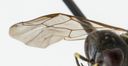
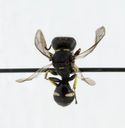
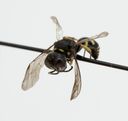
Ectemnius continuus is a small to medium-sized digger wasp in the Crabronidae, widespread throughout the Holarctic region. It is black with yellow markings on the scapes, pronotum, tibiae and tergites, and has a covered with shining silver hairs. The is notable for having 12 antennal segments in both sexes, unlike most where males typically have 13 segments. Males possess unique small spines on the first and second tarsomeres of the mid .
Pronunciation
How to pronounce Ectemnius continuus: /ɛkˈtɛmniəs kənˈtɪnjuəs/
These audio files are automatically generated. While they are not always 100% accurate, they are a good starting point.
Identification
Distinguished from similar Ectemnius by the 12 antennal segments in both sexes (most males have 13). Male specimens can be identified by the small spines on the first and second tarsomeres of the mid . The combination of yellow-marked black coloration with silver-haired helps separate it from related such as Anacrabro, Lestica, and Crabro; unlike Anacrabro, Ectemnius has a convex rather than concave underside of the .
Images
Appearance
Black body with yellow markings on the scapes (antennal bases), pronotum (thoracic segment behind ), tibiae (lower leg segments), and tergites (abdominal segments). (lower part of ) covered with dense, shining silver hairs. Both sexes possess 12 antennal segments. Males have distinctive small spines on the first and second tarsomeres of the mid . Size is small to medium for the .
Habitat
Woodlands, gardens, and farmland. Nests are constructed in cavities in dead wood, particularly old burrows in tree stumps and standing dead wood.
Distribution
Widespread throughout the Holarctic region. Found in Africa, Europe and Northern Asia (excluding China), North America, and Southern Asia. In the United Kingdom, common particularly across the south.
Seasonality
period from early May to late September. Likely (two per year) in the southern UK; (single generation) elsewhere.
Diet
visit flowers of umbellifers for nectar. Females hunt medium-sized Diptera (true flies) including Syrphidae (hoverflies), Muscidae (house flies and relatives), and Calliphoridae (blow flies). Tabanidae (horse flies) and Therevidae (stiletto flies) have also been recorded as prey.
Life Cycle
to depending on latitude. Nests contain up to 10 , with each cell provisioned with 6-8 flies. Nest structure varies from straight to branching. One larva develops per cell, feeding on the stored prey.
Behavior
Females hunt flies to provision nest . are strongly associated with umbellifer flowers including angelica, hogweed, wild carrot, wild parsnip, fennel, cow parsley, and water-dropwort, visiting for both nectar and to hunt prey. Nest entrances are in pre-existing cavities in dead wood rather than excavated in soil.
Ecological Role
of medium-sized Diptera; contributes to regulation of fly . of umbellifer flowers through nectar feeding.
Human Relevance
Potential biocontrol agent for pest fly . Non-aggressive; does not defend nests aggressively. Presence in gardens and farmland indicates healthy dead wood .
Similar Taxa
- Anacrabro ocellatusSimilar black-and-yellow coloration and size, but Anacrabro has a very concave underside of the (Ectemnius has convex), nests in soil rather than wood, and hunts Miridae plant bugs rather than Diptera flies.
- Other Ectemnius speciesMost similar have males with 13 antennal segments; E. continuus males have only 12 segments and distinctive spines on mid tarsomeres 1-2.
- Lestica and CrabroRelated in tribe Crabronini with similar general appearance; distinguished by specific combinations of facial , clypeal hair patterns, and male genitalia.
More Details
Genome sequencing
The of Ectemnius continuus has been sequenced and published (Wellcome Open Research, 2024; PMCID: PMC10964002), providing genetic resources for studying this widespread digger wasp.
Subspecies
Four recognized: E. c. continuus (Fabricius, 1804), E. c. punctatus (Lepeletier de Saint Fargeau & Brullé, 1835), E. c. rufitarsis (Dalla Torre, 1897), and E. c. sulphureipes (F. Smith, 1856).