
Bicyrtes insidiatrix
(Handlirsch, 1889)
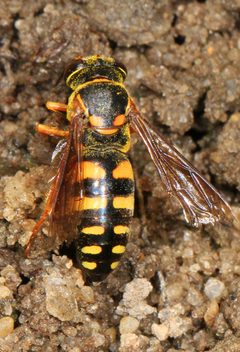
Bicyrtes insidiatrix is a of sand wasp in the Crabronidae. It is found in North America. Like other members of the Bicyrtes, it is a solitary, that nests in sandy or coarse soils. The species is part of a group of wasps known for preying on true bugs (Hemiptera), though specific prey records for this species are not well documented in the available literature.
Pronunciation
How to pronounce Bicyrtes insidiatrix: /bɪˈsɪrtɛs ɪnˌsɪdiˈætrɪks/
These audio files are automatically generated. While they are not always 100% accurate, they are a good starting point.
Identification
Distinguished from other Bicyrtes primarily by subtle morphological characters including details of wing venation and male genitalia. The second submarginal in the forewing and specific patterns of pale markings may aid identification. Separation from the more widespread B. quadrifasciatus and B. ventralis requires examination of structural features rather than general color pattern alone. The boxy, angular separates the from Bembix and Steniolia, which have more rounded thoracic profiles.
Images
Appearance
As a member of the Bicyrtes, this likely exhibits the characteristic boxy with angular hind corners that are often pale or white-marked. The body is typically black with pale markings on the and legs. The genus is generally described as more robust and less streamlined than related sand wasps like Bembix, with a distinctive rectangular profile to the thorax. Specific color pattern details for B. insidiatrix are not clearly distinguished from in available sources.
Habitat
Sandy or coarse-textured soils suitable for burrowing. Unlike some sand wasps that require pure sand, Bicyrtes can nest in soils with pebbles and rocky fragments. include riverbanks, disturbed ground, former industrial sites, and other areas with exposed, workable soil.
Distribution
North America. The has been recorded in the United States, with specific range boundaries poorly documented compared to more common . GBIF and iNaturalist records suggest presence across parts of the United States, though precise distribution limits are unclear.
Seasonality
are active during the warmer months, with peak activity likely in summer. Specific for this is not well documented, though related Bicyrtes species are active from late spring through early autumn.
Life Cycle
As a solitary , females excavate burrows in soil to provision offspring. Based on -level characteristics, nests likely consist of shallow, angled tunnels 15–20 cm deep terminating in one or more . Bicyrtes practice , laying an on the first prey item and stockpiling additional prey before sealing the cell, rather than . Larval development occurs underground, with in the nest cell.
Behavior
Females are dedicated diggers, using a tarsal rake of spines on the forelegs to excavate burrows. The closes the burrow entrance while away hunting. When returning with prey, females use subtle landmarks to relocate hidden nest entrances. Both sexes visit flowers for nectar and can be approached closely when feeding. Males may engage in patrolling near nesting areas.
Ecological Role
of true bugs (Hemiptera), contributing to natural control of and related . As a native , contribute to pollination through nectar feeding at flowers. The serves as prey for velvet ants (Mutillidae) and potentially other .
Human Relevance
Potential biocontrol agent for pest stink bugs, though less studied than the B. quadrifasciatus. The poses minimal sting risk to humans due to solitary, non-aggressive nature. Nesting in sandy areas may occasionally bring it into proximity with human recreational spaces.
Similar Taxa
- Bicyrtes quadrifasciatusMore widespread and well-studied with similar appearance and ; B. insidiatrix distinguished by subtle morphological details
- Bicyrtes ventralisOverlapping range and similar preferences; requires careful examination of wing venation and genitalia for separation
- Bembix speciesRelated sand wasps with more streamlined bodies and rounded thoracic profiles; Bicyrtes has distinctly boxy, angular
More Details
Taxonomic Note
The was originally described by Handlirsch in 1889. The Bicyrtes currently contains eight recognized species in North America, with B. insidiatrix being one of the less commonly encountered and more poorly documented members.
Research Needs
Specific prey records, detailed distribution, and data for B. insidiatrix are lacking in the primary literature. Most biological information is inferred from better-studied .