
Minotetrastichus
Kostjukov, 1977
Species Guides
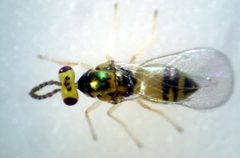
1Minotetrastichus is a of minute in the Eulophidae. are ectoparasitoids of leaf-mining insects, primarily targeting larvae and pupae of Lepidoptera, Coleoptera, and Hymenoptera. The genus was established by Kostjukov in 1977. Detailed biological information exists primarily for Minotetrastichus frontalis, which parasitizes the lime Phyllonorycter issikii.
Pronunciation
How to pronounce Minotetrastichus: //ˌmaɪnoʊˌtɛtrəˈstɪkəs//
These audio files are automatically generated. While they are not always 100% accurate, they are a good starting point.
Identification
Identification to requires examination of morphological characters typical of Tetrastichinae, including four-segmented and specific wing venation patterns. Differentiation from related genera such as Tetrastichus and Aprostocetus depends on subtle characters of the mesosoma and ; keys to Nearctic eulophid genera are required for reliable determination.
Images
Habitat
Associated with leaf mines on plants; specifically documented from mines of Phyllonorycter issikii on Tilia cordata (small-leaved lime).
Distribution
Records from Denmark (DK), Norway (NO), and Sweden (SE) based on GBIF data. Distribution likely broader in Palearctic region given associations.
Host Associations
- Phyllonorycter issikii - Lime (Lepidoptera: Gracillariidae); larvae and pupae are
- Tilia cordata - indirect plant of Phyllonorycter issikii; develops within leaf mines on this plant
Life Cycle
Complete with detailed preimaginal stages documented for M. frontalis: → four larval instars → pupa. Eggs are oval, smooth, and lack attachment structures; 1–7 eggs laid per depending on host stage. Four larval instars with and 13 somatic segments; papilliform processes on thoracic segments II–III and abdominal segments I–VIII facilitate movement. Tracheal system with 8 pairs of on thoracic segments II–III and abdominal segments V–X. Pupa has weakly sclerotized with a specific filament for fixation inside the leaf mine. Total preimaginal development lasts 12–14 days.
Behavior
Females induce permanent paralysis of the before oviposition. The pupa uses a specialized filament to anchor itself within the leaf mine.
Ecological Role
Ectoparasitoid of leaf-mining insects; contributes to of herbivorous leaf miners in forest and woodland .
Similar Taxa
- TetrastichusBoth belong to Tetrastichinae and share four-segmented ; Minotetrastichus differs in specific mesosomal and antennal characters requiring microscopic examination.
- ChrysocharisBoth are eulophid of leaf miners; Chrysocharis often have metallic coloration and different larval (endoparasitoid vs. ectoparasitoid in Minotetrastichus).
- AprostocetusClosely related tetrastichine ; separation depends on subtle differences in antennal segmentation and propodeal structure.
More Details
Taxonomic note
Most detailed biological data pertain to Minotetrastichus frontalis (Nees); whether these traits apply -wide is unknown. The genus was described by Kostjukov in 1977.
Research gap
No information is available on feeding habits, mating , or for any in this .
Sources and further reading
- BugGuide
- Wikipedia
- GBIF taxonomy match
- iNaturalist taxon
- NCBI Taxonomy
- Catalogue of Life
- Preimaginal development of the parasitoid Minotetrastichus frontalis (Nees) (Hymenoptera, Eulophidae)
- Figure 2 - Development of the larva of the wasp Minotetrastichus frontalis (indicated by the arrow) on the host
- The preimaginal stages ofMinotetrastichus frontalis(Nees) andChrysocharis laomedon(Walker) (Hymenoptera: Eulophidae), parasitoids associated withPhyllonorycter issikii(Kumata) (Lepidoptera, Gracillariidae)