
Minotetrastichus frontalis
(Nees, 1834)
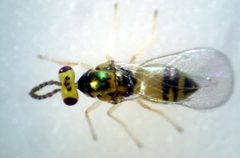
Minotetrastichus frontalis is a chalcid in the Eulophidae. It is an ectoparasitoid of leaf-mining in the Phyllonorycter, with larvae feeding on both larval and pupal stages of the . The has four larval instars and completes preimaginal development in 11–14 days.
Pronunciation
How to pronounce Minotetrastichus frontalis: /ˌmaɪnoʊˌtɛtrəˈstɪkəs frɒnˈteɪlɪs/
These audio files are automatically generated. While they are not always 100% accurate, they are a good starting point.
Images
Habitat
Develops inside leaf mines on Tilia cordata (small-leaved lime), the plant of its host Phyllonorycter issikii. The occupies the subepidermal mining galleries created by the host larva.
Distribution
Recorded from the Middle Volga Basin in Russia; additional records from Canada (Alberta, British Columbia) and Germany based on specimen data.
Host Associations
- Phyllonorycter issikii - ectoparasitoidlarvae and pupae parasitized
- Tilia cordata - indirect plant of Phyllonorycter issikii
Life Cycle
Preimaginal development lasts 12–14 days. Four larval instars with three . are oval, smooth, and lack attachment structures. The pupa has a weakly sclerotized with a specific filament for fixation inside the leaf mine.
Behavior
Females induce permanent paralysis of the prior to oviposition. They lay 1–7 depending on host stage. The pupa uses a specialized filament to anchor itself within the leaf mine.
Ecological Role
Ectoparasitoid of larvae and pupae; contributes to of Phyllonorycter in lime tree .
Similar Taxa
- Chrysocharis laomedonAlso an ectoparasitoid of Phyllonorycter issikii; co-occurs in same mines and geographic region
- Other Minotetrastichus speciesCongeneric may share similar and associations; identification requires examination of morphological details
More Details
Reproductive biology
Females exhibit -stage dependent , adjusting number (1–7) based on whether the host is a larva or pupa. Host paralysis is permanent and induced before egg laying.
Morphological adaptations
The pupal stage possesses a unique filamentous structure for anchoring within the mine, an to the enclosed subepidermal environment. The tracheal system has 8 pairs of .
Sources and further reading
- BugGuide
- Wikipedia
- GBIF taxonomy match
- iNaturalist taxon
- NCBI Taxonomy
- Catalogue of Life
- Encyrtid Holdings | Entomology Research Museum
- Meloidae Holdings | Entomology Research Museum
- Southern Pine Beetle: How a Fellow Species May Help in Host Location
- Managing Southern Pine Beetle Infestations in a Changing Forest Environment
- Communication is Power: Here's How Entomologists Can Use It
- southern pine beetle, small infestation - Entomology Today
- Preimaginal development of the parasitoid Minotetrastichus frontalis (Nees) (Hymenoptera, Eulophidae)
- Figure 2 - Development of the larva of the wasp Minotetrastichus frontalis (indicated by the arrow) on the host
- The preimaginal stages ofMinotetrastichus frontalis(Nees) andChrysocharis laomedon(Walker) (Hymenoptera: Eulophidae), parasitoids associated withPhyllonorycter issikii(Kumata) (Lepidoptera, Gracillariidae)